Russia is the neighbour that took the most territory from Iran. Two wars in the early 19th century cost Qajar Iran its Caucasus provinces, and for a century afterwards Russian armies, banks and Cossack officers shaped Iranian politics. Soviet troops occupied northern Iran twice, in 1920 to 1921 and 1941 to 1946. Since 1979 the two states have drawn closer against the West, signing a strategic partnership treaty in January 2025, but Russia gave Iran no military protection in the wars of 2025 and 2026.
| Wars | 1722 to 1723, 1796, 1804 to 1813, 1826 to 1828 |
|---|---|
| Territory lost by Iran | Georgia, Dagestan, today’s Azerbaijan Republic and Armenia (treaties of 1813 and 1828) |
| Occupations | Northern Iran, 1909 to 1917 (Russian troops), 1920 to 1921 (Gilan), 1941 to 1946 |
| Key treaties | Golestan 1813, Turkmenchay 1828, Akhal 1881, Soviet-Persian Treaty 1921, Caspian Convention 2018, Strategic Partnership 2025 |
| Persian name | روسیه Rusiye |
Early contacts across the Caspian
Rus’ raiders from the Volga attacked the Caspian shores of Tabaristan and Gilan in the early 10th century, as the Arab historian Masudi recorded, and the Cossack rebel Stenka Razin plundered the Mazandaran coast in 1668 to 1669. Diplomacy began with Muscovy’s embassies to the Safavid court in the 16th and 17th centuries, mostly about trade and an alliance against the Ottomans.
The first real war came when the Safavid state collapsed. In 1722 Peter the Great invaded the western Caspian coast, taking Derbent and later Baku and Rasht (see the Russo-Persian War of 1722 to 1723). The Treaties of Rasht (1732) and Ganja (1735) returned the provinces once Nader had made Iran strong again.
The Caucasus wars and Turkmenchay
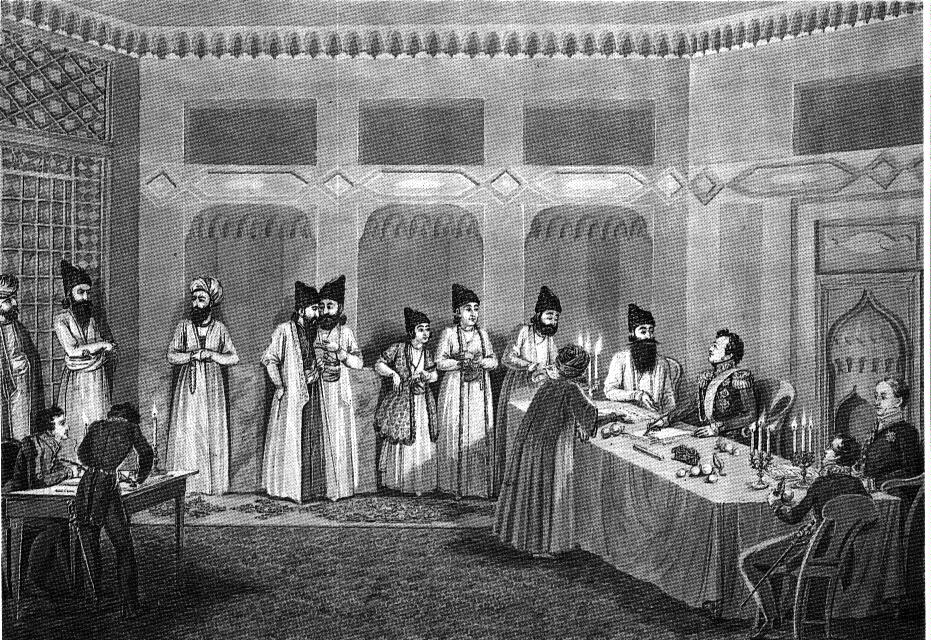
The decisive conflict was over Georgia. In 1783 the Georgian king accepted Russian protection; Agha Mohammad Khan answered with the sack of Tiflis in 1795, and Russia annexed eastern Georgia in 1801. Two wars followed. The first, 1804 to 1813, ended with defeat at Aslanduz and the Treaty of Golestan, which gave Russia Georgia, Dagestan and most of the khanates of today’s Azerbaijan Republic. The second, 1826 to 1828, led by crown prince Abbas Mirza, ended with the Treaty of Turkmenchay: Iran lost Erivan and Nakhchivan, paid a heavy indemnity, and granted Russian subjects legal immunity from Iranian courts. The Aras river became the border it still is.
Turkmenchay remains a byword in Iran for national humiliation. A year later a Tehran crowd killed the Russian envoy, the playwright Alexander Griboyedov, and most of his mission (see the Griboyedov incident).

The Great Game years
For the rest of the 19th century Russia and Britain competed for influence in Iran. Russia encouraged the Qajar siege of Herat in 1837 to 1838, conquered the Turkmen lands east of the Caspian and fixed that border by the Akhal Treaty of 1881. Russian officers founded and commanded the Persian Cossack Brigade from 1879, the shah’s most effective military unit. Russian banks and loans in the 1890s and 1900s gave St Petersburg strong leverage in Tehran.
Russia and the Constitutional Revolution
Russia was hostile to the Constitutional Revolution. The Anglo-Russian Convention of 1907 divided Iran into a Russian sphere in the north, a British sphere in the south-east and a neutral zone. In 1908 Colonel Liakhov’s Cossack Brigade shelled the parliament for Mohammad Ali Shah. Russian troops entered Tabriz during the siege of 1908 to 1909, and a Russian ultimatum in 1911 forced the expulsion of the American treasurer Morgan Shuster, after which Russian forces hanged constitutionalists in Tabriz and in 1912 shelled the shrine of Imam Reza in Mashhad. In the First World War Russian armies occupied much of the north.
The Soviet decades
The 1917 revolution changed the tone. The Soviet government renounced tsarist concessions and debts, and the Soviet-Persian Treaty of 1921 confirmed this, though its Article 6 gave Moscow the right to send troops if a third power used Iran against it. In 1920 to 1921 the Red Army backed a short-lived Soviet republic in Gilan with the Jangali movement of Mirza Kuchik Khan.
In August 1941 Soviet and British forces invaded Iran, deposed Reza Shah and used the country as a supply corridor to the USSR. When the war ended, Soviet troops stayed and backed autonomous governments in Azerbaijan and Kurdistan, the first crisis of the Cold War. Prime Minister Ahmad Qavam, with US and UN pressure behind him, secured a Soviet withdrawal in 1946 (see the Iran crisis of 1946). Moscow also supported the communist Tudeh Party.
Mohammad Reza Shah joined the Western camp but from the 1960s also traded with the USSR, which built the Isfahan steel mill and bought Iranian gas through a pipeline opened in 1970.
From the revolution to partnership
The Islamic Republic’s slogan “Neither East nor West” put the Soviet Union beside the United States as a foe. Iran condemned the Soviet invasion of Afghanistan, banned the Tudeh Party in 1983, and the Soviets were a main arms supplier to Iraq in the Iran-Iraq War. Relations turned after 1989, when Rafsanjani signed arms and economic deals in Moscow. Russia completed the Bushehr nuclear power plant, which began supplying the grid in 2011 (see Iran’s nuclear programme), and the two states, with the other Caspian countries, signed a convention on the sea’s legal status in 2018.
The war in Syria from 2015 made them military partners in support of Bashar al-Assad. After Russia invaded Ukraine in 2022, Western governments and Ukraine said Iranian-designed Shahed drones were being used against Ukrainian cities; Iran’s foreign minister acknowledged in November 2022 that a small number had been sent before the invasion, and Russia later produced the drones itself. On 17 January 2025 Presidents Vladimir Putin and Masoud Pezeshkian signed a Treaty on Comprehensive Strategic Partnership, which is not a military alliance and does not oblige either side to defend the other.
The wars of 2025 and 2026
That limit showed quickly. During the Twelve-Day War of June 2025, Russia condemned the Israeli and US strikes but offered no military help, and some Iranian politicians publicly called the partnership worthless. When the United States and Israel attacked Iran on 28 February 2026 and killed Ali Khamenei, Putin condemned the killing as a violation of international law and morality. Western media reports said Russia passed Iran intelligence for targeting US forces, and in September 2026 the Financial Times reported that Russia had secretly helped Iran develop supersonic cruise missiles since 2023. Moscow has not fought alongside Iran. The course of the war is told in the war of 2026.
A relationship of mistrust and need
Many Iranians, across political camps, remember Russia as the power of Turkmenchay, the shelling of the Majlis and the crisis of 1946. Historians of the post-1979 relationship, such as Nicole Grajewski, describe a partnership driven by shared isolation from the West rather than trust, in which Russia has usually been the stronger and more cautious partner.
Persian words from this page
| روسیه | Rusiye | Russia |
| ترکمانچای | Torkamânchây | Turkmenchay |
| قفقاز | Ghafghâz | the Caucasus |
| قزاق | ghazzâgh | Cossack |
| عهدنامه | ahdnâme | treaty |
| ارس | Aras | the Aras river |
Russia’s partner and rival in Iran for a century was Britain; see Iran and Britain.
Sources and further reading
- Encyclopaedia Iranica, “Russia: Relations with Persia” (multi-part article).
- Firuz Kazemzadeh, Russia and Britain in Persia: Imperial Ambitions in Qajar Iran (1968; new edition 2013).
- Muriel Atkin, Russia and Iran, 1780-1828 (1980).
- Nicole Grajewski, Russia and Iran: Partners in Defiance from Syria to Ukraine (2024).
- Text of the Treaty of Turkmenchay (1828) and the Soviet-Persian Treaty of Friendship (1921).
Want to learn Persian? Get the free Starter Pack
Get the 14-page printable Starter Pack (all 32 letters, a 7-day reading plan, 100 core words and 20 survival phrases) and a short 5-email course. Free.
More in Themes Across Iranian History (3000 BCE–today)
- A History of the Persian Language
- Zoroastrianism through the Ages
- Shi’a Islam in Iranian History
- The Jews of Iran
- The Armenians of Iran
- Christians of Iran
- The Baha’i Faith in Iran
- The Kurds in Iranian History
- Azerbaijanis in Iranian History
- The History of the Iranian Calendar
- Nowruz through History
- The Persian Garden (Pardis) through History
- Qanats: Iran’s Ancient Water Tunnels
- A History of Persian Carpets
- A History of Persian Architecture
- A History of Persian Painting
- A History of Persian Music
- Science in Iranian History
- Women in Iranian History
- Iran and the Silk Road
- Iran and China through History
- Iran and India through History
- Iran and Greece: Perceptions and Exchanges
- Persia and Rome: Seven Centuries of Rivalry
- Iran and the Ottoman Empire
- Iran and Russia through History
- Iran and Britain through History
- Iran and the United States
- How Iran’s Borders Changed
- The Capitals of Iran through History
- Coins of Iran through History: From the Daric to the Rial
- Flags and Symbols of Iran through History
- Myth and History in the Shahnameh: The Epic’s Kings and the Real Past
- Timeline of Iranian History: Key Dates from Elam to Today
- A History of Persian Cuisine: From Royal Banquets to Chelow Kabab
- A History of Persian Poetry: From Rudaki to Forough
- Wine in Iranian History: From Hajji Firuz to Hafez and Prohibition
- Sports in Iranian History: Polo, the Zurkhaneh and Wrestling
- List of Iranian Dynasties and Rulers