The Baha’i Faith began in Iran in the nineteenth century, growing out of the Babi movement founded in Shiraz in 1844, and Iran remains home to its largest religious minority, estimated by the Baha’i community at around 300,000 people. Because Shi’a clerics regard it as a heresy that arose after Islam, the faith has never been recognised by the Iranian state, and its followers have faced recurring persecution under the Qajars, the Pahlavis and, most severely, the Islamic Republic.
| Origins | The Bab (Sayyed Ali Mohammad Shirazi), declared 1844 in Shiraz; Baha’u’llah (Mirza Hoseyn-Ali Nuri), announced his mission 1863 |
|---|---|
| World centre | Haifa and Akka, where Baha’u’llah was exiled by the Ottomans |
| Number in Iran | about 300,000 (Baha’i community estimate); not counted in the census |
| Legal status | Not recognised; administration banned since 1983 |
| Persian name | بهائی (bahâ’i) |
From the Bab to Baha’u’llah
In May 1844 a young merchant of Shiraz, Sayyed Ali Mohammad, announced that he was the Bab, the “gate” to the Hidden Imam, and soon claimed to bring a new revelation. His movement spread rapidly across Qajar Iran, drew in clerics and townspeople, and included the poet Tahirih, who appeared unveiled before a gathering of followers in 1848. The Qajar state and the Shi’a clergy saw it as a threat. Babi uprisings at Shaykh Tabarsi, Zanjan and Nayriz were crushed, the Bab was executed by firing squad in Tabriz in 1850, and after a few Babis tried to kill Naser al-Din Shah in 1852, thousands were killed. These events are told in detail on the Bab and the Babi movement.
One of the Babis imprisoned in 1852 in Tehran’s underground Siyah Chal dungeon was Mirza Hoseyn-Ali Nuri, known as Baha’u’llah. He was exiled to Ottoman Baghdad in 1853, and in 1863 told his followers that he was the messenger the Bab had foretold. Further exiles took him to Istanbul, Edirne and finally the prison city of Akka in Ottoman Palestine, where he died in 1892. Most Babis became Baha’is. The faith’s teachings stress the unity of God, of religions and of humanity, the equality of women and men and universal education. Its leadership passed to his son Abdu’l-Baha, then to Shoghi Effendi, and since 1963 to the elected Universal House of Justice, based in Haifa because of these Ottoman-era exiles.
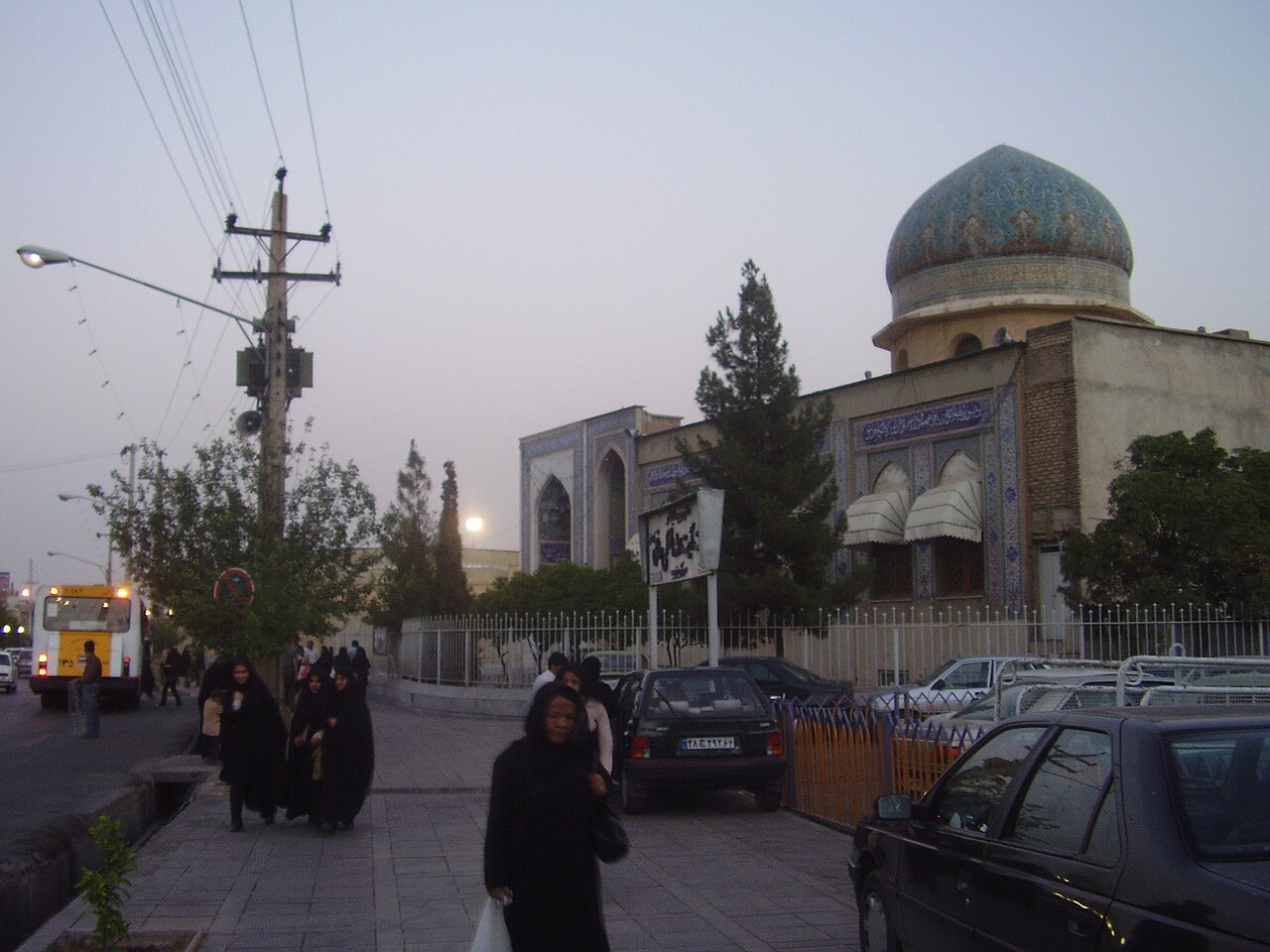

Under the Qajars and Pahlavis
In Iran the community grew through the late nineteenth century, including many converts from Jewish and Zoroastrian families, and outbreaks of violence against Baha’is occurred in Isfahan, Yazd and other towns. Baha’is founded modern schools, among them the Tarbiyat schools of Tehran, which the government closed in 1934 under Reza Shah because they had stayed shut on Baha’i holy days.
The Pahlavi state employed many Baha’is but never recognised the faith, and anti-Baha’i feeling remained strong among clerics. In 1955, during Ramadan, the preacher Mohammad Taqi Falsafi led an anti-Baha’i campaign on national radio with the shah’s permission; the army occupied the Baha’i national centre in Tehran and its dome was demolished, and attacks took place in the provinces. A religious society, the Hojjatiyeh, was founded in the 1950s to oppose the faith. Critics of the shah, for their part, sometimes accused Baha’is of enjoying favour at court.
After 1979
The Islamic Republic’s constitution recognises Zoroastrians, Jews and Christians, but not Baha’is. In 1979 the House of the Bab in Shiraz, the faith’s holiest site in Iran, was destroyed. In August 1980 all nine members of the Baha’i National Spiritual Assembly were abducted and never seen again, and members of later assemblies were executed. According to the Baha’i International Community and the documentation summarised by UN bodies, more than 200 Baha’is were killed, executed or disappeared in the first years of the Islamic Republic. On 29 August 1983 the government banned all Baha’i administrative activity.
In 1993 the UN Special Representative on Iran, Reynaldo Galindo Pohl, made public a 1991 memorandum of the Supreme Council of the Cultural Revolution on “the Baha’i question”, issued at the request of Supreme Leader Ali Khamenei. It directed that Baha’is be expelled from universities once identified as such and that their “progress and development” be blocked. Barred from higher education, the community set up an informal university, the Baha’i Institute for Higher Education, in 1987; its organisers have been raided and imprisoned.
In 2008 the seven members of the “Yaran” (“Friends”), the informal group that looked after the community’s needs, were arrested; they were sentenced to twenty years in prison, a term later reduced to ten, and were released in 2017–2018. Two of them, Mahvash Sabet and Fariba Kamalabadi, were arrested again in July 2022 during a renewed wave of arrests, property confiscations and home raids. Baha’i cemeteries, including land at Khavaran in Tehran, have been seized or destroyed.
How the different sides describe the situation
The Iranian government
Iranian officials and state media describe the Baha’i Faith not as a religion but as a political sect or “misguided group”, created with the help of colonial powers and tied to Israel because its world centre is in Haifa. They say Baha’is are not prosecuted for their beliefs but for security offences such as espionage, “propaganda against the system” or illegal organising, and that Baha’is enjoy the rights of citizens as long as they do not break the law.
The UN human rights mechanisms
Since the 1980s successive UN Special Representatives and, from 2011, Special Rapporteurs on the human rights situation in Iran, including Ahmed Shaheed, Asma Jahangir, Javaid Rehman and Mai Sato, have reported on Baha’is to the UN General Assembly and Human Rights Council. Their reports describe arbitrary arrests, denial of university education, closure of businesses, confiscation of property and desecration of cemeteries, and treat these as discrimination on religious grounds. The UN General Assembly has repeatedly adopted resolutions expressing concern.
The Baha’i International Community
The Baha’i International Community, which represents the faith at the UN, describes the treatment as a systematic, state-led effort to destroy the community as a viable entity in Iran, pointing to the 1991 memorandum and to court verdicts that cite religious activity, such as teaching children or holding prayer meetings, as evidence of crimes. It notes that the faith’s teachings forbid involvement in partisan politics. In 2024 Human Rights Watch, an independent organisation, concluded that Iran’s policy towards Baha’is amounted to the crime against humanity of persecution, a finding the Iranian government rejects.
For today’s religious landscape, see religion in Iran, and for the city where the faith’s story began, Shiraz.
- 1844 The Bab’s declaration in Shiraz
- 1850 Execution of the Bab in Tabriz
- 1863 Baha’u’llah announces his mission in Baghdad
- 1955 Anti-Baha’i campaign; Tehran centre occupied
- 1979–1980 House of the Bab destroyed; National Assembly members disappear
- 1983 Baha’i administration banned
- 1991 Memorandum on “the Baha’i question” (made public 1993)
- 2008 Arrest of the seven Yaran
Persian words from this page
| باب | Bâb | gate; the Bab |
| بهاءالله | Bahâ’ollâh | Baha’u’llah, “Glory of God” |
| بهائی | bahâ’i | Baha’i |
| یاران | Yârân | “Friends”, the former leadership group |
| سیاهچال | Siyâh-Châl | “Black Pit” dungeon in Tehran |
| شیراز | Shirâz | Shiraz |
Sources and further reading
- Reports of the UN Special Rapporteur on the situation of human rights in the Islamic Republic of Iran, and the 1993 report of Special Representative Reynaldo Galindo Pohl to the UN Commission on Human Rights.
- Baha’i International Community, The Baha’i Question: Cultural Cleansing in Iran (2008) and later updates.
- Human Rights Watch, “The Boot on My Neck”: Iranian Authorities’ Crime of Persecution Against Baha’is in Iran (2024).
- Encyclopaedia Iranica, “Bahaism” (multi-part article) and “Bab”; Peter Smith, An Introduction to the Baha’i Faith (2008).
- Eliz Sanasarian, Religious Minorities in Iran (2000).
Want to learn Persian? Get the free Starter Pack
Get the 14-page printable Starter Pack (all 32 letters, a 7-day reading plan, 100 core words and 20 survival phrases) and a short 5-email course. Free.
More in Themes Across Iranian History (3000 BCE–today)
- A History of the Persian Language
- Zoroastrianism through the Ages
- Shi’a Islam in Iranian History
- The Jews of Iran
- The Armenians of Iran
- Christians of Iran
- The Baha’i Faith in Iran
- The Kurds in Iranian History
- Azerbaijanis in Iranian History
- The History of the Iranian Calendar
- Nowruz through History
- The Persian Garden (Pardis) through History
- Qanats: Iran’s Ancient Water Tunnels
- A History of Persian Carpets
- A History of Persian Architecture
- A History of Persian Painting
- A History of Persian Music
- Science in Iranian History
- Women in Iranian History
- Iran and the Silk Road
- Iran and China through History
- Iran and India through History
- Iran and Greece: Perceptions and Exchanges
- Persia and Rome: Seven Centuries of Rivalry
- Iran and the Ottoman Empire
- Iran and Russia through History
- Iran and Britain through History
- Iran and the United States
- How Iran’s Borders Changed
- The Capitals of Iran through History
- Coins of Iran through History: From the Daric to the Rial
- Flags and Symbols of Iran through History
- Myth and History in the Shahnameh: The Epic’s Kings and the Real Past
- Timeline of Iranian History: Key Dates from Elam to Today
- A History of Persian Cuisine: From Royal Banquets to Chelow Kabab
- A History of Persian Poetry: From Rudaki to Forough
- Wine in Iranian History: From Hajji Firuz to Hafez and Prohibition
- Sports in Iranian History: Polo, the Zurkhaneh and Wrestling
- List of Iranian Dynasties and Rulers