The Persian garden is a walled, irrigated garden, usually divided into four parts by water channels and walkways, with a pavilion at its heart. The form is first seen at Cyrus the Great’s Pasargadae around 550 BCE, it gave the world the word “paradise”, and it was rebuilt by every dynasty from the Sasanians to the Qajars. Nine historic gardens in Iran have been a UNESCO World Heritage Site since 2011.
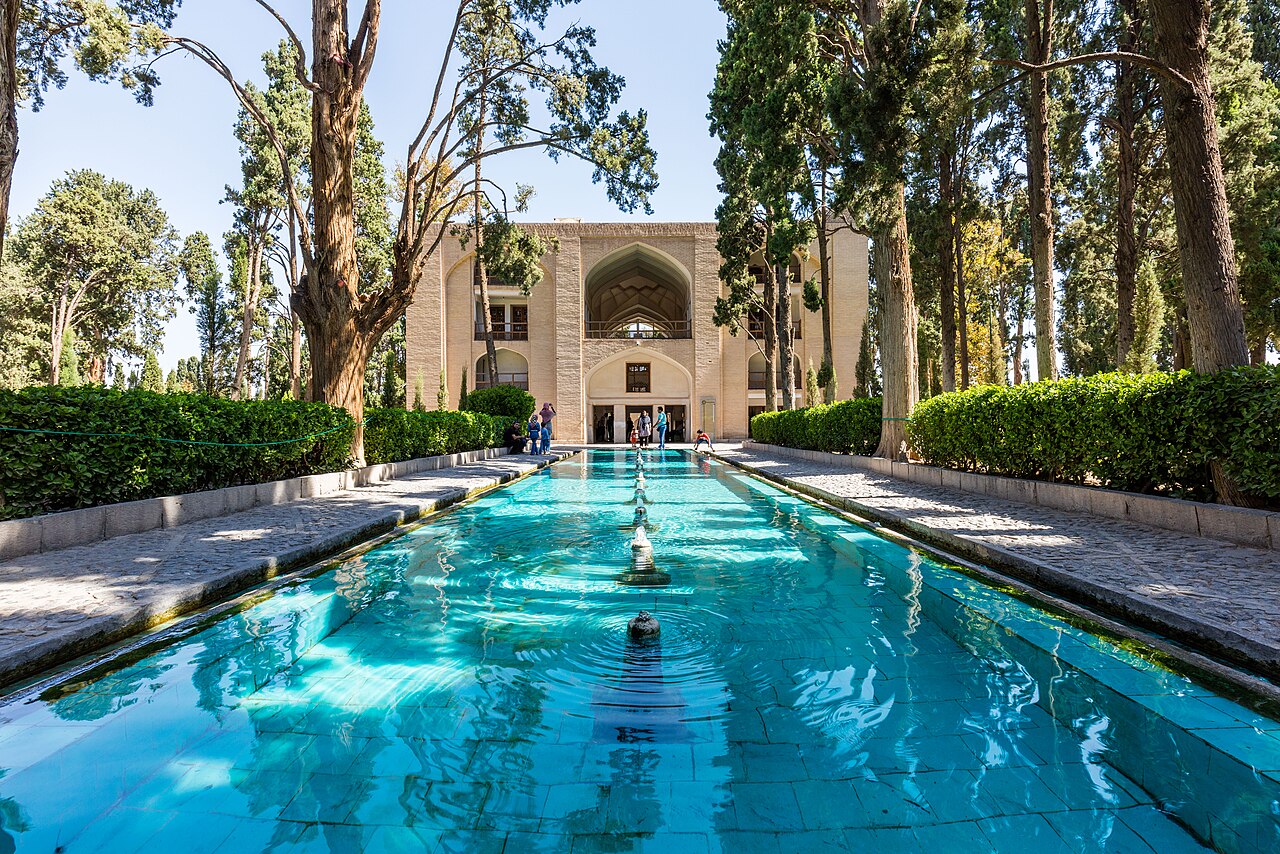

| Persian names | bâgh (garden), chahârbâgh (fourfold garden), pardis (enclosed park) |
|---|---|
| Earliest example | Royal garden at Pasargadae, c. 546–530 BCE |
| Key elements | Wall, water from a qanat or spring, axial channels and pools, shade trees, pavilion (kushk) |
| UNESCO | “The Persian Garden”, nine gardens, inscribed 2011 (no. 1372) |
Water first: why the garden took this shape
A Persian garden begins with water, not plants. On a dry plateau where summer rain is rare, a garden was only possible where water could be brought in, usually by a qanat running under the desert from the foot of the mountains. The water entered at the high end, ran along straight channels, filled pools and then left to irrigate orchards and fields below. A high wall kept out wind, dust and animals. The result was a cool, shaded, ordered world set against the open desert, and that contrast is the point of the design.
Pasargadae and the first “paradise”
The oldest garden plan known from Iran lies at Pasargadae, Cyrus the Great’s capital in Fars. Excavations by David Stronach in the 1960s found limestone water channels with small basins at intervals, framing a garden between two palaces. Stronach read the layout as a fourfold plan, the first chahârbâgh; some scholars think the evidence for four equal quarters is less certain, but all agree it is a deliberately planned royal garden. Our page on the Achaemenid paradise gardens tells that story in detail, and our article on Pasargad covers the site itself.
The Old Iranian word for a walled enclosure, preserved in Avestan as pairi-daêza, passed into Greek as paradeisos. Xenophon describes the Persian prince Cyrus the Younger showing a Spartan visitor a park at Sardis that he had planted himself in straight rows. Through Greek, Latin and the Bible the word became “paradise”, while in Persian it survives as پردیس (pardis) and in the Arabic-derived ferdows.
Sasanian hunting parks and a carpet of spring
Under the Parthians and Sasanians, royal paradises were also hunting parks stocked with game. The great reliefs at Taq-e Bostan show Khosrow II hunting boar and deer in an enclosed marsh, a royal park in stone (see Sasanian art). Arab historians describe a vast carpet in the palace at Ctesiphon, known as the Spring of Khosrow, that showed a garden with paths, streams and flowerbeds woven in silk, gold and jewels. The conquerors are said to have cut it up and shared out the pieces in 637. Nothing of it survives, but it shows that the garden was already the central image of royal pleasure.
The garden in Islamic Iran
Islam gave the Persian garden new meaning. The Quran describes paradise as gardens beneath which rivers flow, and the four rivers of water, milk, wine and honey fitted the fourfold plan neatly. Garden and paradise became one idea, and Persian poets made the garden their favourite setting: Saadi named his two great works the Golestan (rose garden) and the Bustan (orchard).
Few early Islamic gardens survive, because gardens die when their water fails. What we know of Seljuk, Ilkhanid and Timurid gardens comes mostly from texts. Timur and his successors laid out large gardens around Samarkand and Herat, which the Spanish envoy Clavijo described in 1404. From the Timurids the idea passed to Babur, founder of the Mughal dynasty, and from there to the gardens of Kabul, Lahore and Agra, including the fourfold garden in front of the Taj Mahal.
Safavid Isfahan: a city of gardens
Shah Abbas I turned the garden into city planning. In the late 1590s his new capital at Isfahan was laid out along the Chahar Bagh, a long avenue with water channels and rows of plane trees, flanked by walled gardens belonging to the court and nobility (see Isfahan: Half the World). Palaces such as Chehel Sotoun and Hasht Behesht are pavilions set in gardens, opened to them by deep porches and reflecting pools. The Fin Garden near Kashan, with its spring-fed channels and turquoise pools, was rebuilt in the same period; in 1852 it became the place where the reforming minister Amir Kabir was killed in the bathhouse.
Zand and Qajar gardens
The tradition continued after the Safavids. In Shiraz, Karim Khan Zand and later the Qajar governors built gardens that made the city famous for them; the Eram Garden, with its 19th-century pavilion and tall cypresses, is the best known. In Yazd the Dowlatabad Garden of the mid-18th century adds a tall windcatcher that cools the pavilion. The most dramatic is the Shazdeh Garden at Mahan near Kerman, built for a Qajar governor in the late 19th century: a narrow stepped garden of cascades running uphill through bare desert.
The garden on carpets and in the city today
The garden also lived on in other arts. “Garden carpets” of the Safavid and later periods divide the field into channels, pools and flowerbeds seen from above, a theme followed on our page on the history of Persian carpets. In the 20th century, Iran’s modern parks and boulevards borrowed the old vocabulary, and public gardens remain where Iranians go for Sizdah Bedar picnics and summer evenings.
In 2011 UNESCO inscribed nine gardens together as “The Persian Garden”: Pasargadae, Eram in Shiraz, Chehel Sotoun in Isfahan, Fin in Kashan, Abbasabad in Behshahr, Shazdeh in Mahan, Dowlatabad in Yazd, Pahlevanpour in Mehriz and Akbarieh in Birjand. They span more than two thousand years and very different climates, from the Caspian forests to the edge of the Lut desert. See our list of UNESCO sites in Iran.
- c. 546–530 BCE Royal garden with stone channels at Pasargadae
- c. 400 BCE Xenophon describes a Persian paradise at Sardis
- 6th–7th c. Sasanian hunting parks; the Spring of Khosrow carpet at Ctesiphon
- 1404 Clavijo describes Timur’s gardens at Samarkand
- late 1590s Shah Abbas I lays out the Chahar Bagh in Isfahan
- 19th c. Qajar gardens in Shiraz and the Shazdeh Garden at Mahan
- 2011 Nine Persian gardens inscribed by UNESCO
Persian words from this page
| باغ | bâgh | garden |
| چهارباغ | chahârbâgh | fourfold garden |
| پردیس | pardis | enclosed park, paradise |
| فردوس | ferdows | paradise |
| کوشک | kushk | garden pavilion |
| حوض | howz | pool |
| گلستان | golestân | rose garden |
| سرو | sarv | cypress |
Sources and further reading
- UNESCO World Heritage Centre, The Persian Garden (no. 1372).
- Xenophon, Oeconomicus 4.20–25 (Cyrus the Younger’s garden at Sardis).
- David Stronach, Pasargadae, Oxford, 1978.
- Donald N. Wilber, Persian Gardens and Garden Pavilions, 1962.
- Penelope Hobhouse, Gardens of Persia, 2003.
Want to learn Persian? Get the free Starter Pack
Get the 14-page printable Starter Pack (all 32 letters, a 7-day reading plan, 100 core words and 20 survival phrases) and a short 5-email course. Free.
More in Themes Across Iranian History (3000 BCE–today)
- A History of the Persian Language
- Zoroastrianism through the Ages
- Shi’a Islam in Iranian History
- The Jews of Iran
- The Armenians of Iran
- Christians of Iran
- The Baha’i Faith in Iran
- The Kurds in Iranian History
- Azerbaijanis in Iranian History
- The History of the Iranian Calendar
- Nowruz through History
- The Persian Garden (Pardis) through History
- Qanats: Iran’s Ancient Water Tunnels
- A History of Persian Carpets
- A History of Persian Architecture
- A History of Persian Painting
- A History of Persian Music
- Science in Iranian History
- Women in Iranian History
- Iran and the Silk Road
- Iran and China through History
- Iran and India through History
- Iran and Greece: Perceptions and Exchanges
- Persia and Rome: Seven Centuries of Rivalry
- Iran and the Ottoman Empire
- Iran and Russia through History
- Iran and Britain through History
- Iran and the United States
- How Iran’s Borders Changed
- The Capitals of Iran through History
- Coins of Iran through History: From the Daric to the Rial
- Flags and Symbols of Iran through History
- Myth and History in the Shahnameh: The Epic’s Kings and the Real Past
- Timeline of Iranian History: Key Dates from Elam to Today
- A History of Persian Cuisine: From Royal Banquets to Chelow Kabab
- A History of Persian Poetry: From Rudaki to Forough
- Wine in Iranian History: From Hajji Firuz to Hafez and Prohibition
- Sports in Iranian History: Polo, the Zurkhaneh and Wrestling
- List of Iranian Dynasties and Rulers