Iran and China have dealt with each other for more than 2,000 years, from the Han envoys who reached Parthian lands in the 2nd century BCE to the strategic partnership of the 2020s. In between came Sasanian embassies, a Persian prince in exile at the Tang court, Mongol rulers who governed both countries, and a long exchange of ceramics that changed pottery in both lands. This page follows the relationship as a whole; the caravan trade itself is covered in Iran and the Silk Road.
| First recorded contact | Han missions to the Parthian empire, late 2nd century BCE |
|---|---|
| Chinese name for Persia | Anxi (Parthia, from Arsak); later Bosi (Persia) |
| Key exchanges | Silk, horses, silver, Buddhism, Manichaeism, cobalt, porcelain |
| Modern diplomatic ties | Iran and the People’s Republic of China, 1971 |
| Recent milestone | 25-year cooperation agreement, March 2021 |
Han China meets Parthia
The Chinese learned of Iran through the journeys of Zhang Qian, the Han envoy sent west around 138 BCE to look for allies against the nomadic Xiongnu. His reports described a great kingdom called Anxi, the Chinese rendering of Arsak, the name of the Arsacid founder. Han missions followed, and the Chinese histories record that the Parthian king sent ostrich eggs and conjurors from the west in return.
In 97 CE the Han general Ban Chao sent an officer, Gan Ying, to reach Rome. According to the Book of the Later Han, Gan Ying got as far as the Parthian-controlled shore of the Persian Gulf or Mesopotamia, where sailors warned him the sea crossing could take years, and he turned back. Historians have long suspected the Parthians had good reason to discourage a direct link between the two empires whose trade they taxed. The Parthian Silk Road page explains how that middleman role worked.
Religion travelled east too. An Shigao, described in Chinese Buddhist sources as a Parthian prince who gave up his throne, reached the Han capital Luoyang around 148 CE and became one of the first translators of Buddhist texts into Chinese. His surname “An” marks him as a man of Anxi.

Sasanian embassies and a prince in exile
The Sasanian kings kept up the exchange. Chinese dynastic histories list a series of Persian embassies to the Northern Wei, Liang and later the Sui and Tang courts in the 5th to 7th centuries, and Sasanian silver coins have been found in hoards and tombs in Xinjiang and across northern China. Sasanian silverware, glass and textile patterns such as the paired animals in pearl roundels were copied by Chinese craftsmen.
When the Arab armies overran Iran, the last king, Yazdegerd III, appealed to the Tang emperor for help. After his death in 651 his son Peroz went east. The Tang named him head of a nominal “Persian Area Command” in Sistan around 661 and later received him at Chang’an, where he died around 679. His story, and his son Narsieh’s failed attempt to return, are told in Peroz III and the Tang. Persian refugees, merchants and priests settled in Tang cities, and Zoroastrian and Manichaean temples served them; Manichaeism even became the state religion of the Uyghur khaganate in 762.
Mongol rule over both lands
The Mongol conquests put Iran and China under branches of the same family. The Ilkhans in Iran and the Yuan emperors in China were allies, and officials, doctors, astronomers and artists moved between them. A Mongol official called Bolad, sent from the Yuan court, worked in Tabriz with the vizier Rashid al-Din, whose world history includes a section on China drawn from Chinese informants. Chinese astronomers worked at Nasir al-Din Tusi’s observatory at Maragheh, and Chinese landscape conventions, cloud scrolls and dragons entered Ilkhanid painting, shaping Persian manuscript art for centuries.
Cobalt and porcelain
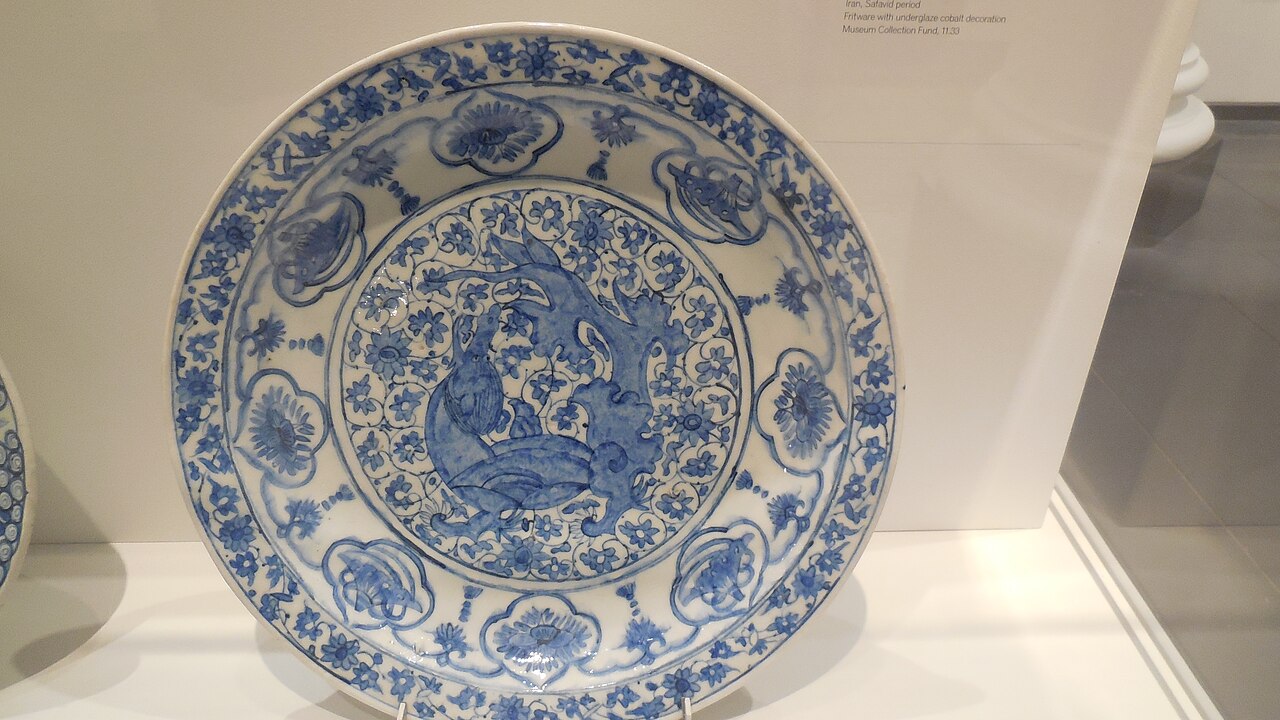
The best-known product of the relationship is blue-and-white porcelain. Chinese potters at Jingdezhen in the 14th century used cobalt ore imported from Iran to paint their designs, a pigment Chinese texts called “Muslim blue”. The finished wares then travelled west in large numbers. In 1611 Shah Abbas I gave more than a thousand pieces of Chinese porcelain to the shrine of his ancestor at Ardabil, and much of that collection is now in the National Museum of Iran in Tehran.
Iranian potters answered with their own versions. Safavid workshops, especially in Kerman, produced blue-and-white dishes in Chinese style, and when civil war in China in the mid-17th century cut supplies, the Dutch East India Company bought Iranian imitations for export.
Timurid and Ming embassies
Diplomacy revived after the Mongols. The Timurid ruler Shahrukh sent a large embassy from Herat to the Ming Yongle emperor in 1419 to 1422; its painter, Ghiyath al-Din Naqqash, kept a diary of the journey that describes Beijing, court banquets and the Chinese bureaucracy. In the same years the Ming admiral Zheng He’s fleets called several times at Hormuz, then the great port at the mouth of the Persian Gulf. After the 16th century, when Europeans took over much of the sea trade, direct contact faded until the 20th century.
The modern relationship
Iran under Mohammad Reza Shah recognised the People’s Republic in 1971, and members of the royal family visited Beijing in the early 1970s. After the 1979 revolution China became an important arms supplier during the Iran-Iraq War, including anti-ship missiles used in the Tanker War, while also selling weapons to Iraq.
From the 2000s China became Iran’s largest trading partner and the main buyer of its oil, especially once Western sanctions closed other markets; much of this oil reaches China through intermediaries, according to trade analysts. In March 2021 the two foreign ministers signed a 25-year cooperation agreement in Tehran. China brokered the restoration of Saudi-Iranian relations in Beijing in March 2023, and backed Iran’s entry into the Shanghai Cooperation Organisation (approved in 2021, completed in 2023) and BRICS (2024).
China has stopped short of a military alliance. When the United States and Israel attacked Iran in February 2026 (see the war of 2026), Beijing condemned the strikes and Foreign Minister Wang Yi called it “a war that should not have happened”, but it did not offer direct military aid in the first weeks of the war. US intelligence later alleged, according to CNN, that China was preparing to send shoulder-fired air-defence missiles through third countries. In 2026 Tehran named Parliament Speaker Mohammad Bagher Ghalibaf its special representative for China.
How historians read the relationship
Older accounts treated Iran mainly as a stage on the road between China and Rome. Recent scholarship gives Iranians more agency: Parthian and Sogdian merchants, Persian exiles at the Tang court, Iranian astronomers in Yuan China and the cobalt trade show traffic in both directions. Chinese records are often the only written evidence for Parthian and Sasanian diplomacy, but they describe foreign missions in the language of tribute, so historians read them with care.
Persian words from this page
| چین | Chin | China |
| چینی | chini | Chinese; also porcelain |
| ابریشم | abrisham | silk |
| سفیر | safir | ambassador |
| پیروز | Piruz | Peroz |
| هرمز | Hormoz | Hormuz |
The Persian word for porcelain, چینی chini, is simply “Chinese”, a reminder of where the finest dishes came from. For the trade routes, read Iran and the Silk Road; for Iran’s other great eastern neighbour, see Iran and India.
Sources and further reading
- Encyclopaedia Iranica, “China-Iranian Relations” (multi-part article).
- Fan Ye, Hou Hanshu (Book of the Later Han), chapter 88, on Anxi and Gan Ying’s mission.
- Matteo Compareti, Samarkand the Center of the World and articles on Sasanian-Chinese relations.
- Thomas T. Allsen, Culture and Conquest in Mongol Eurasia (Cambridge, 2001).
- Ghiyath al-Din Naqqash’s account of Shahrukh’s embassy, preserved in Hafiz-i Abru and Abd al-Razzaq Samarqandi.
- John W. Garver, China and Iran: Ancient Partners in a Post-Imperial World (2006).
Want to learn Persian? Get the free Starter Pack
Get the 14-page printable Starter Pack (all 32 letters, a 7-day reading plan, 100 core words and 20 survival phrases) and a short 5-email course. Free.
More in Themes Across Iranian History (3000 BCE–today)
- A History of the Persian Language
- Zoroastrianism through the Ages
- Shi’a Islam in Iranian History
- The Jews of Iran
- The Armenians of Iran
- Christians of Iran
- The Baha’i Faith in Iran
- The Kurds in Iranian History
- Azerbaijanis in Iranian History
- The History of the Iranian Calendar
- Nowruz through History
- The Persian Garden (Pardis) through History
- Qanats: Iran’s Ancient Water Tunnels
- A History of Persian Carpets
- A History of Persian Architecture
- A History of Persian Painting
- A History of Persian Music
- Science in Iranian History
- Women in Iranian History
- Iran and the Silk Road
- Iran and China through History
- Iran and India through History
- Iran and Greece: Perceptions and Exchanges
- Persia and Rome: Seven Centuries of Rivalry
- Iran and the Ottoman Empire
- Iran and Russia through History
- Iran and Britain through History
- Iran and the United States
- How Iran’s Borders Changed
- The Capitals of Iran through History
- Coins of Iran through History: From the Daric to the Rial
- Flags and Symbols of Iran through History
- Myth and History in the Shahnameh: The Epic’s Kings and the Real Past
- Timeline of Iranian History: Key Dates from Elam to Today
- A History of Persian Cuisine: From Royal Banquets to Chelow Kabab
- A History of Persian Poetry: From Rudaki to Forough
- Wine in Iranian History: From Hajji Firuz to Hafez and Prohibition
- Sports in Iranian History: Polo, the Zurkhaneh and Wrestling
- List of Iranian Dynasties and Rulers