Iran and the Ottoman Empire were neighbours and rivals for four centuries, from the battle of Chaldiran in 1514 to the end of the First World War in 1918. Their wars over Iraq, eastern Anatolia and the Caucasus were sharpened by religion, Shi’a Iran against the Sunni Ottoman sultan-caliphs, but a series of treaties, above all Zuhab in 1639 and Erzurum in 1847, slowly fixed a frontier that is still close to today’s border between Iran, Turkey and Iraq.
| Dates | 1514 to 1918 |
|---|---|
| Iranian dynasties | Safavids, Hotakis, Afsharids, Zands, Qajars |
| Main prizes | Baghdad and the Shi’a shrine cities, Tabriz, Azerbaijan, Armenia, Georgia |
| Key treaties | Amasya 1555, Zuhab 1639, Kerden 1746, Erzurum 1823 and 1847, Constantinople Protocol 1913 |
| Persian name | عثمانی Osmâni |
Chaldiran and a religious frontier
The rivalry began as a contest for the loyalty of the Turkmen tribes of Anatolia. Shah Ismail I, head of the Safavid order, drew Qizilbash followers from Ottoman lands, and his missionaries spread a militant Shi’ism among them (see the Qizilbash). Sultan Selim I answered by massacring suspected Qizilbash in Anatolia and invading Iran. At Chaldiran in August 1514 Ottoman artillery and Janissary musketeers broke the Safavid cavalry and Selim briefly occupied Tabriz.
The defeat made the frontier a religious one. The Safavids made Twelver Shi’ism the state religion; the Ottomans, who conquered Egypt and the Arab lands in 1516 to 1517, presented themselves as defenders of Sunni Islam. Each side called the other heretics, and the shrines of Najaf, Karbala, Kazimayn and Samarra in Iraq, sacred to Shi’a Iranians but under Ottoman rule for most of these centuries, became a constant issue. Culture still crossed the line: Persian was a language of Ottoman poetry and chancery, and Selim I himself wrote poems in Persian.

The Safavid wars
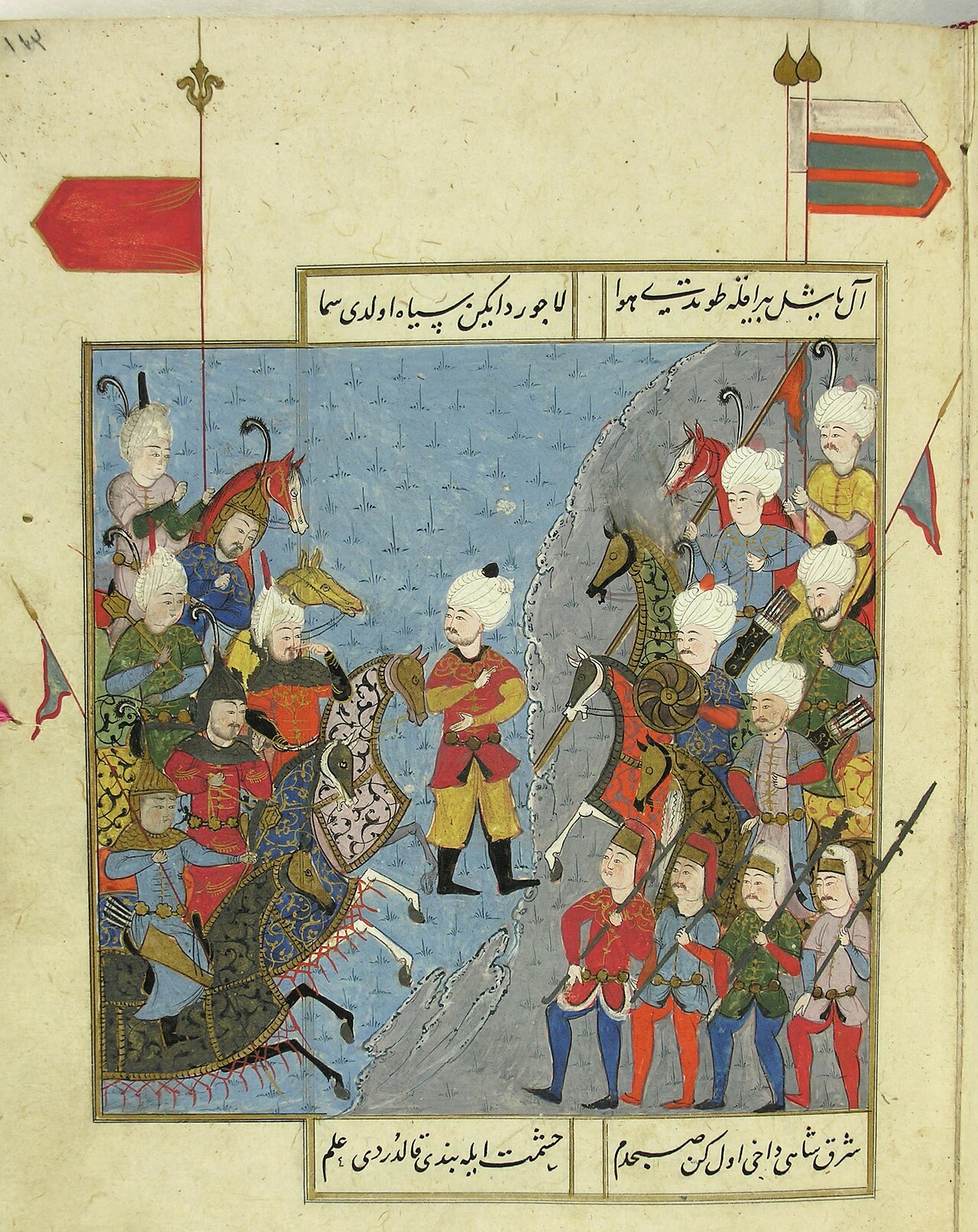
Under Tahmasp I, Suleiman the Magnificent invaded repeatedly and took Baghdad in 1534. The war of 1532 to 1555 ended with the Peace of Amasya, the first formal treaty, which left Iraq to the Ottomans and Azerbaijan to Iran. Tahmasp moved his capital from exposed Tabriz to Qazvin.
A new war from 1578, during the weak reign of Mohammad Khodabanda, cost Iran Tabriz and most of the Caucasus in the Treaty of Constantinople of 1590. Shah Abbas I signed it to gain time, rebuilt his army and struck back in 1603, recovering Tabriz, Erivan and the lost provinces (see the war of 1603 to 1618). In 1624 he took Baghdad, but Sultan Murad IV recaptured it in 1638. The Treaty of Zuhab, also called the Treaty of Qasr-e Shirin, signed in 1639, gave Iraq to the Ottomans and the Caucasus lands of Erivan to Iran, and kept the peace for more than eighty years.
Collapse, Nader and the Zands
When the Afghans took Isfahan in 1722 (see the siege of Isfahan), the Ottomans and Russians both moved in. An Ottoman-Russian agreement of 1724 divided north-western and northern Iran between them, and Ottoman troops occupied Tabriz, Hamadan and Kermanshah. Nader drove them out in the 1730s and fought on into the 1740s (see Nader Shah’s Ottoman wars), proposing that the Ottomans recognise Twelver Shi’ism as a fifth Sunni school of law, which they refused (see Nader Shah and religion). The Treaty of Kerden in 1746 essentially restored the Zuhab border. Under Karim Khan Zand Iranian forces took Basra in 1776 after a long siege, holding it until his death in 1779.
Qajar treaties and a mapped border
The last Ottoman-Iranian war was fought in 1821 to 1823, when the crown prince Abbas Mirza invaded eastern Anatolia. The First Treaty of Erzurum (1823) confirmed the old frontier. By then both states were weaker than Russia and Britain, and the two European powers mediated the Second Treaty of Erzurum in 1847, which gave Iran the port of Mohammerah, today’s Khorramshahr, and rights on the east bank of the Shatt al-Arab (Arvand Rud), while Iran dropped its claim to Sulaymaniyah. The details were contested for decades.
A joint commission with British and Russian surveyors spent years mapping the line, and the Constantinople Protocol of 1913 and the demarcation commission of 1914 finally fixed it from Mount Ararat to the Persian Gulf. That line, later inherited by Turkey and Iraq, is the background to the Shatt al-Arab disputes of the 20th century (see how Iran’s borders changed).
The First World War
Iran declared neutrality in 1914, but Ottoman, Russian and British armies all fought on its soil. Ottoman forces entered Iranian Azerbaijan and Kurdistan, occupied Tabriz briefly in 1915 and again in 1918, and the fighting and famine devastated the north-west, including its Assyrian and Armenian communities (see Iran in the First World War). With the Ottoman defeat in 1918 the empire dissolved, and Iran’s relations passed to the new Republic of Turkey and the British mandate of Iraq.
How historians see the rivalry
Older histories presented the conflict as a holy war between Sunnism and Shi’ism. Recent work, for example by Ernest Tucker and Rudi Matthee, stresses how pragmatic both sides were: wars alternated with long peaces, trade in silk and pilgrims kept flowing, and treaties were carefully negotiated. The religious language mattered most at moments of crisis, such as Chaldiran and Nader’s reign, and less in between.
Persian words from this page
| عثمانی | Osmâni | Ottoman |
| چالدران | Châldorân | Chaldiran |
| قزلباش | Qezelbâsh | Qizilbash |
| بغداد | Baghdâd | Baghdad |
| اروندرود | Arvand Rud | Shatt al-Arab |
| صلح | solh | peace |
Sources and further reading
- Encyclopaedia Iranica, “Ottoman-Persian Relations” (parts I to III).
- Rudi Matthee, Persia in Crisis: Safavid Decline and the Fall of Isfahan (2012).
- Ernest S. Tucker, Nadir Shah’s Quest for Legitimacy in Post-Safavid Iran (2006).
- Sabri Ateş, The Ottoman-Iranian Borderlands: Making a Boundary, 1843-1914 (2013).
- Iskandar Beg Munshi, Tarikh-e Alamara-ye Abbasi (History of Shah Abbas the Great).
Want to learn Persian? Get the free Starter Pack
Get the 14-page printable Starter Pack (all 32 letters, a 7-day reading plan, 100 core words and 20 survival phrases) and a short 5-email course. Free.
More in Themes Across Iranian History (3000 BCE–today)
- A History of the Persian Language
- Zoroastrianism through the Ages
- Shi’a Islam in Iranian History
- The Jews of Iran
- The Armenians of Iran
- Christians of Iran
- The Baha’i Faith in Iran
- The Kurds in Iranian History
- Azerbaijanis in Iranian History
- The History of the Iranian Calendar
- Nowruz through History
- The Persian Garden (Pardis) through History
- Qanats: Iran’s Ancient Water Tunnels
- A History of Persian Carpets
- A History of Persian Architecture
- A History of Persian Painting
- A History of Persian Music
- Science in Iranian History
- Women in Iranian History
- Iran and the Silk Road
- Iran and China through History
- Iran and India through History
- Iran and Greece: Perceptions and Exchanges
- Persia and Rome: Seven Centuries of Rivalry
- Iran and the Ottoman Empire
- Iran and Russia through History
- Iran and Britain through History
- Iran and the United States
- How Iran’s Borders Changed
- The Capitals of Iran through History
- Coins of Iran through History: From the Daric to the Rial
- Flags and Symbols of Iran through History
- Myth and History in the Shahnameh: The Epic’s Kings and the Real Past
- Timeline of Iranian History: Key Dates from Elam to Today
- A History of Persian Cuisine: From Royal Banquets to Chelow Kabab
- A History of Persian Poetry: From Rudaki to Forough
- Wine in Iranian History: From Hajji Firuz to Hafez and Prohibition
- Sports in Iranian History: Polo, the Zurkhaneh and Wrestling
- List of Iranian Dynasties and Rulers