Iran has had more than a dozen capitals in its history, from Susa in Elam to Tehran, which has been the seat of government since 1786. Early empires often had several royal cities at once, moving with the seasons, and many dynasties moved their capital to follow their power base or to escape a dangerous frontier. The table below lists the main seats of power and links to the detailed pages for each.
The capitals at a glance
| Capital | Dynasty or state | Approximate dates |
|---|---|---|
| Susa and Anshan | Elam | c. 2700 to 646 BCE |
| Ecbatana (Hamadan) | Medes | c. 7th century to 550 BCE |
| Pasargadae | Achaemenids (Cyrus II) | c. 550 to 520s BCE |
| Susa, Persepolis, Ecbatana, Babylon | Achaemenids (from Darius I) | c. 520 to 330 BCE |
| Seleucia on the Tigris, later Antioch | Seleucids | c. 305 to 141 BCE in Iran |
| Nisa, Hecatompylos, then Ctesiphon | Parthians (Arsacids) | c. 247 BCE to 224 CE |
| Ardashir-Khurrah and Istakhr, then Ctesiphon | Sasanians | 224 to 637 |
| Merv | Abbasid caliph al-Mamun | 813 to 819 |
| Nishapur | Tahirids | c. 830 to 873 |
| Zaranj | Saffarids | 861 to 1003 |
| Bukhara | Samanids | 892 to 999 |
| Shiraz, Rey and Isfahan | Buyids | 934 to 1062 |
| Ghazni | Ghaznavids | 977 to c. 1160 |
| Nishapur, Rey, then Isfahan; Merv under Sanjar | Great Seljuks | 1037 to 1157 |
| Gurganj (Urgench), later Samarkand | Khwarazmshahs | c. 1077 to 1231 |
| Maragheh, then Tabriz, then Soltaniyeh | Ilkhanate | 1256 to 1335 |
| Samarkand; Herat under Shahrukh | Timurids | 1370 to 1507 |
| Tabriz | Qara Qoyunlu and Aq Qoyunlu | c. 1406 to 1501 |
| Tabriz | Safavids (Ismail I) | 1501 to c. 1555 |
| Qazvin | Safavids (Tahmasp I) | c. 1555 to 1598 |
| Isfahan | Safavids (Abbas I onward), Hotakis | 1598 to 1729 |
| Mashhad | Afsharids (Nader Shah) | 1736 to 1796 |
| Shiraz | Zands | c. 1765 to 1794 |
| Tehran | Qajars, Pahlavis, Islamic Republic | 1786 to today |
Royal cities of the ancient empires
The oldest capital on Iranian soil is Susa, in the lowlands of Khuzestan, seat of the kings of Elam alongside Anshan in the highlands of Fars, until the Assyrians sacked it in about 646 BCE. The Medes ruled from Ecbatana, modern Hamadan, which Herodotus describes, probably with exaggeration, as ringed by seven walls of different colours.
The Achaemenid kings moved between several capitals. Cyrus built Pasargadae in his homeland. Darius I made Susa the administrative centre (see the palace of Darius at Susa), began Persepolis as a ceremonial and treasury city in Fars, and used Ecbatana as a summer residence and Babylon in winter. Greek writers such as Xenophon describe the court travelling between them with the seasons.
The Parthians began at Nisa, near modern Ashgabat, and later governed from Ctesiphon on the Tigris, opposite the Greek city of Seleucia. The Sasanians, who came from Fars, first built Ardashir-Khurrah at Firuzabad but soon took over Ctesiphon, where the vault of the Taq Kasra still stands in Iraq. Ctesiphon fell to the Arabs in 637 (see the fall of Ctesiphon). So for about 700 years the capital of the Iranian empires lay outside today’s Iran, in the rich farmland of Mesopotamia.

Many capitals, many states
After the Arab conquest Iran was ruled first from Damascus and Baghdad, then by regional dynasties with their own capitals. For a few years the caliph al-Mamun governed the whole caliphate from Merv in Khorasan (see al-Mamun in Merv). The Samanids made Bukhara a centre of the new Persian literature; the Buyids shared power among brothers in Shiraz, Rey and Isfahan. Malik Shah made Isfahan the Seljuk capital, which is why its Friday Mosque is so grand.
The Mongol Ilkhans began as nomads, with summer and winter camps, and set up Maragheh and then Tabriz as their capitals; Oljeitu built a new city at Soltaniyeh, now marked by its great dome. Timur ruled from Samarkand, his son Shahrukh from Herat, both today outside Iran.
From Tabriz to Isfahan
The Safavid capital moved east and south, away from the Ottoman frontier. Ismail I was crowned in Tabriz in 1501, but repeated Ottoman occupations led Tahmasp I to move to Qazvin around the middle of the century. Abbas I moved again, to Isfahan in 1598, and rebuilt it around the vast Naqsh-e Jahan square; the city earned the saying “Isfahan is half the world” (اصفهان نصف جهان). Today’s Isfahan is still largely the Safavid city.
After the Afghan conquest of 1722, Nader Shah preferred Mashhad, close to his Khorasan homeland, and Karim Khan made Shiraz his capital, building the citadel and bazaar that still stand there.
Tehran
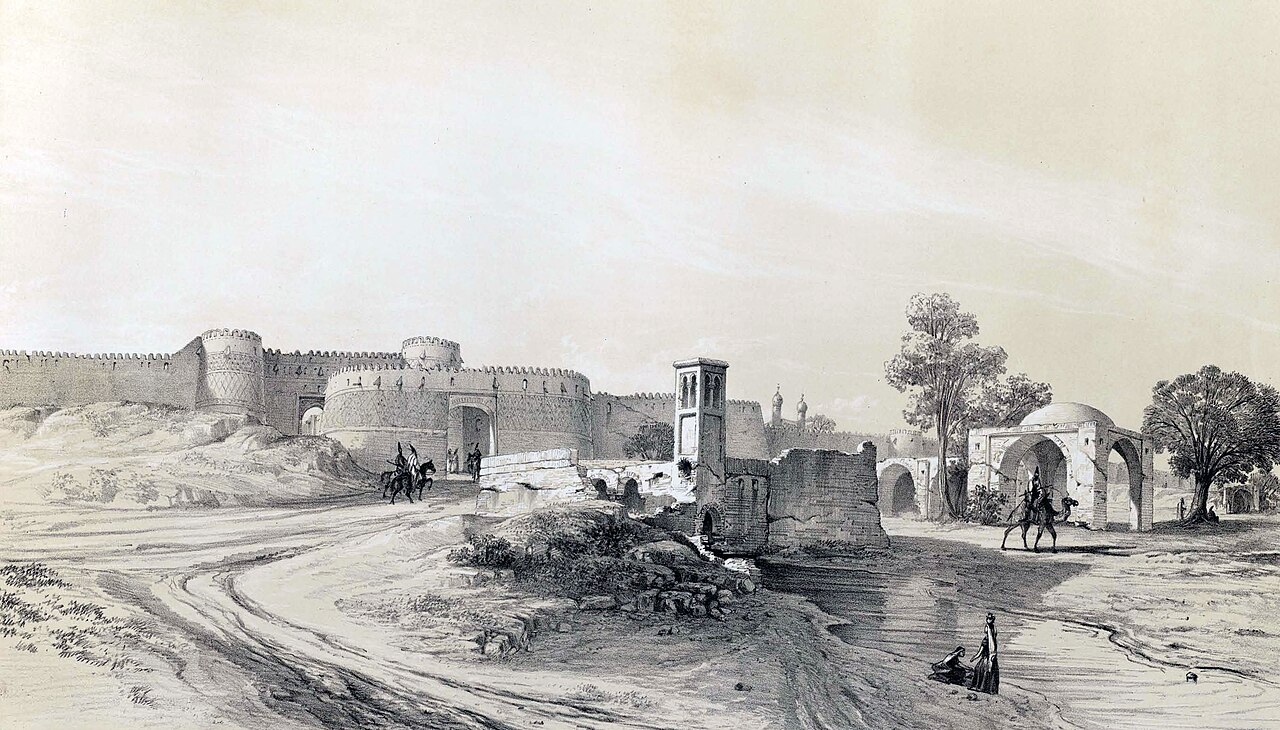
Tehran was a small town near the ruins of ancient Rey when Agha Mohammad Khan made it his capital in 1786. It was close to the Qajar tribal lands near Astarabad, well placed to watch the Caucasus and Khorasan, and away from the Zand loyalists of Shiraz. It grew slowly under the Qajars, who built the Golestan Palace, and then very fast in the 20th century: from a few hundred thousand people around 1900 to a city of about 9 million, with some 16 to 17 million in the wider metropolitan area, in recent estimates.
Tehran’s growth has brought earthquake risk, air pollution and water shortages, and Iranian governments have discussed moving the capital several times without approving a plan. During the war of 2026 (see the war of 2026), Tehran was struck repeatedly from the air, as it had been in the “war of the cities” of the 1980s.
Persian words from this page
| پایتخت | pâytakht | capital (city) |
| شوش | Shush | Susa |
| هگمتانه | Hegmatâne | Ecbatana |
| تیسفون | Tisfun | Ctesiphon |
| اصفهان نصف جهان | Esfahân nesf-e jahân | “Isfahan is half the world” |
| تهران | Tehrân | Tehran |
The Persian word pâytakht means literally “foot of the throne”. For the changing territory these cities ruled, see how Iran’s borders changed.
Sources and further reading
- Herodotus, Histories, Book 1 (Ecbatana).
- Pierre Briant, From Cyrus to Alexander (2002), on the Achaemenid royal residences.
- Encyclopaedia Iranica, articles “Ctesiphon”, “Qazvin”, “Isfahan” and “Tehran”.
- Abbas Amanat, Iran: A Modern History (2017).
- Cambridge History of Iran, vols. 3, 5 and 6.
Want to learn Persian? Get the free Starter Pack
Get the 14-page printable Starter Pack (all 32 letters, a 7-day reading plan, 100 core words and 20 survival phrases) and a short 5-email course. Free.
More in Themes Across Iranian History (3000 BCE–today)
- A History of the Persian Language
- Zoroastrianism through the Ages
- Shi’a Islam in Iranian History
- The Jews of Iran
- The Armenians of Iran
- Christians of Iran
- The Baha’i Faith in Iran
- The Kurds in Iranian History
- Azerbaijanis in Iranian History
- The History of the Iranian Calendar
- Nowruz through History
- The Persian Garden (Pardis) through History
- Qanats: Iran’s Ancient Water Tunnels
- A History of Persian Carpets
- A History of Persian Architecture
- A History of Persian Painting
- A History of Persian Music
- Science in Iranian History
- Women in Iranian History
- Iran and the Silk Road
- Iran and China through History
- Iran and India through History
- Iran and Greece: Perceptions and Exchanges
- Persia and Rome: Seven Centuries of Rivalry
- Iran and the Ottoman Empire
- Iran and Russia through History
- Iran and Britain through History
- Iran and the United States
- How Iran’s Borders Changed
- The Capitals of Iran through History
- Coins of Iran through History: From the Daric to the Rial
- Flags and Symbols of Iran through History
- Myth and History in the Shahnameh: The Epic’s Kings and the Real Past
- Timeline of Iranian History: Key Dates from Elam to Today
- A History of Persian Cuisine: From Royal Banquets to Chelow Kabab
- A History of Persian Poetry: From Rudaki to Forough
- Wine in Iranian History: From Hajji Firuz to Hafez and Prohibition
- Sports in Iranian History: Polo, the Zurkhaneh and Wrestling
- List of Iranian Dynasties and Rulers