Armenians are Iran’s largest Christian community and one of its oldest minorities. Neighbours and often subjects of Iranian empires since Achaemenid times, they became a major presence inside Iran after Shah Abbas I moved tens of thousands of them to Isfahan in 1604–1605, where the merchants of New Julfa built a trading network across Eurasia. Today Iranian Armenians, concentrated in Tehran, Isfahan, Tabriz and Urmia, keep their own churches, schools and two seats in parliament.
| Church | Armenian Apostolic, with small Catholic and Protestant groups |
|---|---|
| Main centres | Tehran, Isfahan (New Julfa), Tabriz, Urmia, Salmas |
| Key date | 1604–1605: Shah Abbas deports Armenians from Julfa on the Aras to Isfahan |
| Population in 1979 | estimated 200,000–300,000 |
| Parliament | Two reserved seats in the Majlis |
| UNESCO | Armenian Monastic Ensembles of Iran (2008) |
Neighbours of the Iranian empires
Armenia appears in the Behistun inscription of Darius I as a land of the Persian empire, and for much of antiquity its fate was tied to Iran. A branch of the Parthian royal family, the Arsacids, ruled Armenia from the first century CE, and its throne was the prize in the long wars between Rome and Parthia (see Vologases I and the war over Armenia). Armenia adopted Christianity in the early fourth century, which set it apart from Zoroastrian Iran. In 387 Rome and the Sasanians partitioned the country (see the partition of Armenia), and in 451 Armenians under Vardan Mamikonian fought Yazdegerd II’s attempt to impose Zoroastrianism at the Battle of Avarayr. They lost the battle, but the church kept its freedom, and Vardan is a national saint.
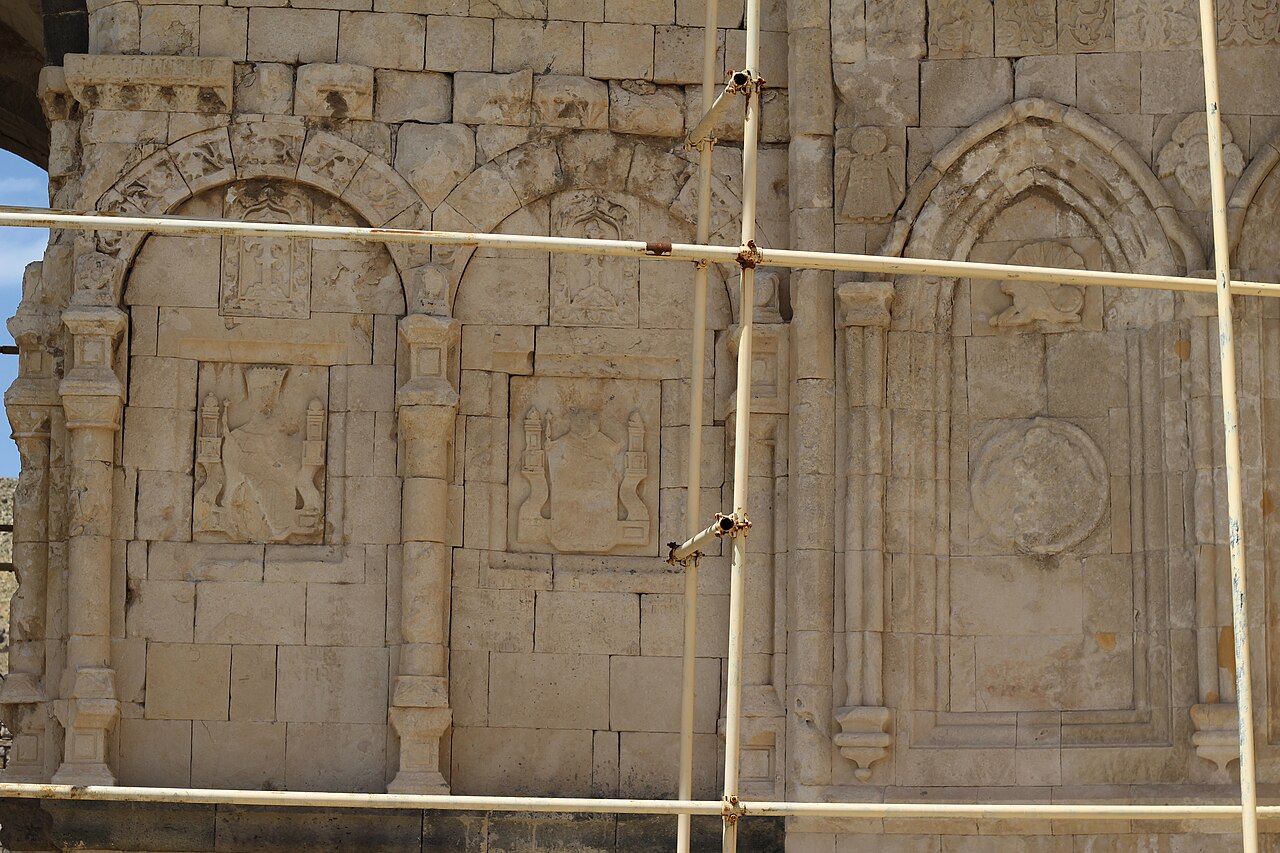
Armenians also lived within Iran’s own north-west from early times. The monastery of St Thaddeus near Maku, known in Persian as Qara Kelisa (“black church”), is linked by tradition to the apostle Thaddeus; the present church dates mostly from the fourteenth century, with large additions in the early nineteenth.

Shah Abbas and New Julfa
The decisive change came during the Ottoman–Safavid war of 1603–1618. To deny the Ottomans resources, Shah Abbas I laid waste to the frontier region and deported its population, including the Armenians of Julfa, a wealthy trading town on the Aras river. The numbers are uncertain and estimates vary widely, but tens of thousands were moved and many died on the way. The Julfa merchants were settled across the river from Isfahan in a new suburb, New Julfa (جلفا), where they were allowed their own churches and administration.
The shah’s motives were partly economic. New Julfa’s merchants received a privileged role in the export of Iranian silk, and their family firms traded from Amsterdam and Venice to Moscow, India and Manila (see New Julfa and the Armenian merchants and the Safavid silk trade). Armenian, Georgian and Circassian converts also served in the shah’s new ghulam corps. New Julfa’s Holy Saviour Cathedral, the Vank, completed in the 1660s, mixes an Iranian dome and tilework with Christian wall paintings; it is described on Vank Cathedral.
The good times did not last. Later Safavid shahs taxed and pressured the community, conversions were encouraged, and after the Afghan sack of Isfahan in 1722 and the wars of Nader Shah many merchant families moved to India and Russia.
The Qajar century
When Russia took the Caucasus from Iran in the treaties of Golestan (1813) and Turkmenchay (1828), Russian officials encouraged Armenians from Iranian Azerbaijan to resettle in the newly Russian territory around Yerevan, and many thousands did so. Those who stayed in Iran were concentrated in Tabriz, Salmas, Urmia, Isfahan and the villages of Chaharmahal and Fereydan. Armenians played a large part in bringing new trades and technology to Qajar Iran, from photography to printing. In the Constitutional Revolution the Armenian revolutionary Yeprem Khan led fighters who helped take Tehran in 1909 and then became the capital’s police chief; he was killed in battle in 1912. After 1915 Iran received survivors of the Armenian genocide in the Ottoman Empire, and the north-west itself suffered heavily from Ottoman invasions during the First World War.
The Pahlavi era
The modernisation of the Pahlavi decades drew Armenians to Tehran, where by 1978 an estimated 110,000 lived. They were prominent as engineers, craftsmen, photographers, film-makers and in sport, and the community ran its own clubs, newspapers and schools. By 1979 an estimated 200,000 to 300,000 Armenians lived in Iran.
Since 1979
The constitution of the Islamic Republic recognises Christians as a religious minority and reserves two Majlis seats for Armenians, one for the north and one for the south of the country. Armenian schools, churches and community bodies continue to operate, although schools must follow the national curriculum and the use of the Armenian language in teaching has been limited. Armenians served and died in the Iran–Iraq war, and their memorials stand in Armenian cemeteries. Emigration, to Armenia, the United States and elsewhere, has greatly reduced the community, and today’s numbers are a fraction of those in 1979. Iran and the Republic of Armenia have kept close relations since 1991.
The three monasteries listed by UNESCO in 2008, St Thaddeus, St Stepanos near Jolfa and the Chapel of Dzordzor, are covered on the Armenian monasteries of Iran. For other Christian communities, especially the Assyrians, see Christians of Iran, and for the city of New Julfa, Isfahan.
Persian words from this page
| ارمنی | armani | Armenian |
| کلیسا | kelisâ | church |
| قره کلیسا | Qare Kelisâ | “Black Church”, St Thaddeus |
| کلیسای وانک | Kelisâ-ye Vânk | Vank Cathedral |
| جلفا | Jolfâ | Julfa |
| ارس | Aras | the Aras river |
Sources and further reading
- Sebouh David Aslanian, From the Indian Ocean to the Mediterranean: The Global Trade Networks of Armenian Merchants from New Julfa (2011).
- Ina Baghdiantz McCabe, The Shah’s Silk for Europe’s Silver: The Eurasian Trade of the Julfa Armenians in Safavid Iran and India (1999).
- Encyclopaedia Iranica, “Armenia and Iran” (multi-part article).
- Eliz Sanasarian, Religious Minorities in Iran (2000).
- UNESCO World Heritage Centre, Armenian Monastic Ensembles of Iran.
Want to learn Persian? Get the free Starter Pack
Get the 14-page printable Starter Pack (all 32 letters, a 7-day reading plan, 100 core words and 20 survival phrases) and a short 5-email course. Free.
More in Themes Across Iranian History (3000 BCE–today)
- A History of the Persian Language
- Zoroastrianism through the Ages
- Shi’a Islam in Iranian History
- The Jews of Iran
- The Armenians of Iran
- Christians of Iran
- The Baha’i Faith in Iran
- The Kurds in Iranian History
- Azerbaijanis in Iranian History
- The History of the Iranian Calendar
- Nowruz through History
- The Persian Garden (Pardis) through History
- Qanats: Iran’s Ancient Water Tunnels
- A History of Persian Carpets
- A History of Persian Architecture
- A History of Persian Painting
- A History of Persian Music
- Science in Iranian History
- Women in Iranian History
- Iran and the Silk Road
- Iran and China through History
- Iran and India through History
- Iran and Greece: Perceptions and Exchanges
- Persia and Rome: Seven Centuries of Rivalry
- Iran and the Ottoman Empire
- Iran and Russia through History
- Iran and Britain through History
- Iran and the United States
- How Iran’s Borders Changed
- The Capitals of Iran through History
- Coins of Iran through History: From the Daric to the Rial
- Flags and Symbols of Iran through History
- Myth and History in the Shahnameh: The Epic’s Kings and the Real Past
- Timeline of Iranian History: Key Dates from Elam to Today
- A History of Persian Cuisine: From Royal Banquets to Chelow Kabab
- A History of Persian Poetry: From Rudaki to Forough
- Wine in Iranian History: From Hajji Firuz to Hafez and Prohibition
- Sports in Iranian History: Polo, the Zurkhaneh and Wrestling
- List of Iranian Dynasties and Rulers