Naser al-Din Shah Qajar (1831–1896) ruled Iran for almost 48 years, from September 1848 until he was shot dead at a shrine near Tehran in May 1896, the longest reign of any Qajar and of any Iranian monarch since the Safavid Shah Tahmasp. His reign brought the telegraph, the first modern college and the first royal visits to Europe, and he was one of the first rulers anywhere to take up photography, but it also brought foreign concessions and mounting protest that prepared the way for the Constitutional Revolution.
| Born | July 1831 |
|---|---|
| Reigned | September 1848 – 1 May 1896 |
| Capital | Tehran |
| Main chief ministers | Amir Kabir, Mirza Aqa Khan Nuri, Mirza Hosayn Khan Sepahsalar, Amin al-Soltan |
| Journeys to Europe | 1873, 1878, 1889 |
| Died | Assassinated at the shrine of Shah Abdol-Azim, Rey |
| Persian name | ناصرالدین شاه قاجار |
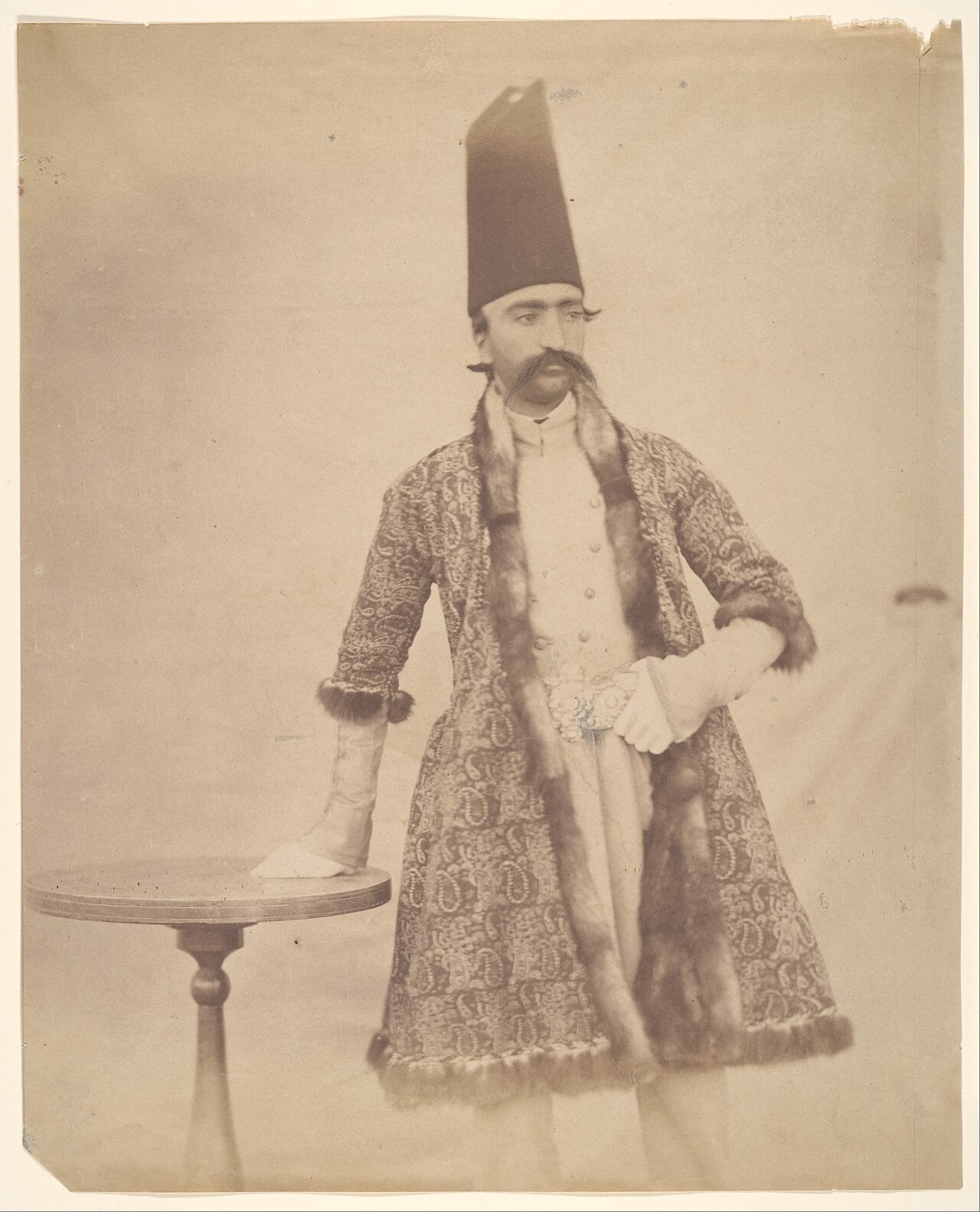

A teenage shah and his first minister
Naser al-Din was the son of Mohammad Shah and of Mahd-e Olia, a strong-willed Qajar princess who remained a power at court for decades. He was governor of Azerbaijan at Tabriz when his father died in September 1848, and he was just seventeen when he entered Tehran to take the throne. In the same year, as crown prince, he had presided over the tribunal that examined the Bab, whose movement is described on the page about the Bab and the Babi movement.
His first chief minister, Mirza Taqi Khan, known as Amir Kabir, used the next three years for a burst of reform: balancing the budget, cutting court pensions, reorganising the army and founding the Dar al-Funun, Iran’s first modern college, which opened in 1851. His enemies at court, including the queen mother, turned the shah against him. Amir Kabir was dismissed in November 1851 and killed at the Fin garden in Kashan in January 1852 on the shah’s orders, a decision historians often see as the lost opportunity of the reign.
Herat, the British and a new kind of government
Under the next chief minister, Mirza Aqa Khan Nuri, Iran made another attempt to take Herat. Iranian troops entered the city in 1856, and Britain declared war, landing troops at Bushehr and Mohammareh. The Anglo-Persian War of 1856–1857 ended with the Treaty of Paris, in which Iran gave up its claims to Herat.
After dismissing Nuri in 1858, the shah experimented with a cabinet of ministers responsible to himself, and over the next decades he swung between periods of reform and periods of personal rule. The most ambitious reforming minister of his middle years was Mirza Hosayn Khan Sepahsalar, chief minister from 1871 to 1873, who encouraged the shah’s first trip to Europe. In the last part of the reign, real power lay with Amin al-Soltan, a court official who managed finances and foreign loans.
The shah behind the camera
Naser al-Din’s personal passion was photography. A daguerreotype camera had reached the Qajar court in his father’s time, and the young shah learned from French and Italian photographers working in Tehran. He took pictures himself from the 1850s onward: courtiers, ministers, servants, landscapes on his hunting trips, and the women of his household, a subject no outside photographer could reach. He set up a photographic workshop in the palace, appointed a court photographer, and had prints mounted in albums, often adding captions in his own hand.
The result is one of the largest royal photographic collections in the world. The albums kept at the Golestan Palace hold tens of thousands of images and are a primary source for historians of Qajar society, as later commercial photographers such as Antoin Sevruguin also are. The page on Qajar art, photography and society looks at this visual culture more widely.
Building a modern capital
Tehran changed visibly under Naser al-Din. In the late 1860s new, wider walls with decorated gates were built around a larger city. In the palace complex he added the Shams ol-Emareh, the tall “edifice of the sun” with its clock towers, and the Takyeh Dowlat, a great round theatre for the passion plays of Muharram. Telegraph lines linked Tehran to the provinces and, through the Indo-European line, to Europe in the 1860s. A postal service with Iran’s first stamps followed, and newspapers were printed by the government.
Three journeys to Europe
In 1873 Naser al-Din became the first Iranian monarch to visit Europe, travelling through Russia, Germany, Britain, France and other countries; he went again in 1878 and 1889. He kept detailed diaries of what he saw: factories, theatres, zoos, parliaments and royal courts. They were published in Persian and translated, and they show both his curiosity and his difficulty in turning what he saw into policy at home. The trips are the subject of Naser al-Din Shah’s journeys to Europe.
Concessions, famine and protest
The travels were expensive, and the government searched for money. In 1872 the shah granted the British financier Baron Julius de Reuter a sweeping concession over railways, mines and much else, which was cancelled after protest; see the Reuter Concession. Other concessions followed for banks, river navigation and telegraphs, divided between British and Russian interests. Meanwhile the great famine of 1870–1872 killed a large share of the population in several provinces.
The turning point came in 1890, when a British company was given a monopoly over Iran’s tobacco trade. Merchants, clerics and townspeople united against it, a ruling attributed to the senior cleric Mirza Hasan Shirazi led to a nationwide boycott, and in January 1892 the shah cancelled the concession. The Tobacco Protest showed that a coalition of bazaar and clergy could defeat the crown.
Death at the shrine
On 1 May 1896, days before celebrations planned for the fiftieth lunar year of his reign, Naser al-Din was shot while visiting the shrine of Shah Abdol-Azim at Rey by Mirza Reza Kermani, a follower of the pan-Islamic activist Jamal al-Din Afghani. He died soon after and was buried at the shrine; the event is told in the assassination of Naser al-Din Shah.
How historians judge him
Abbas Amanat’s biography, Pivot of the Universe, presents a ruler who was intelligent, curious and hard-working, but cautious and fearful of losing control, who kept power by balancing ministers, courtiers and the two great powers against one another. Reform under him came in bursts and then stopped. To the constitutionalists of the next generation his reign looked like half a century of lost chances; to others it was a long period of relative stability in which Iran stayed independent between Russia and Britain.
Persian words from this page
| عکاسی | akkâsi | photography |
| سفرنامه | safarnâme | travel diary |
| امتیاز | emtiyâz | concession |
| شمسالعماره | Shams ol-Emâre | Edifice of the Sun |
| تکیه دولت | Takye Dowlat | the royal theatre for passion plays |
| مهد علیا | Mahd-e Olyâ | title of the queen mother |
Sources and further reading
- Abbas Amanat, Pivot of the Universe: Nasir al-Din Shah Qajar and the Iranian Monarchy, 1831–1896 (University of California Press, 1997).
- Encyclopaedia Iranica, “Nāṣer-al-Din Shah”.
- Nasir al-Din Shah, The Diary of H.M. the Shah of Persia during his Tour through Europe in A.D. 1873, translated by J. W. Redhouse (1874).
- Carmen Pérez González, Local Portraiture: Through the Lens of the 19th-Century Iranian Photographers (Leiden University Press, 2012).
- Nikki R. Keddie, Qajar Iran and the Rise of Reza Khan (Mazda, 1999).
Want to learn Persian? Get the free Starter Pack
Get the 14-page printable Starter Pack (all 32 letters, a 7-day reading plan, 100 core words and 20 survival phrases) and a short 5-email course. Free.
More in The Qajar Dynasty (1789–1925)
- Agha Mohammad Khan Qajar
- The Battle of Krtsanisi and Sack of Tiflis (1795)
- Fath-Ali Shah Qajar
- The Qajar Court and Harem
- The Russo-Persian War of 1804–1813
- The Battle of Aslanduz (1812)
- The Treaty of Golestan (1813)
- Abbas Mirza and the First Reforms
- The Russo-Persian War of 1826–1828
- The Treaty of Turkmenchay (1828)
- The Death of Griboyedov (1829)
- Mohammad Shah and the Siege of Herat
- The Bab and the Babi Movement
- Tahirih (Qurrat al-Ayn)
- Naser al-Din Shah Qajar
- Amir Kabir
- Dar al-Funun: Iran’s First Modern School
- The Anglo-Persian War (1856–1857)
- How Iran Lost Herat
- The Great Persian Famine of 1870–1872
- The Reuter Concession (1872)
- Naser al-Din Shah’s Journeys to Europe
- The Tobacco Protest (1891–1892)
- Mirza Malkam Khan and Early Reformers
- The Assassination of Naser al-Din Shah (1896)
- Photography in Qajar Iran
- Mozaffar ad-Din Shah
- Taj al-Saltaneh
- The D’Arcy Concession and the Discovery of Oil (1908)
- The Persian Constitutional Revolution (1905–1911)
- The First Majlis and the Constitution of 1906
- The Anglo-Russian Convention of 1907
- Mohammad Ali Shah and the Bombardment of the Majlis
- The Siege of Tabriz and Sattar Khan
- The Constitutionalists Take Tehran (1909)
- The Bakhtiari and the Revolution
- Morgan Shuster and the Russian Ultimatum (1911)
- Women in the Constitutional Revolution
- Iran in the First World War
- The Persian Famine of 1917–1919
- Mirza Kuchik Khan and the Jangali Movement
- The Anglo-Persian Agreement of 1919
- The 1921 Coup: Reza Khan and Seyyed Zia
- The End of the Qajar Dynasty (1925)
- Qajar Art, Photography and Society