Persian classical music is an improvised art built on the dastgah (دستگاه) system: twelve modal groups, each a family of melodies, collected in a repertoire called the radif. The radif was codified in 19th-century Tehran, but it draws on a much older tradition that reaches back through the music theory of al-Farabi and Safi al-Din to the legendary Sasanian court minstrel Barbad.

| Core system | 7 dastgahs and 5 âvâz (derived modes), 12 in all |
|---|---|
| Repertoire | The radif, a body of several hundred short melodies (gusheh) |
| Classical instruments | tar, setar, santur, kamancheh, ney, tombak, daf |
| UNESCO | Radif of Iranian music, Intangible Cultural Heritage, 2009 |
Ancient Iran: what the evidence shows
Music in ancient Iran is known only from pictures and from what others wrote. Elamite reliefs and seals show harps and lutes; Greek writers report that the Persian Magi chanted hymns at sacrifices; and Zoroastrian worship has always been sung, as the Gathas, Zoroaster’s hymns, are verses meant to be chanted. No notation survives from any of this.
Barbad and the Sasanian court
The first named Iranian musicians belong to the court of Khosrow II Parviz (590–628). Persian and Arabic tradition remembers Barbad as his chief minstrel, a poet-singer who played the barbat, a short-necked lute and the ancestor of the Arab oud. Later writers credit him with a cycle of seven “royal” modes, thirty melodies and 360 songs, one for each day of the year. Ferdowsi and Nezami tell stories of how Barbad used song to tell the king news no one else dared to give, and Nakisa, a harpist, appears as his rival in the romance of Khosrow and Shirin. These are literary memories, not records, but the great hunting relief at Taq-e Bostan really does show women harpists in boats accompanying the royal hunt (see Sasanian art and the Taq-e Bostan site).
The age of theory: Farabi to Maraghi
After the Arab conquest, Persian musicians shaped the music of Baghdad, and Iranian scholars wrote the theory of the whole Islamic world. Al-Farabi, from Central Asia, wrote the Great Book of Music in the 10th century, analysing intervals and the tuning of the lute. Avicenna included a long section on music in his encyclopaedia. In the 13th century Safi al-Din Urmavi, a musician at the last Abbasid court and then under the Mongols, described the system of twelve maqams that ruled Persian, Arab and Turkish music for centuries, and Abd al-Qadir Maraghi, who worked at the courts of the Jalayirids and Timurids until his death in 1435, carried it forward. Poetry and music were inseparable: Rudaki, the first great Persian poet, was also a singer who played the chang (harp).
Safavid and Qajar courts
Safavid shahs kept musicians at court, and the frescoes of Chehel Sotoun show players at royal banquets, but music had an uneasy place in a state where many Shi’a jurists disapproved of it. Musicians depended on court patronage, and religious mourning music, the chanting of elegies for Imam Hossein, developed at the same time and kept many melodies alive.
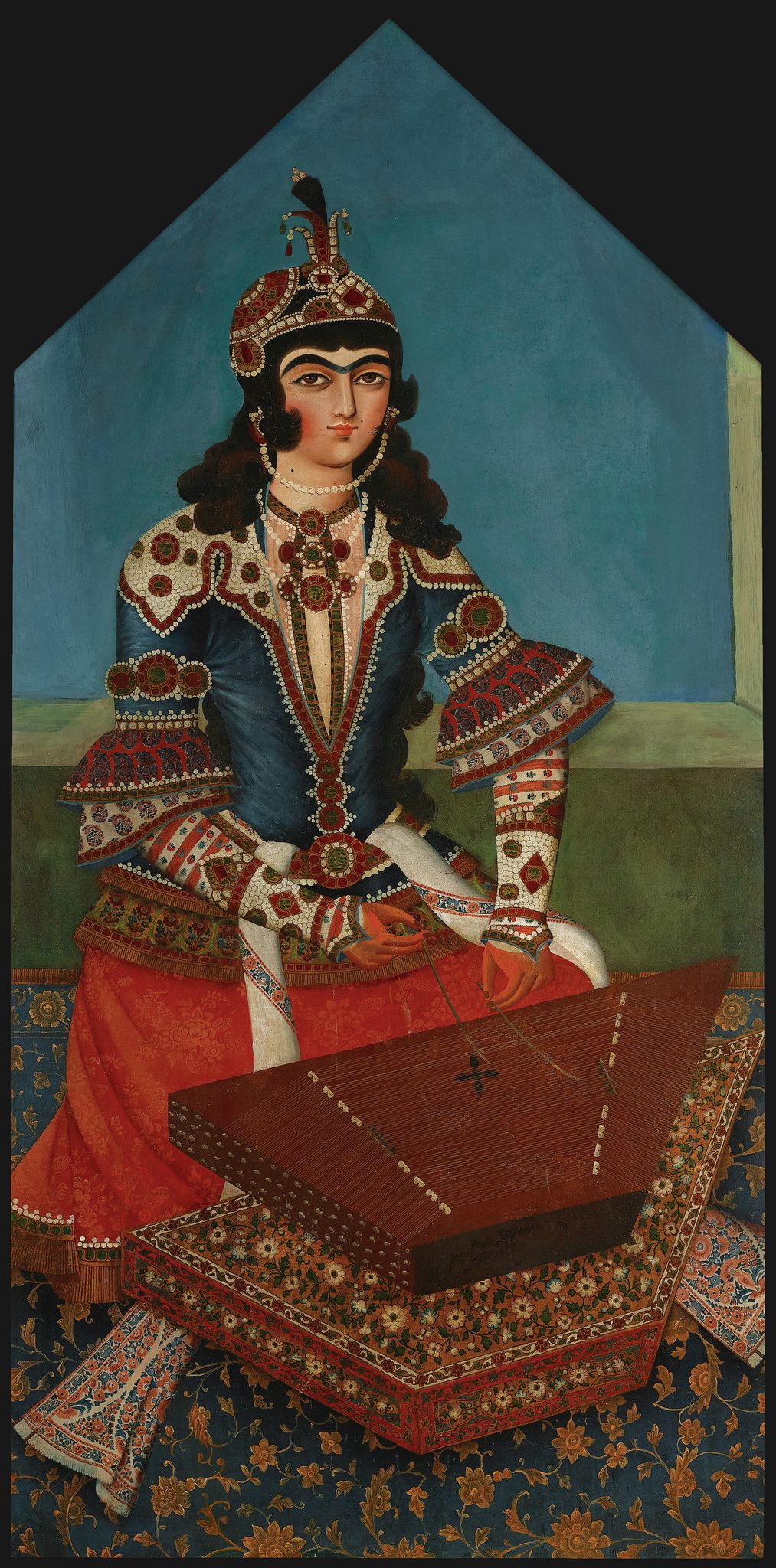
The decisive period was the Qajar 19th century. At the court of Naser al-Din Shah, the tar player Ali Akbar Farahani and above all his sons Mirza Abdollah (1843–1918) and Mirza Hossein-Qoli taught a fixed body of melodies to their pupils. This became the radif, arranged into seven dastgahs (Shur, Mahur, Homayun, Segah, Chahargah, Rast-Panjgah and Nava) and five âvâz derived from them (Abu Ata, Bayat-e Tork, Afshari, Dashti and Bayat-e Esfahan). The old twelve-maqam theory gave way to this practical system, learned by ear from a master and used as the basis for improvisation. For the court world it grew in, see Qajar art and society.
Modern music in the 20th century
After the Constitutional Revolution, music moved from the court into public concerts, schools and recordings. Colonel Ali-Naqi Vaziri, who returned from studying in Europe in 1924, founded a music school, wrote the radif in Western notation and invented the koron and sori signs for Persian quarter tones. In 1924 Qamar ol-Moluk Vaziri became the first woman to sing in public without a veil, at the Grand Hotel in Tehran. Radio Tehran began broadcasting in 1940, and the Golha (“Flowers”) radio programmes of 1956–1979, produced by Davud Pirnia, set classical poetry to music with singers such as Banan, Marzieh and Delkash. A thriving pop industry grew alongside, with stars like Googoosh and Vigen.
After 1979
The revolution brought sharp restrictions. Pop music was banned and its stars left, many for Los Angeles, which became the centre of Iranian pop in exile. Classical music, with its roots in mystical poetry, fared better, and the 1980s and 1990s saw a revival led by the singer Mohammad-Reza Shajarian (1940–2020), the tar player Mohammad-Reza Lotfi and the composer Hossein Alizadeh. Rules eased from the late 1990s, and licensed pop returned, but as of 2025 women were still not allowed to sing solo in front of mixed audiences, and many musicians work in a legal grey zone or abroad. The poetry that most Persian songs set is the subject of our page on the history of Persian poetry. If you are learning the language, our articles on learning Persian with music and lyrics and how music helps your Persian suggest where to start.
Persian words from this page
| موسیقی | musiqi | music |
| دستگاه | dastgâh | modal system |
| ردیف | radif | classical repertoire |
| گوشه | gushe | melody within a dastgah |
| آواز | âvâz | song; derived mode |
| سهتار | setâr | long-necked lute |
| سنتور | santur | hammered dulcimer |
| باربد | Bârbad | Sasanian minstrel |
Sources and further reading
- Bruno Nettl, The Radif of Persian Music: Studies of Structure and Cultural Context, 1987.
- Ella Zonis, Classical Persian Music: An Introduction, Harvard, 1973.
- Encyclopaedia Iranica, “Bārbad” and “Dastgāh”.
- Laudan Nooshin, Iranian Classical Music: The Discourses and Practice of Creativity, 2015.
- UNESCO Intangible Cultural Heritage, “Radif of Iranian music” (2009).
Want to learn Persian? Get the free Starter Pack
Get the 14-page printable Starter Pack (all 32 letters, a 7-day reading plan, 100 core words and 20 survival phrases) and a short 5-email course. Free.
More in Themes Across Iranian History (3000 BCE–today)
- A History of the Persian Language
- Zoroastrianism through the Ages
- Shi’a Islam in Iranian History
- The Jews of Iran
- The Armenians of Iran
- Christians of Iran
- The Baha’i Faith in Iran
- The Kurds in Iranian History
- Azerbaijanis in Iranian History
- The History of the Iranian Calendar
- Nowruz through History
- The Persian Garden (Pardis) through History
- Qanats: Iran’s Ancient Water Tunnels
- A History of Persian Carpets
- A History of Persian Architecture
- A History of Persian Painting
- A History of Persian Music
- Science in Iranian History
- Women in Iranian History
- Iran and the Silk Road
- Iran and China through History
- Iran and India through History
- Iran and Greece: Perceptions and Exchanges
- Persia and Rome: Seven Centuries of Rivalry
- Iran and the Ottoman Empire
- Iran and Russia through History
- Iran and Britain through History
- Iran and the United States
- How Iran’s Borders Changed
- The Capitals of Iran through History
- Coins of Iran through History: From the Daric to the Rial
- Flags and Symbols of Iran through History
- Myth and History in the Shahnameh: The Epic’s Kings and the Real Past
- Timeline of Iranian History: Key Dates from Elam to Today
- A History of Persian Cuisine: From Royal Banquets to Chelow Kabab
- A History of Persian Poetry: From Rudaki to Forough
- Wine in Iranian History: From Hajji Firuz to Hafez and Prohibition
- Sports in Iranian History: Polo, the Zurkhaneh and Wrestling
- List of Iranian Dynasties and Rulers