The Battle of Aslanduz was a Russian surprise attack on the army of the Qajar crown prince Abbas Mirza, fought at a ford of the Aras River on the night of 31 October and the morning of 1 November 1812. A Russian column of about 2,000 men under General Pyotr Kotlyarevsky scattered a far larger Persian force, and this defeat, followed by the storming of Lankaran, effectively decided the Russo-Persian War of 1804–1813.
| Date | 31 October to 1 November 1812 (19 to 20 October in the Russian Old Style calendar) |
|---|---|
| Place | Aslanduz (Persian اصلاندوز), a crossing on the Aras River, in today’s Ardabil province of Iran |
| Persian commander | Crown Prince Abbas Mirza |
| Russian commander | Major General Pyotr Kotlyarevsky |
| Forces | Russian: about 2,000 infantry and Cossacks with a few guns. Persian: estimates range from about 5,000 to 30,000 |
| Result | Decisive Russian victory; Persian artillery captured; Captain Charles Christie killed |
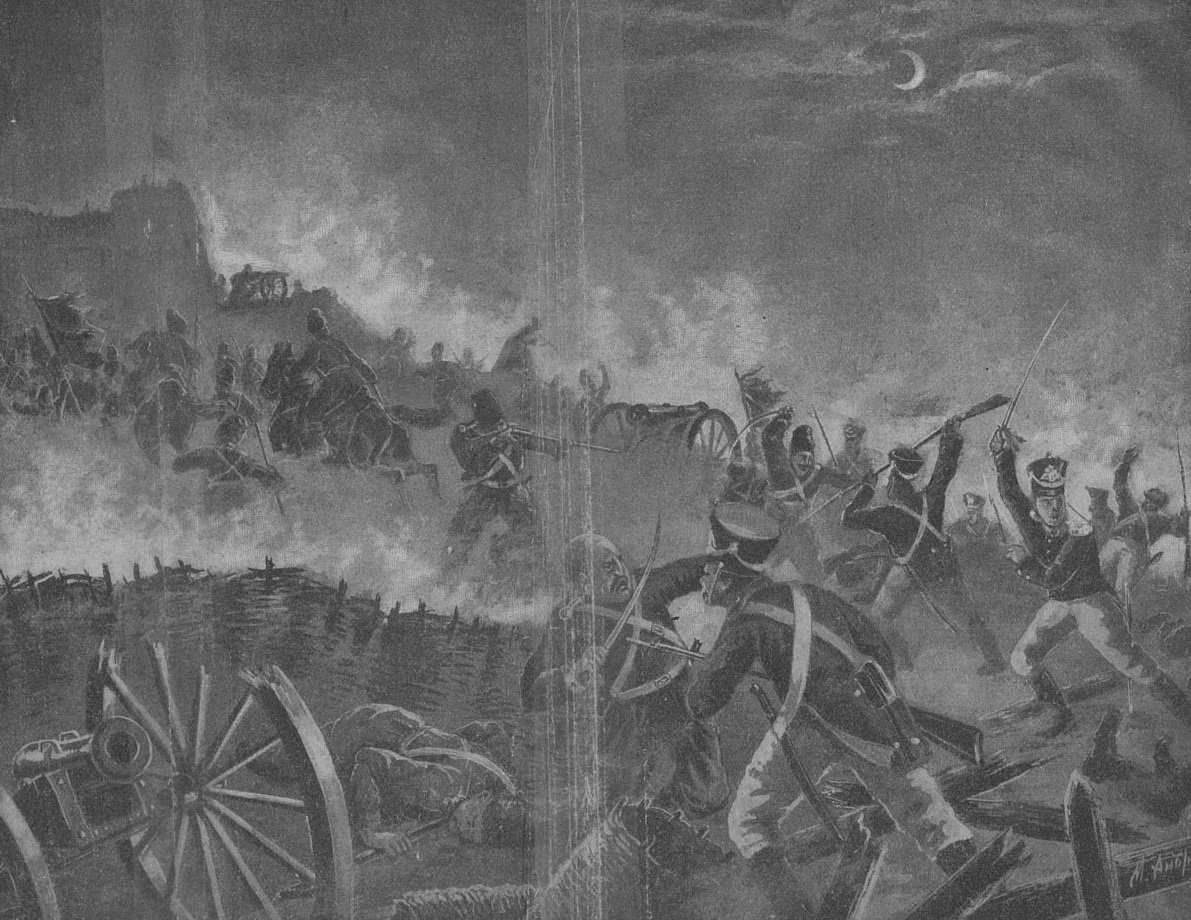

Peace talks on the riverbank
By 1812 the war over the Caucasus khanates had dragged on for eight years, and both sides wanted out of it. Russia was facing Napoleon, who crossed the Niemen in June 1812. Iran had signed a treaty with Britain in March of the same year that promised money and officers against Russia. Then the diplomatic ground shifted: once Napoleon invaded, Britain and Russia became allies, and British support for an Iranian war against Russia lost its point.
Aslanduz itself was first a place of negotiation. According to the Encyclopaedia Iranica, Russian and Iranian military representatives met in the village from 29 September to 1 October 1812 for preliminary peace talks. They broke off without agreement. Abbas Mirza kept his army camped at the ford, on the southern bank of the Aras, apparently expecting no serious Russian move before winter.
Abbas Mirza’s new army and its British officers
The army at Aslanduz was the showpiece of Abbas Mirza’s reforms in Azerbaijan, the نظام جدید (Nezâm-e Jadid, “new order”). Its infantry, the sarbâz, had been drilled in European fashion, first with French help and then by British officers sent under the preliminary treaty of 1809. When London made peace with Russia, most of these officers were withdrawn. A handful stayed at the prince’s request, among them Captain Charles Christie of the Bombay army, Lieutenant Henry Lindsay and William Monteith, with a group of British sergeants.
Christie was already well known in Iran. In 1810 he and Lieutenant Henry Pottinger had travelled in disguise from the Makran coast to survey the routes towards India, and Christie had crossed Sistan, Herat and the central desert to Yazd and Isfahan. In Azerbaijan he commanded one of the new infantry regiments and had fought at the Persian victory of Sultanabad in February 1812.
The night attack
Kotlyarevsky, then about thirty, had a reputation for speed and risk. With a column of roughly 2,000 men and a few field guns he crossed the Aras and fell on the Persian camp at night on 31 October. Many soldiers were asleep. The Persian army broke into separate groups, some of which fought on in the dark and into the next day before the last of them were overrun.
The new infantry, used to fighting in formation by day, could not hold together in a confused night action. Christie was shot in the neck and, by the accounts of British contemporaries, refused to surrender and was killed fighting. John Cormick, the British physician to Abbas Mirza, later recovered his body and buried him near the place where he fell. Abbas Mirza escaped, but his camp, baggage and nearly all his artillery fell into Russian hands.
How many fought and how many died
The numbers are uncertain and come mostly from the winning side. Russian reports claimed that around 2,000 Persians were killed and more than 500 taken prisoner, with eleven guns captured, against a few dozen Russian dead and about a hundred wounded. Modern writers repeat figures between 5,000 and 30,000 for the Persian army; the higher number probably counts the whole force under the prince’s command, including irregular cavalry who were not all in the camp. Historians such as Muriel Atkin and George Bournoutian use the Russian documents but treat the casualty totals with caution.
What Aslanduz decided
The Encyclopaedia Iranica calls the night attack the event that settled the ten-year war, because the army of Azerbaijan could no longer resist. Kotlyarevsky moved straight on to the new Persian fort at Lankaran on the Caspian, which he stormed in January 1813 at heavy cost on both sides. With his regular army broken and his British advisers urging peace, Abbas Mirza accepted a ceasefire, and the Treaty of Golestan was signed in October 1813, giving Russia most of the khanates north of the Aras.
The defeat also shaped Iranian views of reform. Critics at court argued that the new European-style troops had failed, while Abbas Mirza concluded that the reforms had not gone far enough. His continued efforts are followed on the page on Abbas Mirza and the first reforms. For the wider course of the war, from Ganja in 1804 to the peace, see the Russo-Persian War of 1804–1813.
Memory of the battle
In Russia, Aslanduz became part of the legend of Kotlyarevsky, later called the “meteor general”, who was badly wounded at Lankaran and retired soon after. Nineteenth-century Russian painters and writers treated the battle as a heroic episode of the Caucasus wars. In Iran it is remembered mainly as the moment the first war with Russia was lost. Iranian historians, including the author of the Encyclopaedia Iranica entry, stress that the attack came only after Britain and Russia had been reconciled in Europe, leaving Iran without the ally it had counted on.
- March 1812 Iran signs a treaty with Britain promising subsidies and officers
- June 1812 Napoleon invades Russia; Britain and Russia become allies
- 29 Sept to 1 Oct 1812 Peace talks at Aslanduz fail
- 31 Oct to 1 Nov 1812 Kotlyarevsky’s night attack routs the Persian camp
- January 1813 Russians storm Lankaran
- October 1813 Treaty of Golestan
Persian words from this page
| اصلاندوز | Aslânduz | Aslanduz |
| ارس | Aras | the Aras River |
| عباس میرزا | Abbâs Mirzâ | Abbas Mirza |
| سرباز | sarbâz | soldier, infantryman |
| نظام جدید | nezâm-e jadid | the new army (“new order”) |
| لنکران | Lankarân | Lankaran |
Sources and further reading
- J. Qa’em-Maqami, “Aslanduz”, Encyclopaedia Iranica: iranicaonline.org
- Muriel Atkin, Russia and Iran, 1780–1828 (University of Minnesota Press, 1980)
- George A. Bournoutian, From the Kur to the Aras: A Military History of Russia’s Move into the South Caucasus and the First Russo-Iranian War, 1801–1813 (Brill, 2021)
- Robert Grant Watson, A History of Persia from the Beginning of the Nineteenth Century to the Year 1858 (1866)
- Henry Pottinger, Travels in Beloochistan and Sinde (1816), with Christie’s journal as an appendix
Want to learn Persian? Get the free Starter Pack
Get the 14-page printable Starter Pack (all 32 letters, a 7-day reading plan, 100 core words and 20 survival phrases) and a short 5-email course. Free.
More in The Qajar Dynasty (1789–1925)
- Agha Mohammad Khan Qajar
- The Battle of Krtsanisi and Sack of Tiflis (1795)
- Fath-Ali Shah Qajar
- The Qajar Court and Harem
- The Russo-Persian War of 1804–1813
- The Battle of Aslanduz (1812)
- The Treaty of Golestan (1813)
- Abbas Mirza and the First Reforms
- The Russo-Persian War of 1826–1828
- The Treaty of Turkmenchay (1828)
- The Death of Griboyedov (1829)
- Mohammad Shah and the Siege of Herat
- The Bab and the Babi Movement
- Tahirih (Qurrat al-Ayn)
- Naser al-Din Shah Qajar
- Amir Kabir
- Dar al-Funun: Iran’s First Modern School
- The Anglo-Persian War (1856–1857)
- How Iran Lost Herat
- The Great Persian Famine of 1870–1872
- The Reuter Concession (1872)
- Naser al-Din Shah’s Journeys to Europe
- The Tobacco Protest (1891–1892)
- Mirza Malkam Khan and Early Reformers
- The Assassination of Naser al-Din Shah (1896)
- Photography in Qajar Iran
- Mozaffar ad-Din Shah
- Taj al-Saltaneh
- The D’Arcy Concession and the Discovery of Oil (1908)
- The Persian Constitutional Revolution (1905–1911)
- The First Majlis and the Constitution of 1906
- The Anglo-Russian Convention of 1907
- Mohammad Ali Shah and the Bombardment of the Majlis
- The Siege of Tabriz and Sattar Khan
- The Constitutionalists Take Tehran (1909)
- The Bakhtiari and the Revolution
- Morgan Shuster and the Russian Ultimatum (1911)
- Women in the Constitutional Revolution
- Iran in the First World War
- The Persian Famine of 1917–1919
- Mirza Kuchik Khan and the Jangali Movement
- The Anglo-Persian Agreement of 1919
- The 1921 Coup: Reza Khan and Seyyed Zia
- The End of the Qajar Dynasty (1925)
- Qajar Art, Photography and Society