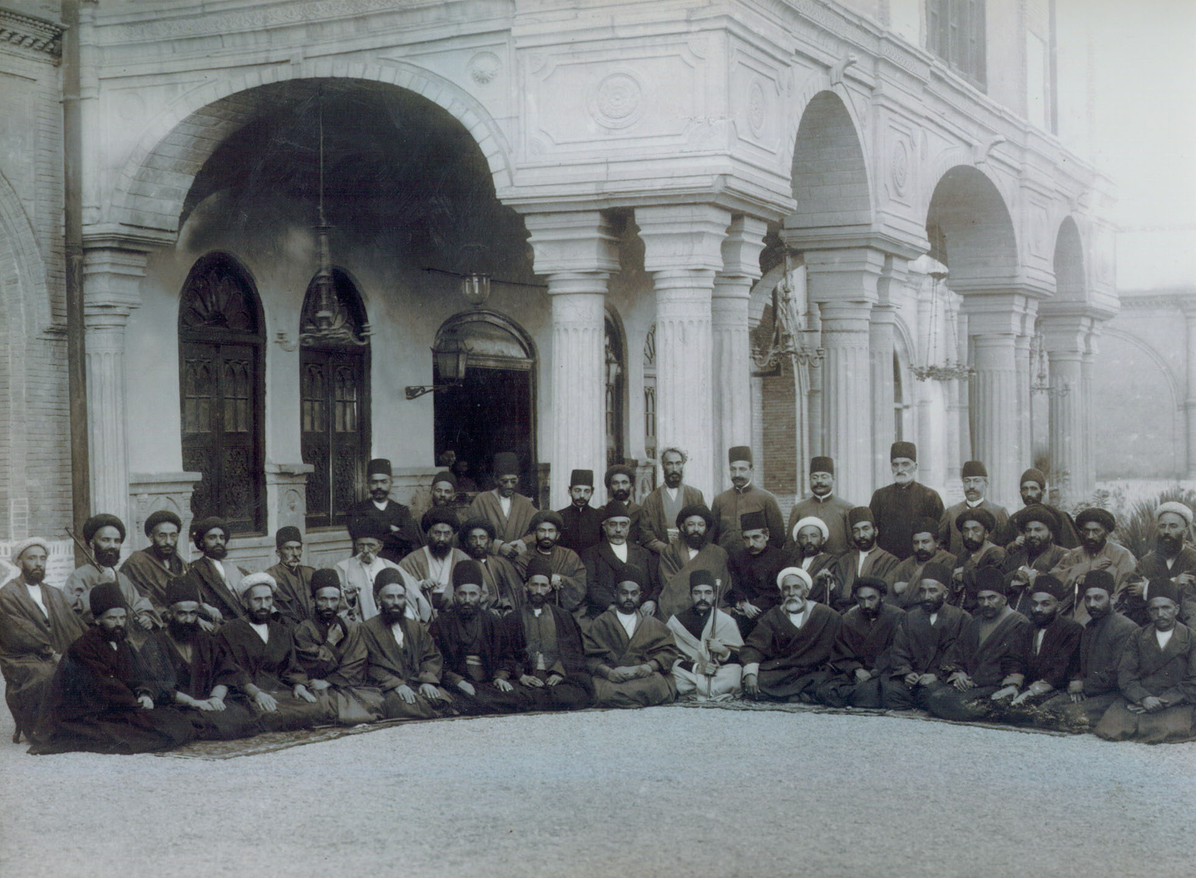
The First Majlis was Iran’s first elected parliament, the National Consultative Assembly, which sat in Tehran from 7 October 1906 until it was shelled by royalist troops on 23 June 1908. In under two years its deputies wrote the Fundamental Law of December 1906 and the Supplementary Fundamental Law of October 1907, which together formed Iran’s constitution until 1979, and they challenged the shah’s control of the budget, foreign loans and the courts.
| Opened | 7 October 1906 (18 Sha’ban 1324) |
|---|---|
| Closed | 23 June 1908, by bombardment |
| Seats | 156, of which 60 for Tehran |
| Seat | Baharestan, the former palace of Sepahsalar, Tehran |
| Speakers | Morteza-Qoli Khan Sani’ al-Dowleh; then Mahmud Khan Ehtesham al-Saltaneh |
| Constitution | Fundamental Law, 51 articles (30 December 1906); Supplementary Fundamental Law, 107 articles (7 October 1907) |
| Persian name | مجلس شورای ملی Majles-e Showrâ-ye Melli |

Electing a parliament by classes
The royal decree of 5 August 1906, won by the sit-in at the British legation described in the Constitutional Revolution, promised an assembly but said nothing about who would sit in it. An electoral law issued on 9 September 1906 answered that. Voters were divided into six classes (tabaqat):
- princes and members of the Qajar tribe;
- clerics and religious students;
- nobles and notables;
- merchants;
- landowners and peasants;
- members of the trade guilds.
Only men of at least 25 could vote, and only men between 30 and 70 who could read and write Persian could be elected. Women, soldiers, foreigners and convicted criminals were excluded, and landowners needed property worth at least 1,000 tomans. Deputies served two-year terms.
Tehran received 60 of the 156 seats: 32 for the guilds (one for each recognised guild), 10 for merchants, 10 for landowners and peasants, and 4 each for princes and clerics. The provinces elected in two stages, choosing delegates who then met in the provincial capital. Because the capital voted first and travel was slow, the Majlis opened with Tehran deputies alone, and provincial members, including a strong group from Tabriz, arrived over the following months.
The result was an assembly dominated by the bazaar and the guilds, with clerics, landowners and a small but active group of educated reformers. The class system was dropped in the second electoral law of 1909.
The opening and the building
Mozaffar ad-Din Shah, already very ill, opened the assembly on 7 October 1906 in a hall of the military school near the Golestan Palace. The Majlis then moved to Baharestan, the palace and garden built by Mirza Hosayn Khan Sepahsalar beside his great mosque and madrasa. Baharestan remained the seat of Iran’s parliament through most of the twentieth century, and the square in front of it was the scene of many later political gatherings.
Writing the Fundamental Law
The deputies’ first task was to give the assembly a legal basis before the shah died. A committee drafted a Fundamental Law (qanun-e asasi) of 51 articles, drawing partly on European models, above all the Belgian constitution of 1831. It dealt mainly with the Majlis itself: how it was organised, its right to approve the budget, taxes, loans, concessions and treaties, and the creation of a senate, half appointed by the shah. Mozaffar ad-Din signed it on 30 December 1906 and died a few days later.
The Supplementary Fundamental Law of 1907
The new shah, Mohammad Ali Shah, resisted further limits on his power, and the second text took most of 1907 to agree. The Supplementary Fundamental Law (motammem-e qanun-e asasi) of 107 articles, signed on 7 October 1907, set out the shape of the state. Among its main provisions:
- Twelver Shi’i Islam was the official religion, and the shah had to profess and promote it.
- A committee of at least five senior mujtahids was to examine bills and reject any that contradicted Islamic law (Article 2), a clause pressed by Shaykh Fazlollah Nuri.
- Citizens were equal before the law and had rights to security of life and property, freedom of the press and of association, and education, within limits set by law and religion.
- The powers of the state derived from the nation, and the monarchy was a trust given by the people to the shah.
- Legislative, judicial and executive powers were separated, and ministers were responsible to the Majlis.
Debates over equality between Muslims and non-Muslims, over the press and over the religious committee divided the deputies and their supporters, and opened the split between constitutionalists and Nuri’s camp.
What the Majlis tried to do
Money and loans
The assembly refused a new loan from Britain and Russia that the court wanted in late 1906, and tried instead to found a national bank (Bank-e Melli) with money raised from Iranians; the subscription raised less than hoped. It investigated the court’s finances, cut pensions and the royal budget, and abolished the tuyul system, under which revenue from land was assigned to princes and officials.
Foreign officials and concessions
Under pressure from the bazaar, the Belgian customs chief Joseph Naus was dismissed in early 1907. The Majlis asserted its right to approve all future concessions, a right later invoked over oil, and it protested the Anglo-Russian Convention of 1907, which it had not been consulted on.
Councils, newspapers and the street
The deputies worked alongside the anjomans, the local and professional councils that sprang up in Tehran, Tabriz and other cities, and a new free press. Their sessions were reported and argued over in the bazaar. Sayyed Hasan Taqizadeh, a young deputy from Tabriz, became the best-known voice of the radicals.
Crisis and bombardment
Conflict with the shah grew through 1907. The chief minister Amin al-Soltan, who had tried to work with the assembly, was shot dead outside Baharestan on 31 August 1907. In December 1907 royalist crowds gathered at Tupkhaneh Square in an attempt to overthrow the Majlis, but the shah backed down when armed volunteers rallied to the assembly. In June 1908 he tried again. On 23 June the Cossack Brigade shelled Baharestan; several leading constitutionalists, among them the preacher Malek al-Motakallemin and the journalist Jahangir Khan of Sur-e Esrafil, were seized and executed. The story continues in Mohammad Ali Shah and the bombardment of the Majlis.
Legacy
The First Majlis lasted less than two years, but historians such as Ervand Abrahamian and Janet Afary see it as the most remarkable assembly of the period: chosen largely by guilds and merchants, it tried to bring the court’s finances, foreign concessions and the law under elected control. The constitution it wrote, amended several times, remained in force through the Pahlavi era. Article 2’s committee of mujtahids was never put into effect under the monarchy, but the question it raised, the relation between parliament and religious law, has run through Iranian politics ever since.
Persian words from this page
| مجلس شورای ملی | Majles-e Showrâ-ye Melli | National Consultative Assembly |
| قانون اساسی | qânun-e asâsi | constitution, fundamental law |
| نماینده | namâyande | deputy, representative |
| انتخابات | entekhâbât | elections |
| طبقات | tabaqât | classes (of electors) |
| بهارستان | Bahârestân | the parliament building |
| تیول | tiyul | revenue assignment (tuyul) |
Sources and further reading
- Electoral Law of 9 September 1906, English translation in the Abdorrahman Boroumand Center library; also in E. G. Browne, The Persian Revolution of 1905–1909 (1910).
- Encyclopaedia Iranica, “Elections” and “Constitutional Revolution”.
- Janet Afary, The Iranian Constitutional Revolution, 1906–1911 (Columbia University Press, 1996).
- Ervand Abrahamian, Iran Between Two Revolutions (Princeton, 1982).
- Mangol Bayat, Iran’s First Revolution: Shi’ism and the Constitutional Revolution of 1905–1909 (Oxford University Press, 1991).
Want to learn Persian? Get the free Starter Pack
Get the 14-page printable Starter Pack (all 32 letters, a 7-day reading plan, 100 core words and 20 survival phrases) and a short 5-email course. Free.
More in The Qajar Dynasty (1789–1925)
- Agha Mohammad Khan Qajar
- The Battle of Krtsanisi and Sack of Tiflis (1795)
- Fath-Ali Shah Qajar
- The Qajar Court and Harem
- The Russo-Persian War of 1804–1813
- The Battle of Aslanduz (1812)
- The Treaty of Golestan (1813)
- Abbas Mirza and the First Reforms
- The Russo-Persian War of 1826–1828
- The Treaty of Turkmenchay (1828)
- The Death of Griboyedov (1829)
- Mohammad Shah and the Siege of Herat
- The Bab and the Babi Movement
- Tahirih (Qurrat al-Ayn)
- Naser al-Din Shah Qajar
- Amir Kabir
- Dar al-Funun: Iran’s First Modern School
- The Anglo-Persian War (1856–1857)
- How Iran Lost Herat
- The Great Persian Famine of 1870–1872
- The Reuter Concession (1872)
- Naser al-Din Shah’s Journeys to Europe
- The Tobacco Protest (1891–1892)
- Mirza Malkam Khan and Early Reformers
- The Assassination of Naser al-Din Shah (1896)
- Photography in Qajar Iran
- Mozaffar ad-Din Shah
- Taj al-Saltaneh
- The D’Arcy Concession and the Discovery of Oil (1908)
- The Persian Constitutional Revolution (1905–1911)
- The First Majlis and the Constitution of 1906
- The Anglo-Russian Convention of 1907
- Mohammad Ali Shah and the Bombardment of the Majlis
- The Siege of Tabriz and Sattar Khan
- The Constitutionalists Take Tehran (1909)
- The Bakhtiari and the Revolution
- Morgan Shuster and the Russian Ultimatum (1911)
- Women in the Constitutional Revolution
- Iran in the First World War
- The Persian Famine of 1917–1919
- Mirza Kuchik Khan and the Jangali Movement
- The Anglo-Persian Agreement of 1919
- The 1921 Coup: Reza Khan and Seyyed Zia
- The End of the Qajar Dynasty (1925)
- Qajar Art, Photography and Society