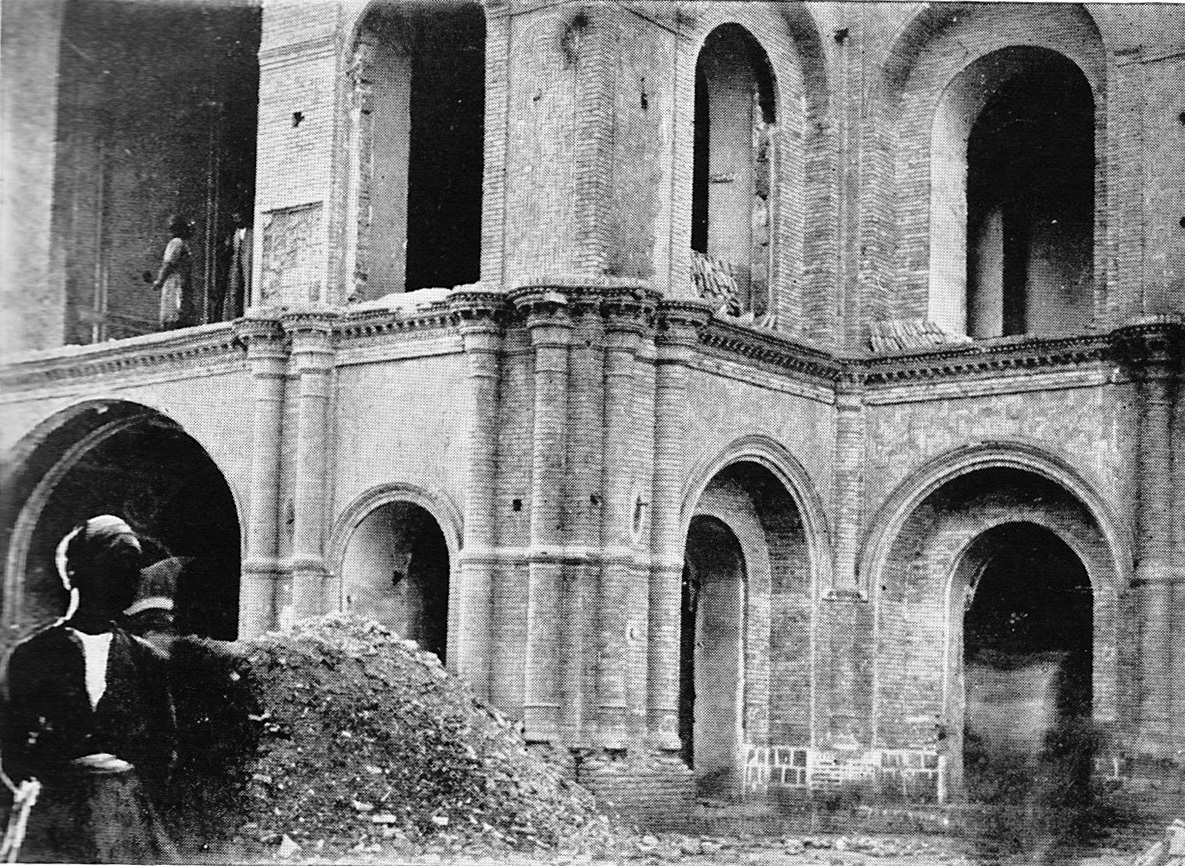
On 23 June 1908 the Persian Cossack Brigade, commanded by the Russian colonel Vladimir Liakhov, shelled the Majlis building in Tehran on the orders of Mohammad Ali Shah. The coup closed Iran’s first parliament after less than two years, led to the execution of leading constitutionalists and began the thirteen months Iranians call the “Lesser Despotism” (استبداد صغیر), which ended only when the shah was deposed in July 1909.

A crown prince raised in Tabriz
Mohammad Ali Mirza was born in Tabriz in 1872, the son of the future Mozaffar ad-Din Shah. Like other Qajar heirs he spent his years as crown prince as governor of Azerbaijan, at Tabriz, where Russian influence was strong. His tutor there was Seraya Shapshal, a Karaite scholar from the Crimea with close ties to Russian officials, who stayed on as one of his advisers in Tehran.
His father signed the decree for an assembly in August 1906 and the Fundamental Law at the end of that year, a few days before he died. Mohammad Ali took the throne in January 1907. He had signed the constitution as crown prince, but from the start he treated the Majlis as a rival. He did not invite the deputies to his coronation, and he resisted the Supplementary Fundamental Law that the Majlis drafted to limit the crown. He signed it only in October 1907, after mass demonstrations.
Two years of confrontation
The story of the First Majlis and its conflicts with the court is told on the page on the First Majlis and the constitution of 1906. Three moments mattered most for what followed:
- In August 1907 the chief minister Amin al-Soltan, who had tried to steer between court and parliament, was shot dead outside the Majlis. In the same weeks Britain and Russia signed the Anglo-Russian Convention, which left the constitutionalists without a foreign friend.
- In December 1907 royalist crowds and armed men gathered at Tupkhaneh Square to bring the Majlis down. The shah arrested his prime minister, then backed off when volunteers from the political societies (anjomans) rallied to defend the assembly.
- In February 1908 a bomb was thrown at the shah’s motorcar in Tehran. He was not hurt, but he took the attack as proof that radicals in the anjomans wanted him dead.
By the spring of 1908 the radical press was attacking the shah personally. The newspaper Sur-e Esrafil, edited by Mirza Jahangir Khan Shirazi and the satirist Ali-Akbar Dehkhoda, and the sermons of the preachers Malek al-Motakallemin and Sayyed Jamal al-Din Va’ez Esfahani drew large crowds and furious royal responses.
Bagh-e Shah and the ultimatum
In early June 1908 the shah left the city for the Bagh-e Shah, a walled royal garden on the western edge of Tehran, and gathered troops there. He demanded that the Majlis hand over a list of radical speakers and journalists, including Malek al-Motakallemin, Jamal al-Din Va’ez and Jahangir Khan, and that the press be curbed. Liakhov, whom the shah had made military governor of Tehran, cut the telegraph and posted Cossacks in the city. Armed volunteers and members of the anjomans gathered in the Majlis building at Baharestan and the Sepahsalar mosque next to it.
23 June 1908
On the morning of 23 June, Cossacks surrounded Baharestan. Fighting broke out with the defenders, and the brigade’s artillery opened fire on the parliament and the mosque. Resistance lasted some hours. By the afternoon the building was badly damaged and the volunteers were dead, captured or scattered. Cossacks and others then looted the building and the houses of leading deputies. Estimates of the dead vary and no firm count exists.
Some leaders escaped. Sayyed Hasan Taqizadeh, the Tabriz deputy, and others took refuge in the British legation and were allowed to leave the country. The two senior clerics of the movement, Sayyed Abdollah Behbahani and Sayyed Mohammad Tabatabai, were arrested and sent away from the capital.
Others were taken to the Bagh-e Shah. On 24 June Malek al-Motakallemin and Jahangir Khan were strangled there. Jamal al-Din Va’ez fled but was caught and killed near Borujerd. Dehkhoda escaped to Europe, where he and others kept Sur-e Esrafil going from Switzerland. Photographs of chained prisoners in the Bagh-e Shah circulated widely and became some of the best-known images of the revolution.
| Date | 23 June 1908 (2 Tir 1287 in the solar calendar) |
|---|---|
| Place | Baharestan, Tehran: the Majlis building and Sepahsalar mosque |
| Ordered by | Mohammad Ali Shah (reigned 1907–1909) |
| Force | Persian Cossack Brigade under Colonel V. P. Liakhov |
| Executed | Malek al-Motakallemin, Mirza Jahangir Khan; Sayyed Jamal al-Din Va’ez killed later |
| Result | Majlis closed; “Lesser Despotism” until July 1909 |
Russia, Liakhov and responsibility
The Cossack Brigade had been founded in 1879 with Russian officers and remained under Russian command, paid partly from Iranian funds. That a Russian officer led the attack made many Iranians see the coup as Russian policy. Russian diplomats said Liakhov had acted as an employee of the shah. Historians who have worked in the Russian archives, among them Firuz Kazemzadeh, show that the Russian legation knew of the shah’s plans and encouraged firm action, although how much was directed from St Petersburg remains a matter of debate. Britain protested mildly and did not act, in keeping with its new agreement with Russia.
The Lesser Despotism and the shah’s fall
The shah announced that he would call a new assembly once order returned, but it never met. In most of the country the coup succeeded. In Tabriz it did not: the city’s fighters, led by Sattar Khan and Baqer Khan, drove out the royalists and held on through a long siege (see the siege of Tabriz). Revolts followed in Gilan and Isfahan, and in July 1909 their forces entered the capital, as told in the constitutionalists take Tehran.
On 16 July 1909 Mohammad Ali Shah took refuge in the Russian legation and an emergency assembly deposed him in favour of his eleven-year-old son, Ahmad. He went into exile in Odessa with a pension. In July 1911 he landed on Iran’s Caspian coast in the Turkmen country near Astarabad with Russian connivance, trying to win back the throne. His army was defeated near Tehran in September 1911 by government forces under Yeprem Khan and the Bakhtiari. He spent his last years in Istanbul and Italy and died in San Remo in April 1925, months before the Majlis ended the dynasty he had tried to save from parliament.
How the coup is remembered
For constitutionalists the bombardment became a story of martyrdom: Malek al-Motakallemin and Jahangir Khan are honoured as early heroes of Iranian freedom, and Dehkhoda’s poem in memory of Jahangir Khan, written in exile, is still taught. Royalist and some clerical writers at the time saw the shah as defending religion and order against radicals. Most modern historians, including Janet Afary and Abbas Amanat, see the coup as the moment the conflict between the court and the constitution became a civil war, and note that it only delayed the shah’s fall by a year.
Persian words from this page
| استبداد صغیر | estebdâd-e saghir | the Lesser Despotism |
| باغشاه | Bâgh-e Shâh | the Shah’s Garden |
| بهارستان | Bahârestân | site of the Majlis |
| قزاق | qazzâq | Cossack |
| انجمن | anjoman | society, council |
| صور اسرافیل | Sur-e Esrâfil | “Trumpet of Israfil” (newspaper) |
Sources and further reading
- Edward G. Browne, The Persian Revolution of 1905–1909 (Cambridge University Press, 1910).
- Ahmad Kasravi, Tarikh-e mashruteh-ye Iran (History of the Iranian Constitution), first published 1940s.
- Janet Afary, The Iranian Constitutional Revolution, 1906–1911 (Columbia University Press, 1996).
- Encyclopaedia Iranica, “Constitutional Revolution”: iranicaonline.org
- Firuz Kazemzadeh, Russia and Britain in Persia, 1864–1914 (Yale University Press, 1968).
- Abbas Amanat, Iran: A Modern History (Yale University Press, 2017).
Want to learn Persian? Get the free Starter Pack
Get the 14-page printable Starter Pack (all 32 letters, a 7-day reading plan, 100 core words and 20 survival phrases) and a short 5-email course. Free.
More in The Qajar Dynasty (1789–1925)
- Agha Mohammad Khan Qajar
- The Battle of Krtsanisi and Sack of Tiflis (1795)
- Fath-Ali Shah Qajar
- The Qajar Court and Harem
- The Russo-Persian War of 1804–1813
- The Battle of Aslanduz (1812)
- The Treaty of Golestan (1813)
- Abbas Mirza and the First Reforms
- The Russo-Persian War of 1826–1828
- The Treaty of Turkmenchay (1828)
- The Death of Griboyedov (1829)
- Mohammad Shah and the Siege of Herat
- The Bab and the Babi Movement
- Tahirih (Qurrat al-Ayn)
- Naser al-Din Shah Qajar
- Amir Kabir
- Dar al-Funun: Iran’s First Modern School
- The Anglo-Persian War (1856–1857)
- How Iran Lost Herat
- The Great Persian Famine of 1870–1872
- The Reuter Concession (1872)
- Naser al-Din Shah’s Journeys to Europe
- The Tobacco Protest (1891–1892)
- Mirza Malkam Khan and Early Reformers
- The Assassination of Naser al-Din Shah (1896)
- Photography in Qajar Iran
- Mozaffar ad-Din Shah
- Taj al-Saltaneh
- The D’Arcy Concession and the Discovery of Oil (1908)
- The Persian Constitutional Revolution (1905–1911)
- The First Majlis and the Constitution of 1906
- The Anglo-Russian Convention of 1907
- Mohammad Ali Shah and the Bombardment of the Majlis
- The Siege of Tabriz and Sattar Khan
- The Constitutionalists Take Tehran (1909)
- The Bakhtiari and the Revolution
- Morgan Shuster and the Russian Ultimatum (1911)
- Women in the Constitutional Revolution
- Iran in the First World War
- The Persian Famine of 1917–1919
- Mirza Kuchik Khan and the Jangali Movement
- The Anglo-Persian Agreement of 1919
- The 1921 Coup: Reza Khan and Seyyed Zia
- The End of the Qajar Dynasty (1925)
- Qajar Art, Photography and Society