Abbas Mirza (1789–1833) was the Qajar crown prince and governor of Azerbaijan who led Iran’s armies against Russia and started the country’s first deliberate attempt to adopt European methods. From his court at Tabriz he built a European-style infantry, set up workshops and an early printing press, and sent the first Iranian students to study in England, though he died a year before his father and never became shah.
| Born | 1789, at Nava in Mazandaran |
|---|---|
| Parents | Fath-Ali Shah and a Qajar mother of the Davalu clan |
| Seat | Tabriz, as governor of Azerbaijan |
| Ministers | Mirza Bozorg Qaem-Maqam, then his son Mirza Abolqasem Qaem-Maqam |
| Died | October 1833, Mashhad |
| Persian name | عباس میرزا |
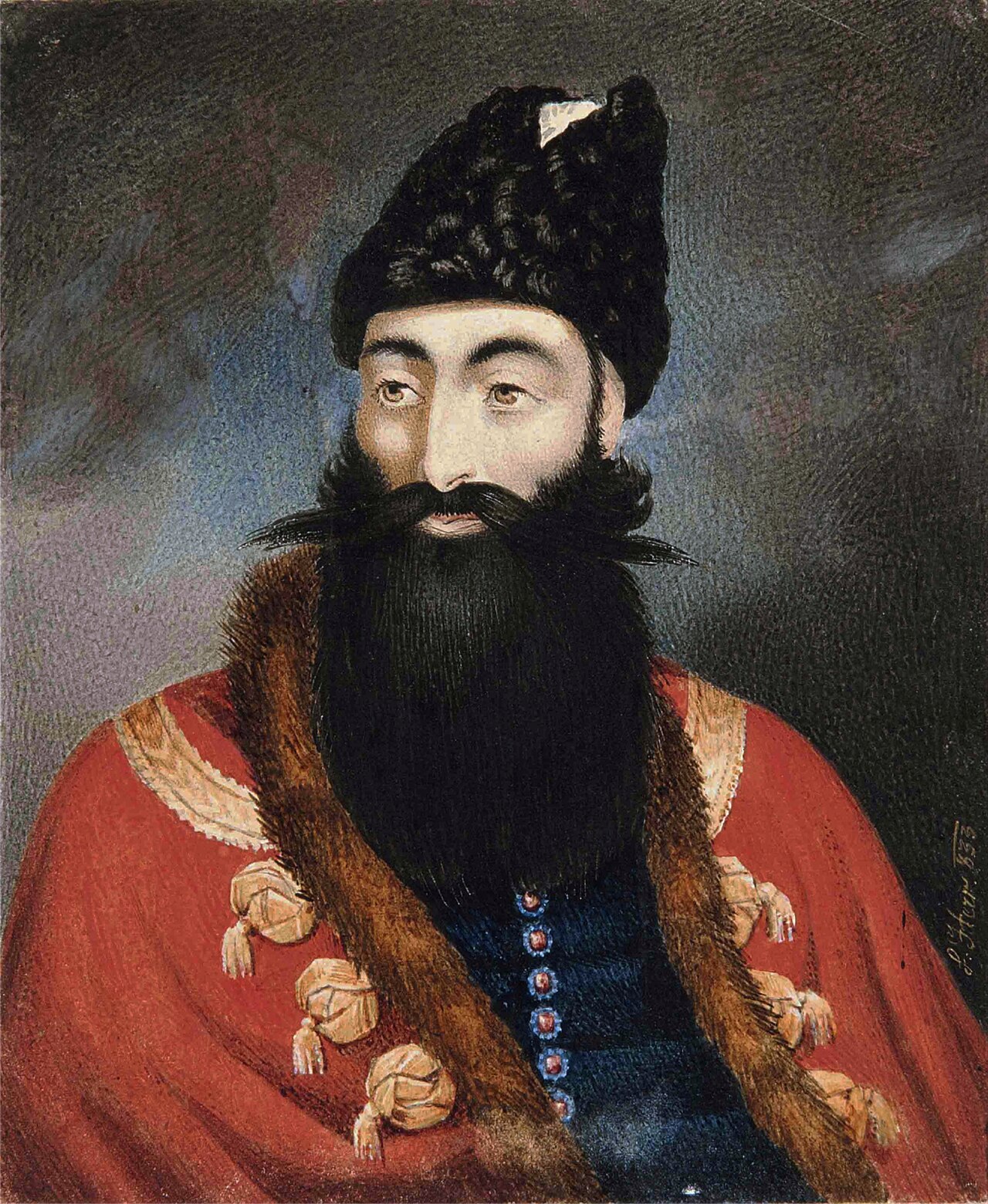

An heir chosen for his mother
Fath-Ali Shah had older sons, notably Mohammad Ali Mirza Dowlatshah, a capable soldier who governed Kermanshah. Abbas Mirza was chosen as heir partly because his mother came from the Davalu branch of the Qajar tribe, which joined the two rival clans of the royal family in one person. He was named crown prince as a boy and sent to Tabriz as governor of Azerbaijan, the province that faced Russia and the Ottoman Empire.
Tabriz became a second capital. It stood on the trade routes to Russia and Istanbul, and it was where foreign envoys, officers and merchants first arrived. Under Abbas Mirza it grew into the most outward-looking city in Iran, a position it kept through the nineteenth century.
Learning from defeat
Abbas Mirza was a teenager when he took command against Russia in the war of 1804–1813. The war taught him that Persian cavalry, however brave, could not beat Russian infantry squares and field guns. The French envoy Amédée Jaubert, who visited Iran in 1805–1806, later recorded the prince asking what had given Europeans such superiority over Iran, and whether it lay in their armies, their governments or their learning. The exchange is often quoted as a summary of the questions that Iranian reformers would ask for the next hundred years.
The Nezam-e Jadid
His answer began with the army. With French instructors from 1807 and British officers from 1809, he raised a body of regular infantry, drilled, uniformed and paid in the European manner, called the Nezam-e Jadid, the “new order”, after the reforms of the Ottoman sultan Selim III. Drill commands were translated into Persian. An arsenal and cannon foundry in Tabriz produced guns and muskets, and workshops made uniforms and powder.
The new troops performed better than the old levies, but they were never numerous or well funded enough to change the balance against Russia. Many Iranians distrusted them too: some members of the clergy and the court saw European uniforms and drill as an imitation of unbelievers, and the expense fell on the provincial treasury of Azerbaijan.
Students, books and a press
The reforms reached beyond soldiers. In 1811 two young men went to England with the returning British envoy, one to study painting and one to study medicine. In 1815 five more followed, to learn engineering, artillery, gunsmithing, chemistry and languages. They were the first Iranians sent abroad by the state for education.
The best known of them is Mirza Saleh Shirazi, who wrote a detailed account of his years in England, describing its parliament, newspapers and laws for Persian readers. Back in Iran he brought a printing press, and in 1837 he published in Tehran the first Persian newspaper, known as Kaghaz-e Akhbar (“the news sheet”). A typographic press had already been set up in Tabriz by around 1817–1819, and translations of European works on military science and history began to appear there.
The Qaem-Maqams: reformers in the chancery
Abbas Mirza’s chief ministers were Mirza Bozorg Farahani, who held the title Qaem-Maqam, and after his death in 1822 his son Mirza Abolqasem, who inherited the title. Abolqasem Qaem-Maqam is remembered as a master of Persian prose, who replaced the heavily ornamented chancery style with simpler, clearer writing that influenced Persian for generations. He supported the prince’s projects and later served briefly as chief minister to Mohammad Shah, who had him executed in 1835.
The second war and after
In 1826, under pressure from the clergy and the court, Iran went to war with Russia again. Abbas Mirza opposed the war at first, then commanded it. After early gains his army was beaten near Ganja in September 1826, and in 1827 Russian forces took Erivan and entered Tabriz itself. He personally negotiated the Treaty of Turkmenchay in 1828, in which Russia again confirmed him as heir. The campaign is described on the page about the Russo-Persian War of 1826–1828.
In his last years he turned east. He campaigned in Yazd, Kerman and Khorasan to restore central control, and in 1833 his forces moved toward Herat. He fell ill and died at Mashhad in October 1833, aged 44, and was buried at the shrine of Imam Reza there. His son Mohammad Mirza became crown prince and, a year later, shah.
How historians see him
Iranian nationalists of the twentieth century made Abbas Mirza a hero: a patriotic prince who fought bravely, recognised Iran’s weakness and tried to cure it. Historians today, among them Abbas Amanat and Muriel Atkin, agree that he was the first Qajar ruler to treat reform as a policy, but stress how narrow it was. His changes were military first, depended on foreign officers and his own provincial income, and did not touch the structure of government in Tehran. Later reformers such as Amir Kabir built on his example, and the school he never founded was eventually created as the Dar al-Funun in 1851.
A statue of him stands in Tabriz, and his name is used for streets and schools across Iran. Readers can find more about the city on our page about Tabriz.
Persian words from this page
| ولیعهد | valiahd | crown prince |
| تبریز | Tabriz | Tabriz |
| نظام جدید | Nezâm-e Jadid | the “new order” army |
| قائممقام | Qâem-Maqâm | deputy; title of the prince’s ministers |
| روزنامه | ruznâme | newspaper |
| چاپخانه | châpkhâne | printing house |
Sources and further reading
- Encyclopaedia Iranica, “ʿAbbās Mīrzā”.
- Abbas Amanat, Iran: A Modern History (Yale, 2017).
- Nile Green, The Love of Strangers: What Six Muslim Students Learned in Jane Austen’s London (Princeton, 2016).
- Mirza Saleh Shirazi, Safarnameh (travel account of England, written c. 1819–1820).
- Amédée Jaubert, Voyage en Arménie et en Perse (Paris, 1821).
Want to learn Persian? Get the free Starter Pack
Get the 14-page printable Starter Pack (all 32 letters, a 7-day reading plan, 100 core words and 20 survival phrases) and a short 5-email course. Free.
More in The Qajar Dynasty (1789–1925)
- Agha Mohammad Khan Qajar
- The Battle of Krtsanisi and Sack of Tiflis (1795)
- Fath-Ali Shah Qajar
- The Qajar Court and Harem
- The Russo-Persian War of 1804–1813
- The Battle of Aslanduz (1812)
- The Treaty of Golestan (1813)
- Abbas Mirza and the First Reforms
- The Russo-Persian War of 1826–1828
- The Treaty of Turkmenchay (1828)
- The Death of Griboyedov (1829)
- Mohammad Shah and the Siege of Herat
- The Bab and the Babi Movement
- Tahirih (Qurrat al-Ayn)
- Naser al-Din Shah Qajar
- Amir Kabir
- Dar al-Funun: Iran’s First Modern School
- The Anglo-Persian War (1856–1857)
- How Iran Lost Herat
- The Great Persian Famine of 1870–1872
- The Reuter Concession (1872)
- Naser al-Din Shah’s Journeys to Europe
- The Tobacco Protest (1891–1892)
- Mirza Malkam Khan and Early Reformers
- The Assassination of Naser al-Din Shah (1896)
- Photography in Qajar Iran
- Mozaffar ad-Din Shah
- Taj al-Saltaneh
- The D’Arcy Concession and the Discovery of Oil (1908)
- The Persian Constitutional Revolution (1905–1911)
- The First Majlis and the Constitution of 1906
- The Anglo-Russian Convention of 1907
- Mohammad Ali Shah and the Bombardment of the Majlis
- The Siege of Tabriz and Sattar Khan
- The Constitutionalists Take Tehran (1909)
- The Bakhtiari and the Revolution
- Morgan Shuster and the Russian Ultimatum (1911)
- Women in the Constitutional Revolution
- Iran in the First World War
- The Persian Famine of 1917–1919
- Mirza Kuchik Khan and the Jangali Movement
- The Anglo-Persian Agreement of 1919
- The 1921 Coup: Reza Khan and Seyyed Zia
- The End of the Qajar Dynasty (1925)
- Qajar Art, Photography and Society