Taj al-Saltaneh (1884–1936) was a daughter of Naser al-Din Shah whose memoir, written around 1914, is the most personal account we have of life inside the Qajar royal harem. Married at about thirteen, she later divorced, took part in the women’s circles of the constitutional period and wrote openly about the veil, marriage and the education of women.
| Name | Zahra Khanom, titled Taj al-Saltaneh (تاجالسلطنه, “crown of the state”) |
|---|---|
| Born | 1884, Tehran |
| Died | 1936, Tehran |
| Parents | Naser al-Din Shah and Turan al-Saltaneh |
| Known for | Her memoir (Khâterât), covering 1884 to 1914 |
| Published | Persian edition, Tehran, 1982; English: Crowning Anguish (Mage, 1993) |
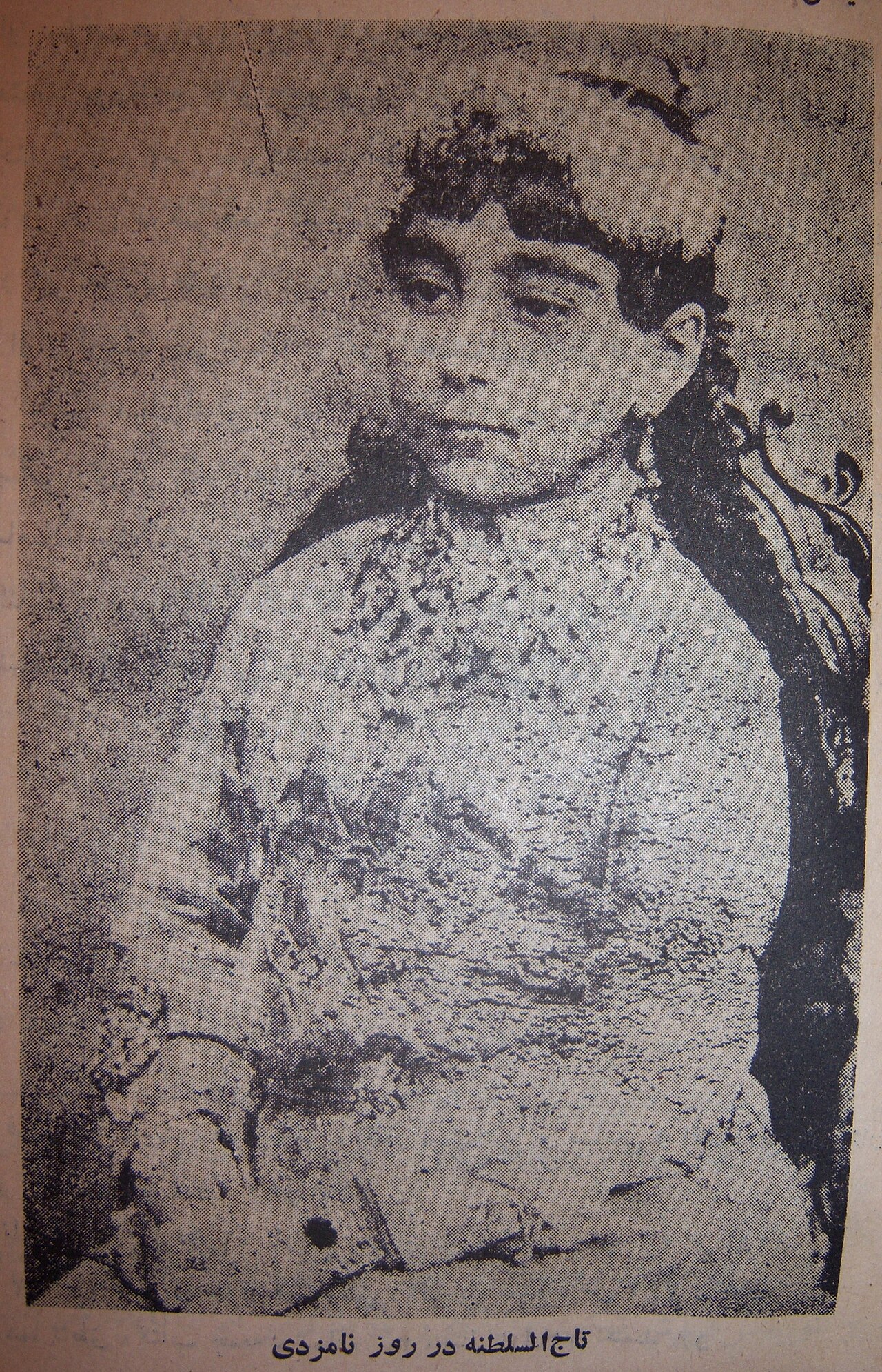

A childhood in the andaruni
Zahra Khanom was born in Tehran in 1884, a daughter of Naser al-Din Shah by one of his wives, Turan al-Saltaneh. Like other royal children she grew up in the women’s quarters of the palace, the andaruni, cared for mostly by a wet nurse and nannies rather than by her mother. Her memoir describes the routines of that world: the crowds of wives and servants, the rivalries between their households, the eunuchs at the doors and the visits of her father, whom she remembered with affection. The institution itself is described on the page on the Qajar court and harem.
She was engaged as a child, a common arrangement in elite families, and her education was the usual one for a princess: reading, Persian poetry, religious instruction. She later blamed this upbringing for leaving her, as she saw it, unprepared for life, and she wrote of how she later left behind the folk beliefs of her nannies.
Marriage and divorce
In 1896 her father was assassinated at the shrine of Shah Abdol-Azim (see the assassination of Naser al-Din Shah). At about thirteen she was married to Hasan Khan Shoja al-Saltaneh, son of a senior Qajar military official. The couple had four children. The memoir portrays the marriage as deeply unhappy and speaks of her husband’s affairs and her own loneliness.
Over the following years she is said to have adopted European dress, and under the influence of a tutor she came to question religion; her mother accused her of having “turned Babi”, a common insult for any unconventional idea at the time. She eventually divorced her husband, a rare and scandalous step for a woman of the royal family.
A princess in the constitutional era
The Constitutional Revolution of 1905–1911 brought a new language of rights and reform, and Taj al-Saltaneh welcomed it. She is said to have been among the founders or early members of a women’s society known as the Anjoman-e Horriyat-e Nesvan, the Society for Women’s Freedom, which met in Tehran during the revolutionary years. The wider story of women’s societies and schools at this time is told in women in the Constitutional Revolution.
The memoir
Around 1914, at about thirty, she wrote an account of her life up to that point. It moves between memories, regret and argument. Among its main themes:
- The harem from inside: the daily life of the royal women, their quarrels and pleasures, and the effect on children of growing up among them.
- Her father’s court: a portrait of Naser al-Din Shah as a loving father but a ruler surrounded by flatterers, and a critical account of the waste and misgovernment she saw around him.
- Women’s position: criticism of the veil and seclusion, of early marriage and of the lack of education for girls, which she saw as a cause of Iran’s weakness.
- Slavery and servants: sympathetic and critical passages about the enslaved and servant women of the household.
The manuscript stayed unpublished for decades. A Persian edition, prepared by the historians Mansoureh Ettehadieh and Cyrus Sa’dvandian, appeared in Tehran in 1982, and an English translation by Anna Vanzan and Amin Neshati, edited with an introduction by Abbas Amanat, was published as Crowning Anguish: Memoirs of a Persian Princess from the Harem to Modernity, 1884–1914 in 1993.
Later life and legend
Little is known of her last two decades. The fall of the Qajar dynasty in 1925 ended the privileges of the royal family, and she is generally said to have lived in reduced circumstances until her death in Tehran in 1936.
In recent years photographs of Taj al-Saltaneh, often mislabelled, have circulated widely online with claims that she was the “ideal beauty” of her age and that young men killed themselves for love of her. These stories are not supported by her memoir or by other sources from the period. Her importance lies elsewhere: as Amanat argues in his introduction, she was one of the first Iranian women to write about her own life with such candour, and her memoir gives a rare woman’s view of the last decades of the old Qajar court. She also appears on the page on Qajar art, photography and society.
Persian words from this page
| تاجالسلطنه | Tâj al-Saltaneh | “crown of the state” |
| خاطرات | khâterât | memoirs |
| اندرونی | andaruni | women’s quarters |
| دایه | dâyeh | wet nurse |
| طلاق | talâq | divorce |
| حجاب | hejâb | veil, veiling |
Sources and further reading
- Taj al-Saltana, Crowning Anguish: Memoirs of a Persian Princess from the Harem to Modernity, 1884–1914, ed. Abbas Amanat, trans. Anna Vanzan and Amin Neshati (Mage, Washington DC, 1993)
- Khâterât-e Tâj al-Saltaneh, ed. Mansoureh Ettehadieh and Cyrus Sa’dvandian (Tehran, 1982, in Persian)
- Afsaneh Najmabadi, Women with Mustaches and Men without Beards (University of California Press, 2005)
- Janet Afary, The Iranian Constitutional Revolution, 1906–1911 (Columbia University Press, 1996)
Want to learn Persian? Get the free Starter Pack
Get the 14-page printable Starter Pack (all 32 letters, a 7-day reading plan, 100 core words and 20 survival phrases) and a short 5-email course. Free.
More in The Qajar Dynasty (1789–1925)
- Agha Mohammad Khan Qajar
- The Battle of Krtsanisi and Sack of Tiflis (1795)
- Fath-Ali Shah Qajar
- The Qajar Court and Harem
- The Russo-Persian War of 1804–1813
- The Battle of Aslanduz (1812)
- The Treaty of Golestan (1813)
- Abbas Mirza and the First Reforms
- The Russo-Persian War of 1826–1828
- The Treaty of Turkmenchay (1828)
- The Death of Griboyedov (1829)
- Mohammad Shah and the Siege of Herat
- The Bab and the Babi Movement
- Tahirih (Qurrat al-Ayn)
- Naser al-Din Shah Qajar
- Amir Kabir
- Dar al-Funun: Iran’s First Modern School
- The Anglo-Persian War (1856–1857)
- How Iran Lost Herat
- The Great Persian Famine of 1870–1872
- The Reuter Concession (1872)
- Naser al-Din Shah’s Journeys to Europe
- The Tobacco Protest (1891–1892)
- Mirza Malkam Khan and Early Reformers
- The Assassination of Naser al-Din Shah (1896)
- Photography in Qajar Iran
- Mozaffar ad-Din Shah
- Taj al-Saltaneh
- The D’Arcy Concession and the Discovery of Oil (1908)
- The Persian Constitutional Revolution (1905–1911)
- The First Majlis and the Constitution of 1906
- The Anglo-Russian Convention of 1907
- Mohammad Ali Shah and the Bombardment of the Majlis
- The Siege of Tabriz and Sattar Khan
- The Constitutionalists Take Tehran (1909)
- The Bakhtiari and the Revolution
- Morgan Shuster and the Russian Ultimatum (1911)
- Women in the Constitutional Revolution
- Iran in the First World War
- The Persian Famine of 1917–1919
- Mirza Kuchik Khan and the Jangali Movement
- The Anglo-Persian Agreement of 1919
- The 1921 Coup: Reza Khan and Seyyed Zia
- The End of the Qajar Dynasty (1925)
- Qajar Art, Photography and Society