Mohammad Shah Qajar (1808–1848), grandson of Fath-Ali Shah and son of Abbas Mirza, ruled Iran from 1834 to 1848. His reign is remembered above all for the siege of Herat in 1837–1838, a ten-month attempt to recover the city for Iran that Britain ended by landing troops on Kharg Island in the Persian Gulf, an early episode in the Anglo-Russian rivalry later called the Great Game.
| Reigned | 1834–1848 |
|---|---|
| Chief minister | Mirza Abolqasem Qaem-Maqam (1834–1835), then Hajji Mirza Aqasi |
| Siege of Herat | November 1837 – September 1838 |
| Defenders | Kamran Shah Sadozai and his vizier Yar Mohammad Khan |
| British response | Occupation of Kharg Island, June 1838 |
| Died | September 1848, near Tehran |
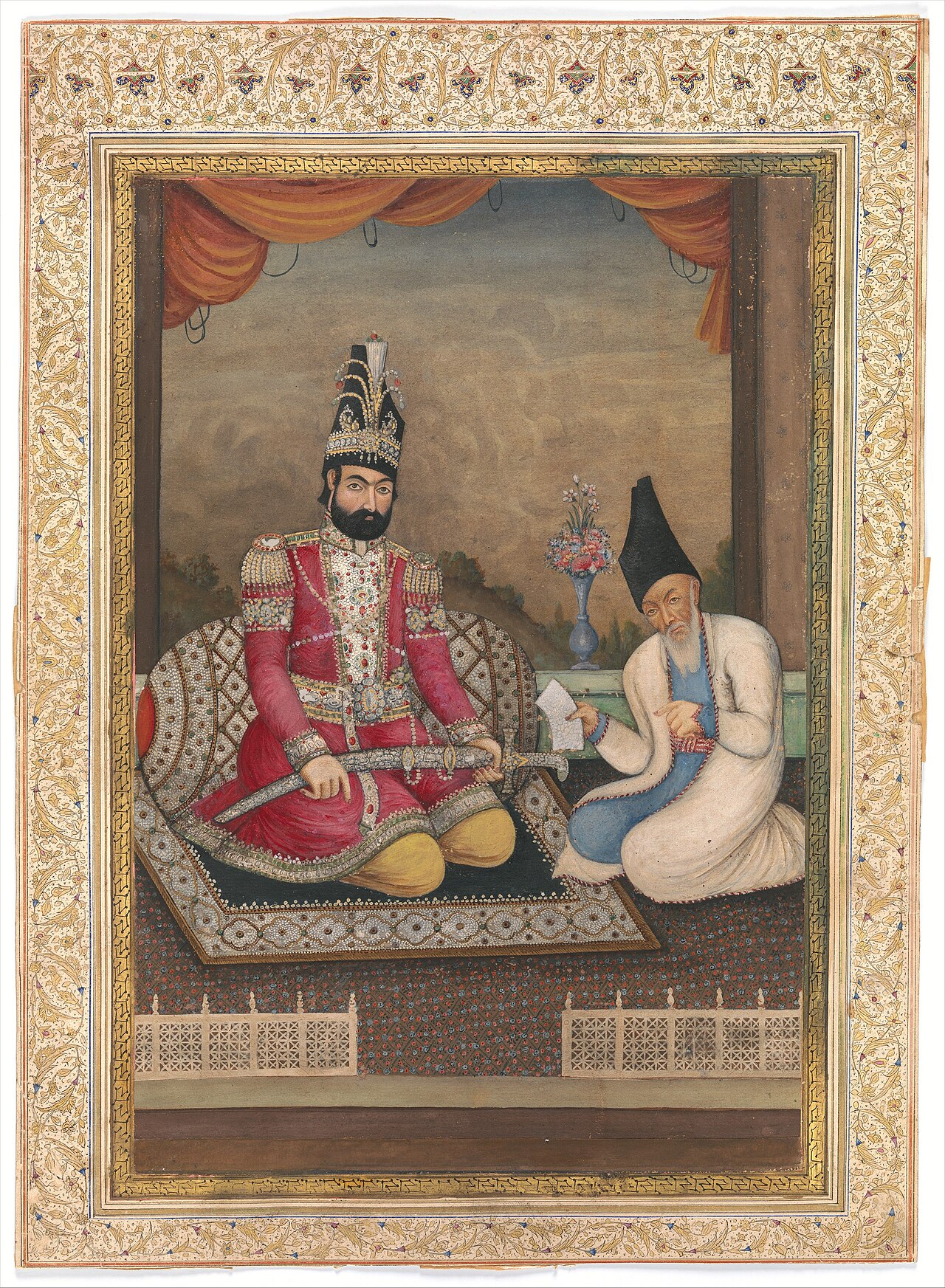

An heir backed by two empires
Mohammad Mirza became crown prince after his father Abbas Mirza died in 1833, and he succeeded Fath-Ali Shah in October 1834. Two of his uncles claimed the throne, but both Russia, bound by the Treaty of Turkmenchay to support Abbas Mirza’s line, and Britain backed him. British officers helped his troops reach Tehran, and the rivals were defeated within months.
His first chief minister was Mirza Abolqasem Qaem-Maqam, his father’s reforming minister and a celebrated prose writer. Within a year the shah, persuaded that the minister was too powerful, had him strangled in the Negarestan garden in Tehran in 1835. In his place he appointed Hajji Mirza Aqasi, his old tutor, a Sufi from Erivan who held power for the rest of the reign. Aqasi was devoted to the shah but had little experience of government, and most historians judge his long ministry harshly, though some credit him with keeping peace with both great powers.
Why Herat
Herat, today in western Afghanistan, had been part of the Iranian world for most of its history. Under the Safavids it was one of the great cities of Khorasan, and Nader Shah had held it. Since his death it had been ruled by Afghan princes of the Sadozai family, and in the 1830s its ruler, Kamran Shah, and his vizier Yar Mohammad Khan were accused by Tehran of raiding Iranian Khorasan and of selling captured Iranians as slaves. The Qajars saw recovering Herat as a matter of restoring their rightful frontier. Abbas Mirza had sent an army toward it in 1833, but his death had ended that campaign.
For Britain the city meant something quite different. Herat sat on the main route from Iran and Central Asia into Afghanistan and toward India. British officials feared that Iran, now under strong Russian influence, could become a channel for Russian power, and that if Herat fell to the shah a Russian presence might follow.
The siege, 1837–1838
Mohammad Shah marched east in 1837 and laid siege to Herat in November with a large army and artillery. The Russian minister in Tehran, Count Ivan Simonich, accompanied the camp and encouraged the attack, and a Russian agent, Ivan Vitkevich, was at the same time negotiating in Kabul. The British envoy, John McNeill, tried to mediate and then protested.
The defence held for months. A young British officer, Eldred Pottinger, who happened to be in Herat when the siege began, helped organise it and became famous in Britain as its hero, though historians now stress the role of Yar Mohammad Khan and the garrison. A general Persian assault in June 1838 broke into the defences but was driven back with heavy losses.
Kharg Island and the retreat
In June 1838 McNeill broke off relations and left the shah’s camp. That month a small British force from Bombay occupied Kharg Island in the Persian Gulf. In August a British officer, Colonel Charles Stoddart, delivered an ultimatum: Britain would treat the continued siege as a hostile act. Russia, unwilling to risk a confrontation, recalled Simonich and disowned his advice. In September 1838 Mohammad Shah lifted the siege and returned to Tehran.
The crisis did not end there. Convinced that Afghanistan had to be secured against Russia, the British government in India launched the First Anglo-Afghan War in 1839. Relations between Tehran and London were restored only in 1841, with a commercial treaty that gave British merchants the same privileges Russia had won in 1828. Herat itself remained an issue: Iran took it briefly in 1856, which led to the Anglo-Persian War of 1856–1857, and the long story of the city’s separation from Iran is told on the page How Iran Lost Herat.
The rest of the reign
The later years of Mohammad Shah’s reign were quieter abroad. A dispute with the Ottoman Empire over the border and the port of Mohammareh (Khorramshahr) was settled, with British and Russian mediation, by the Second Treaty of Erzurum in 1847. At home there was unrest. Aga Khan Mahallati, hereditary imam of the Nizari Ismailis, rebelled in Kerman around 1840–1841 and later left for India. From 1844 the new religious movement led by Sayyed Ali Mohammad of Shiraz, known as the Bab, spread through the country, and the government’s response is described on the page about the Bab and the Babi movement.
The shah himself was drawn to Sufism, as was his minister, and suffered badly from gout in his last years. He died in September 1848. His son Naser al-Din, then governor of Azerbaijan in Tabriz, came to Tehran and began the longest Qajar reign; see Naser al-Din Shah.
How historians judge the reign
Older accounts describe Mohammad Shah as a weak, pious ruler who left government to an eccentric minister. Recent historians, including Abbas Amanat, see a more consistent policy: an attempt to reassert Iranian claims in the east, frustrated by a British empire that would not allow any change on the approaches to India. Herat showed that Iran’s foreign policy was now limited from both sides, with Russia dominant in the north and Britain able to strike in the south.
Persian words from this page
| هرات | Herât | Herat |
| محاصره | mohâsere | siege |
| خارک | Khârk | Kharg Island |
| صدراعظم | sadr-e a’zam | chief minister |
| خراسان | Khorâsân | Khorasan |
| صوفی | sufi | Sufi, mystic |
Sources and further reading
- Gavin R. G. Hambly, “Iran during the reigns of Fath ‘Alī Shāh and Muhammad Shāh”, in The Cambridge History of Iran, vol. 7 (1991).
- Encyclopaedia Iranica, the entries on Herat and on Ḥājī Mīrzā Āqāsī.
- J. L. Lee, The “Ancient Supremacy”: Bukhara, Afghanistan and the Battle for Balkh, 1731–1901 (Brill, 1996).
- Abbas Amanat, Iran: A Modern History (Yale, 2017).
- John William Kaye, History of the War in Afghanistan, vol. 1 (1851).
Want to learn Persian? Get the free Starter Pack
Get the 14-page printable Starter Pack (all 32 letters, a 7-day reading plan, 100 core words and 20 survival phrases) and a short 5-email course. Free.
More in The Qajar Dynasty (1789–1925)
- Agha Mohammad Khan Qajar
- The Battle of Krtsanisi and Sack of Tiflis (1795)
- Fath-Ali Shah Qajar
- The Qajar Court and Harem
- The Russo-Persian War of 1804–1813
- The Battle of Aslanduz (1812)
- The Treaty of Golestan (1813)
- Abbas Mirza and the First Reforms
- The Russo-Persian War of 1826–1828
- The Treaty of Turkmenchay (1828)
- The Death of Griboyedov (1829)
- Mohammad Shah and the Siege of Herat
- The Bab and the Babi Movement
- Tahirih (Qurrat al-Ayn)
- Naser al-Din Shah Qajar
- Amir Kabir
- Dar al-Funun: Iran’s First Modern School
- The Anglo-Persian War (1856–1857)
- How Iran Lost Herat
- The Great Persian Famine of 1870–1872
- The Reuter Concession (1872)
- Naser al-Din Shah’s Journeys to Europe
- The Tobacco Protest (1891–1892)
- Mirza Malkam Khan and Early Reformers
- The Assassination of Naser al-Din Shah (1896)
- Photography in Qajar Iran
- Mozaffar ad-Din Shah
- Taj al-Saltaneh
- The D’Arcy Concession and the Discovery of Oil (1908)
- The Persian Constitutional Revolution (1905–1911)
- The First Majlis and the Constitution of 1906
- The Anglo-Russian Convention of 1907
- Mohammad Ali Shah and the Bombardment of the Majlis
- The Siege of Tabriz and Sattar Khan
- The Constitutionalists Take Tehran (1909)
- The Bakhtiari and the Revolution
- Morgan Shuster and the Russian Ultimatum (1911)
- Women in the Constitutional Revolution
- Iran in the First World War
- The Persian Famine of 1917–1919
- Mirza Kuchik Khan and the Jangali Movement
- The Anglo-Persian Agreement of 1919
- The 1921 Coup: Reza Khan and Seyyed Zia
- The End of the Qajar Dynasty (1925)
- Qajar Art, Photography and Society