The Treaty of Turkmenchay, signed on 22 February 1828 (10 February in the Russian calendar), ended the Russo-Persian War of 1826–1828. Iran gave up the khanates of Erivan and Nakhchivan, accepted the Aras river as its northern border, agreed to pay a war indemnity of 20 million silver roubles, and in a commercial treaty signed the same day granted Russian subjects legal immunity from Iranian courts, the model for the “capitulations” later claimed by other European powers.
| Signed | 22 February 1828 (10 February Old Style) |
|---|---|
| Place | Turkmenchay, a village between Tabriz and Mianeh in Azerbaijan |
| Signatories | Abbas Mirza and Allahyar Khan Asaf al-Dowleh for Iran; General Ivan Paskevich and Alexander Obreskov for Russia |
| Territory lost | Khanates of Erivan and Nakhchivan, the rest of Talesh, Ordubad and Mughan |
| Indemnity | 10 korur (crores) of tomans, set at 20 million silver roubles |
| Persian name | عهدنامه ترکمانچای |
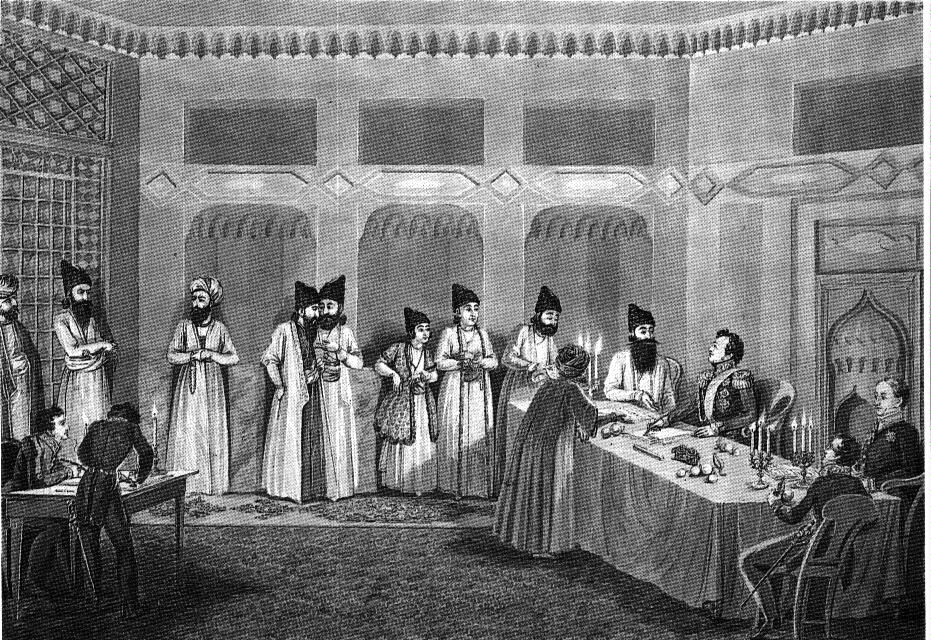

Signed under occupation
By the end of 1827 Russian troops held Erivan and had entered Tabriz, the seat of the crown prince, and Paskevich was ready to march on Tehran (see the Russo-Persian War of 1826–1828). Negotiations opened at Dehkhargan in November but stalled over money: Fath-Ali Shah, famous for guarding his treasury, resisted the size of the indemnity. After Russian forces moved again in January 1828, taking Ardabil and Urmia, the Iranian side accepted terms at Turkmenchay.
Among the Russian negotiators was the diplomat and playwright Alexander Griboyedov, who helped draft the text and carried it to St Petersburg. His return to Iran as ambassador a year later ended in his death, told on the page about the death of Griboyedov.
The main terms
A new border on the Aras
Iran ceded the khanates of Erivan and Nakhchivan, which it had kept in 1813, together with the rest of the Talesh khanate and the districts of Ordubad and Mughan. For most of its length the new frontier followed the Aras river. With adjustments, it is still the border between Iran and the republics of Armenia and Azerbaijan today.
The indemnity
Iran was to pay 10 korur of tomans, fixed at 20 million silver roubles, a sum that strained a treasury raised mainly from land tax. Russian troops stayed in parts of Azerbaijan as security until instalments arrived. To help pay, the British government agreed in 1828 to cancel the subsidy articles of its 1814 treaty with Iran in return for a lump sum, a deal that ended the promise of British money in a future war.
The Caspian and the succession
Russia’s sole right to keep warships on the Caspian, first granted at Golestan, was confirmed. Russia also recognised Abbas Mirza as heir and promised to support him, which gave the tsar a lasting interest in the Qajar succession.
Movement of people
Article 15 offered an amnesty and allowed inhabitants of the ceded and occupied provinces to move to the other side of the border within a set period. In practice it was used mainly by Armenians from Iranian Azerbaijan, encouraged by Russian officials, to resettle in the former khanate of Erivan. Estimates of the number who left Iran in 1828–1830 are around 30,000 to 45,000. The migration changed the population of the Erivan region, where Muslims had been the majority, and is part of the background to modern Armenia.
The commercial treaty and the capitulations
A separate trade agreement signed the same day was, in the long run, as important as the border. It fixed the customs duty on Russian goods at 5 percent of their value, with no further internal tolls. It also gave Russian subjects in Iran what Europeans called capitulatory rights: disputes between Russians were to be judged by Russian consuls, and cases between Russians and Iranians were to be heard only with a Russian consular official present. Russian consuls could be posted in Iranian towns, and Russian merchants could buy property for homes and warehouses.
Through most-favoured-nation clauses, Britain obtained similar terms in its commercial treaty of 1841, and other states followed. Foreign merchants thus paid lower duties than Iranian traders and stood outside the shah’s courts. Iranian merchants complained about the unequal competition for the rest of the century, and their grievances fed later protests such as the Tobacco Protest of 1891–1892. The capitulations were abolished only in 1928, under Reza Shah.
A word for humiliation
Turkmenchay has a heavier place in Iranian memory than any other Qajar treaty. Together with Golestan it marks the loss of the Caucasus, but it also stands for the moment when foreign powers gained legal privileges inside Iran itself. In Persian political speech the name is still used as shorthand for a one-sided agreement imposed from outside; critics of many later treaties and contracts have called them “a new Turkmenchay”.
Historians stress how far the treaty went beyond territory. Firuz Kazemzadeh and Abbas Amanat both describe it as the start of Iran’s semi-colonial position in the nineteenth century, with Russia dominant in the north and Britain soon seeking the same privileges in the south. The treaty’s effects run through the rest of the Qajar story, from the career of Mohammad Shah, whose accession Russia backed under its terms, to the concessions of Naser al-Din Shah.
Persian words from this page
| ترکمانچای | Torkamânchây | Turkmenchay |
| غرامت | gherâmat | indemnity |
| کاپیتولاسیون | kâpitulâsiyon | capitulation (legal immunity) |
| کنسول | konsul | consul |
| گمرک | gomrok | customs |
| نخجوان | Nakhjavân | Nakhchivan |
Sources and further reading
- Encyclopaedia Iranica, “Russia i. Russo-Iranian relations up to the Bolshevik Revolution”.
- Firuz Kazemzadeh, “Iranian relations with Russia and the Soviet Union, to 1921”, in The Cambridge History of Iran, vol. 7 (1991).
- J. C. Hurewitz (ed.), The Middle East and North Africa in World Politics: A Documentary Record, vol. 1 (Yale, 1975), for English texts of the treaty and commercial agreement.
- Muriel Atkin, Russia and Iran, 1780–1828 (University of Minnesota Press, 1980).
- Abbas Amanat, Iran: A Modern History (Yale, 2017).
Want to learn Persian? Get the free Starter Pack
Get the 14-page printable Starter Pack (all 32 letters, a 7-day reading plan, 100 core words and 20 survival phrases) and a short 5-email course. Free.
More in The Qajar Dynasty (1789–1925)
- Agha Mohammad Khan Qajar
- The Battle of Krtsanisi and Sack of Tiflis (1795)
- Fath-Ali Shah Qajar
- The Qajar Court and Harem
- The Russo-Persian War of 1804–1813
- The Battle of Aslanduz (1812)
- The Treaty of Golestan (1813)
- Abbas Mirza and the First Reforms
- The Russo-Persian War of 1826–1828
- The Treaty of Turkmenchay (1828)
- The Death of Griboyedov (1829)
- Mohammad Shah and the Siege of Herat
- The Bab and the Babi Movement
- Tahirih (Qurrat al-Ayn)
- Naser al-Din Shah Qajar
- Amir Kabir
- Dar al-Funun: Iran’s First Modern School
- The Anglo-Persian War (1856–1857)
- How Iran Lost Herat
- The Great Persian Famine of 1870–1872
- The Reuter Concession (1872)
- Naser al-Din Shah’s Journeys to Europe
- The Tobacco Protest (1891–1892)
- Mirza Malkam Khan and Early Reformers
- The Assassination of Naser al-Din Shah (1896)
- Photography in Qajar Iran
- Mozaffar ad-Din Shah
- Taj al-Saltaneh
- The D’Arcy Concession and the Discovery of Oil (1908)
- The Persian Constitutional Revolution (1905–1911)
- The First Majlis and the Constitution of 1906
- The Anglo-Russian Convention of 1907
- Mohammad Ali Shah and the Bombardment of the Majlis
- The Siege of Tabriz and Sattar Khan
- The Constitutionalists Take Tehran (1909)
- The Bakhtiari and the Revolution
- Morgan Shuster and the Russian Ultimatum (1911)
- Women in the Constitutional Revolution
- Iran in the First World War
- The Persian Famine of 1917–1919
- Mirza Kuchik Khan and the Jangali Movement
- The Anglo-Persian Agreement of 1919
- The 1921 Coup: Reza Khan and Seyyed Zia
- The End of the Qajar Dynasty (1925)
- Qajar Art, Photography and Society