The Anglo-Russian Convention, signed in St Petersburg on 31 August 1907, was a treaty in which Britain and Russia settled their rivalry in Persia, Afghanistan and Tibet. In Persia it drew lines that gave Russia a zone of influence across the north, Britain a zone in the south-east and left a neutral zone between them. No Iranian was consulted, and it arrived just as the new constitutional government was trying to assert its independence.
| Signed | 31 August 1907, St Petersburg |
|---|---|
| Signatories | Sir Arthur Nicolson (British ambassador) and Alexander Izvolsky (Russian foreign minister) |
| Covered | Persia, Afghanistan, Tibet |
| Russian zone | North of a line from Qasr-e Shirin through Isfahan and Yazd to the Afghan frontier |
| British zone | South-east of a line from the Afghan frontier through Birjand and Kerman to Bandar Abbas |
| Shah at the time | Mohammad Ali Shah |
| Persian name | قرارداد ۱۹۰۷ (Qarârdâd-e 1907) |
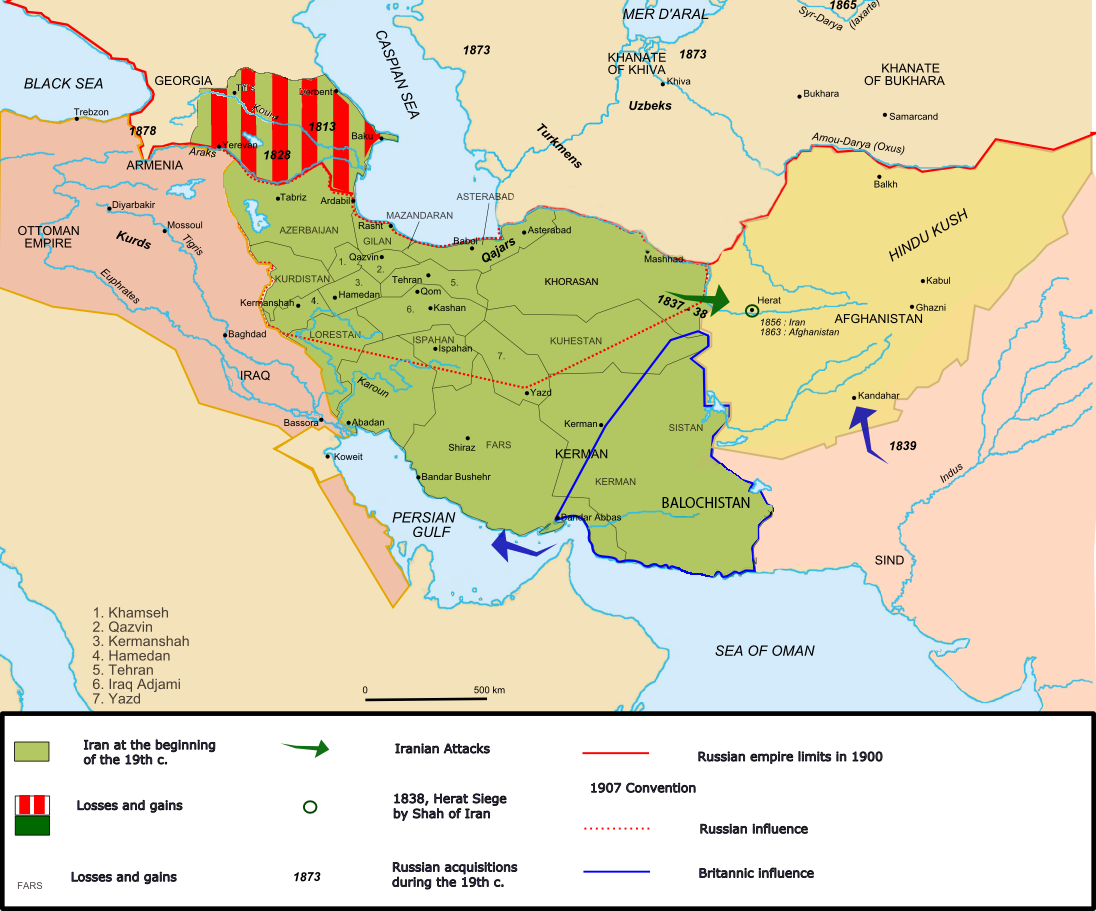

The Great Game reaches a settlement
For most of the nineteenth century Britain and Russia had competed for influence across Central Asia, a contest the British called the Great Game. In Iran the competition took the form of loans, concessions, rival banks and pressure on the shah’s ministers. Russia had taken the Caucasus from Iran in the wars that ended with the Treaty of Golestan and the Treaty of Turkmenchay, and by 1900 Russian goods, Russian officers in the Cossack Brigade and Russian banks dominated the north. Britain cared most about the approaches to India: Sistan, Baluchistan and the Persian Gulf.
Two changes pushed the rivals together. Russia’s defeat by Japan in 1904–1905 and the revolution of 1905 at home left it weak and in need of friends. Britain, worried by the growth of the German navy and German ambitions in the Ottoman Empire and beyond, wanted Russia as a partner in Europe. France, allied to Russia since 1894 and to Britain through the Entente Cordiale of 1904, encouraged the deal. The British foreign secretary, Sir Edward Grey, saw settling the Asian quarrels as the price of that partnership.
What the convention said about Persia
The Persian section began by promising to respect the “integrity and independence” of Persia. It then divided the country into three parts:
- The Russian zone, the largest and richest, ran north of a line from Qasr-e Shirin on the Ottoman border through Isfahan, Yazd and Kakh to the point where the Russian and Afghan frontiers met. It contained Tehran, Tabriz, Mashhad, Rasht and Isfahan itself.
- The British zone lay south-east of a line from the Afghan frontier through Gazik, Birjand and Kerman to Bandar Abbas. It was small and mostly desert, but it covered the land routes towards India.
- The neutral zone in between included the south-west, Fars and the Persian Gulf coast west of Bandar Abbas.
Each power agreed not to seek political or commercial concessions, such as railways, banks, telegraphs or roads, in the other’s zone. Revenues from Persian customs that guaranteed loans owed to each country were assigned to it from its own zone. The Persian Gulf itself was left out of the text, but Grey published a letter stating that Britain’s special interests there were recognised.
The neutral zone mattered more than anyone admitted at the time. William Knox D’Arcy’s oil concession covered most of the country outside the five northern provinces, and in May 1908 his engineers struck oil at Masjed Soleyman in the neutral zone, as told on the page on the D’Arcy concession and the discovery of oil.
How Iranians received it
The convention was signed only four weeks after the assassination of the chief minister Amin al-Soltan outside the Majlis, and less than a year after the first constitution. Many constitutionalists had looked to Britain as a friend: in the summer of 1906 thousands of protesters had taken sanctuary (bast) in the grounds of the British legation. The news that London had now agreed spheres of influence with Russia was read as betrayal.
The Iranian government was informed after the event and never accepted the agreement. Newspapers in Tehran and Tabriz attacked it, and deputies in the First Majlis protested. The British reply was that the convention restrained Russia, since it bound St Petersburg to respect Iranian independence and kept Russian expansion out of the south and east. Critics in Britain, including the Persian scholar Edward Browne, argued the opposite: that it gave Russia a free hand in the north, where most Iranians lived.
The convention in practice, 1908–1915
Events soon tested the British claim. When Mohammad Ali Shah turned on the Majlis in June 1908, the force that shelled the parliament was the Russian-officered Cossack Brigade, and Britain did not intervene beyond diplomatic protests (see Mohammad Ali Shah and the bombardment of the Majlis). In April 1909 Russian troops entered Tabriz, officially to protect foreigners during the siege of the city, and stayed. In 1911 Russia used its position in the north to force out the American treasurer Morgan Shuster, partly because he had appointed a British officer to command a tax gendarmerie that would operate in the Russian zone. Britain accepted the Russian demands.
By 1912 Russian troops were stationed across much of the north. In March 1915, as part of wartime bargaining over Constantinople and the Straits, Britain and Russia agreed in secret that the neutral zone would pass into the British sphere, while Russia gained a freer hand in its own. The Bolshevik government published the tsarist secret treaties after the revolution of 1917 and renounced Russia’s claims in Iran, which it later confirmed in the Soviet-Iranian Treaty of February 1921.
- 1904–1905 Russia defeated by Japan; revolution in Russia
- Aug 1906 Mozaffar ad-Din Shah accepts a constitutional assembly
- 31 Aug 1907 Convention signed in St Petersburg
- May 1908 Oil struck at Masjed Soleyman, in the neutral zone
- Apr 1909 Russian troops enter Tabriz
- Dec 1911 Russian ultimatum ends the second Majlis
- Mar 1915 Secret agreement assigns the neutral zone to Britain
- 1917–1918 Bolsheviks repudiate tsarist claims
Historians’ judgements
Diplomatic historians who write mainly about Europe treat the convention as a step in the formation of the Triple Entente of Britain, France and Russia that fought Germany in 1914. Historians of Iran see it differently. Ervand Abrahamian and Abbas Amanat both present it as the moment the two powers stopped competing for Iran and started managing it together, which left the constitutional movement without an outside counterweight. Firuz Kazemzadeh’s study of Russia and Britain in Persia shows from the archives how far Russian officials in the north acted beyond what the text allowed, and how reluctant Grey was to risk the European partnership by objecting.
The memory of 1907 lasted. The Anglo-Persian Agreement of 1919 was opposed partly because it looked like a British attempt to take over the whole country once Russia had collapsed, and Iranian nationalists of later generations cited the convention as proof that foreign powers would divide the country if they could. The longer story is traced on the pages on Iran and Russia and Iran and Britain.
Persian words from this page
| قرارداد | qarârdâd | agreement, treaty |
| روس | Rus | Russia, Russian |
| انگلیس | Engelis | England, Britain |
| مجلس | majles | parliament, assembly |
| بست | bast | sanctuary, sit-in |
| اصفهان | Esfahân | Isfahan |
Sources and further reading
- Text of the Convention between the United Kingdom and Russia relating to Persia, Afghanistan and Thibet, signed at St Petersburg, 31 August 1907.
- Firuz Kazemzadeh, Russia and Britain in Persia, 1864–1914: A Study in Imperialism (Yale University Press, 1968).
- Encyclopaedia Iranica, “Anglo-Russian Convention of 1907”: iranicaonline.org
- Edward G. Browne, The Persian Revolution of 1905–1909 (Cambridge University Press, 1910).
- Ervand Abrahamian, A History of Modern Iran (Cambridge University Press, 2008).
- Abbas Amanat, Iran: A Modern History (Yale University Press, 2017).
Want to learn Persian? Get the free Starter Pack
Get the 14-page printable Starter Pack (all 32 letters, a 7-day reading plan, 100 core words and 20 survival phrases) and a short 5-email course. Free.
More in The Qajar Dynasty (1789–1925)
- Agha Mohammad Khan Qajar
- The Battle of Krtsanisi and Sack of Tiflis (1795)
- Fath-Ali Shah Qajar
- The Qajar Court and Harem
- The Russo-Persian War of 1804–1813
- The Battle of Aslanduz (1812)
- The Treaty of Golestan (1813)
- Abbas Mirza and the First Reforms
- The Russo-Persian War of 1826–1828
- The Treaty of Turkmenchay (1828)
- The Death of Griboyedov (1829)
- Mohammad Shah and the Siege of Herat
- The Bab and the Babi Movement
- Tahirih (Qurrat al-Ayn)
- Naser al-Din Shah Qajar
- Amir Kabir
- Dar al-Funun: Iran’s First Modern School
- The Anglo-Persian War (1856–1857)
- How Iran Lost Herat
- The Great Persian Famine of 1870–1872
- The Reuter Concession (1872)
- Naser al-Din Shah’s Journeys to Europe
- The Tobacco Protest (1891–1892)
- Mirza Malkam Khan and Early Reformers
- The Assassination of Naser al-Din Shah (1896)
- Photography in Qajar Iran
- Mozaffar ad-Din Shah
- Taj al-Saltaneh
- The D’Arcy Concession and the Discovery of Oil (1908)
- The Persian Constitutional Revolution (1905–1911)
- The First Majlis and the Constitution of 1906
- The Anglo-Russian Convention of 1907
- Mohammad Ali Shah and the Bombardment of the Majlis
- The Siege of Tabriz and Sattar Khan
- The Constitutionalists Take Tehran (1909)
- The Bakhtiari and the Revolution
- Morgan Shuster and the Russian Ultimatum (1911)
- Women in the Constitutional Revolution
- Iran in the First World War
- The Persian Famine of 1917–1919
- Mirza Kuchik Khan and the Jangali Movement
- The Anglo-Persian Agreement of 1919
- The 1921 Coup: Reza Khan and Seyyed Zia
- The End of the Qajar Dynasty (1925)
- Qajar Art, Photography and Society