Qajar art is the art of Iran under the Qajar dynasty (1789–1925): large oil portraits of shahs and courtly women, painted lacquer, enamel and tiles, illustrated lithographed books, and from the 1840s photography. Long dismissed as a decline from the Safavid golden age, it is now valued as Iran’s first encounter with European techniques on its own terms, and as a record of a society changing between the court of Fath-Ali Shah and the Constitutional Revolution.

Painting the king: the age of Fath-Ali Shah
The second Qajar shah, Fath-Ali Shah (reigned 1797–1834), used painting as propaganda. Court artists such as Mihr Ali painted him life-size in oil on canvas, enthroned or standing, with a long black beard, a narrow waist, a jewelled crown and armbands. These portraits hung in palaces and were sent as diplomatic gifts to the courts of Europe, Russia and India. Huge wall paintings showed him surrounded by his sons and courtiers, and he revived the custom of carving royal images on rock, at Cheshmeh Ali near Rey, south of Tehran, in imitation of the Sasanian reliefs (see Fath-Ali Shah Qajar).
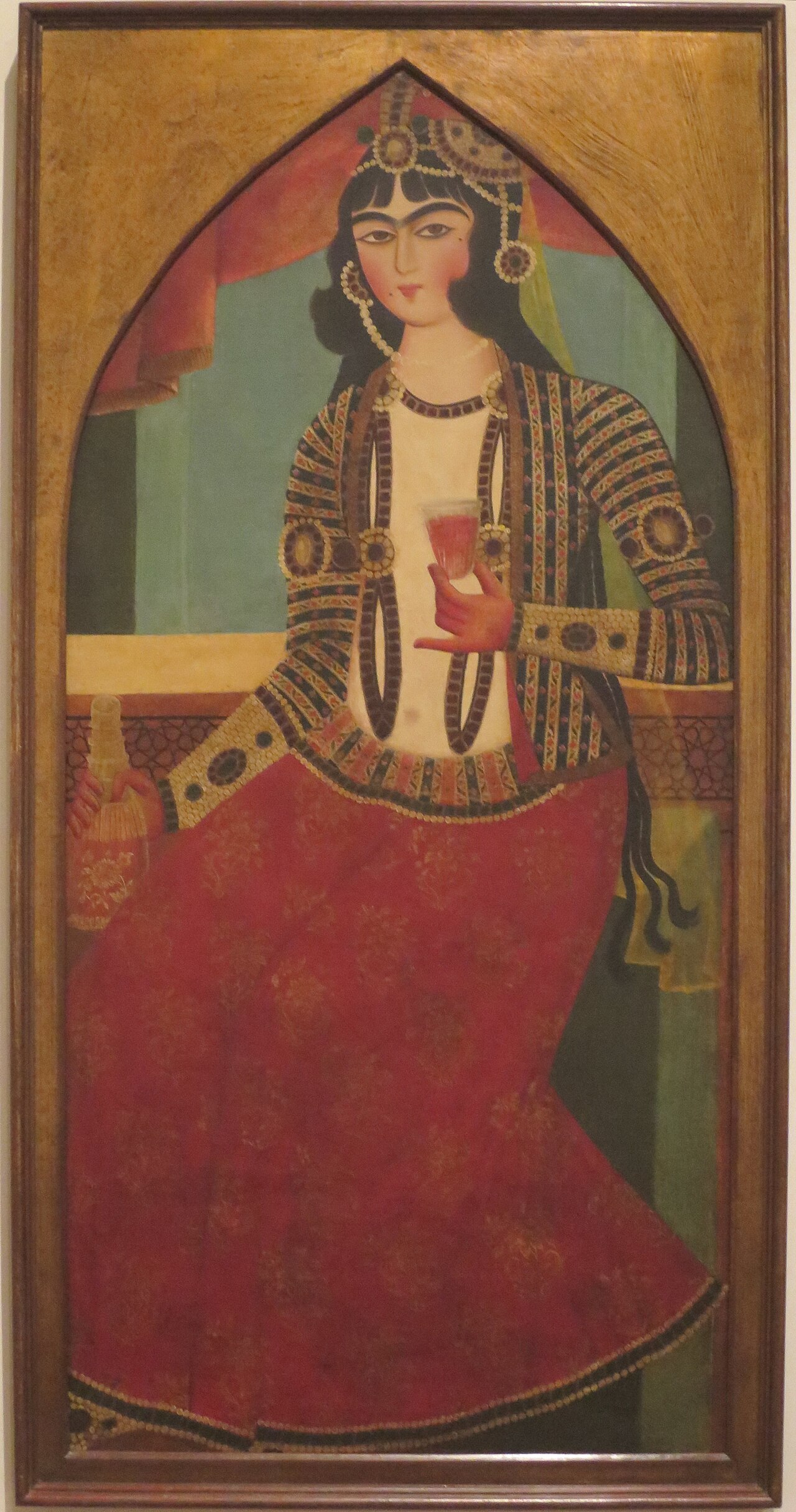
The same workshops painted life-size images of dancers, musicians and women holding wine or fruit for the walls of palaces and mansions, like the one shown above. The faces follow a fixed ideal, with joined eyebrows, large almond eyes and small mouths. The colours are strong, red and gold dominate, and the figures stand in shallow space against curtains and windows.
Lacquer, enamel and tiles
Much of the finest Qajar painting is small. Painted and varnished papier-mâché, called lacquer work (لاکی, lâki), was used for pen boxes, mirror cases, book covers and caskets, decorated with flowers, birds, portraits and scenes from poetry. Families of painters such as that of Najaf Ali of Isfahan worked in this medium for several generations. Enamel painters decorated gold and silver objects, water pipes and royal gifts.
Tilework changed too. Qajar builders used tiles painted in pink, yellow and blue with roses, figures from the Shahnameh, European-style buildings, soldiers and portraits of shahs. The gateways of Tehran, the Golestan Palace (see Golestan Palace), and the Takyeh Mo’aven al-Molk in Kermanshah, with its tiles of religious and royal scenes, show the range.
New techniques: Sani al-Molk and Kamal-ol-Molk
From the middle of the century the court looked more directly to Europe. Abolhasan Ghaffari, known as Sani al-Molk, studied in Italy and returned to direct the illustration of a vast Persian translation of the Thousand and One Nights for Naser al-Din Shah in the 1850s, with hundreds of paintings made by his workshop, now in the Golestan Palace library. He also drew portraits for the government newspaper and taught at a painting school in Tehran.
His nephew Mohammad Ghaffari, Kamal-ol-Molk (c. 1848–1940), trained at the Dar al-Funun, became court painter to Naser al-Din Shah and later studied in Europe. His realist oils, such as his view of the Hall of Mirrors in the Golestan Palace, introduced European perspective and light. His school of fine arts, founded in 1911, shaped Iranian painting for a generation.
Lithographs, coffee houses and the street
Printing by lithography arrived in Tabriz and Tehran in the 1830s and 1840s and made illustrated books cheap for the first time. Editions of the Shahnameh, of Nezami and of popular religious works carried lively black-and-white drawings by artists such as Mirza Ali-Qoli Khoi. At the end of the Qajar period, painters such as Hossein Qollar-Aghasi developed coffee-house painting (نقاشی قهوهخانهای): large canvases of the battles of Karbala and heroes of the Shahnameh, painted for coffee houses where storytellers recited.
Religious theatre flourished in the same years. The ta’zieh, plays about the martyrdom of Imam Hossein, were staged in Muharram, and Naser al-Din Shah built a great round theatre, the Takyeh Dowlat, in Tehran around 1868 for royal performances.
The camera
A daguerreotype camera reached the court in 1842, and Naser al-Din Shah became an enthusiastic photographer himself, photographing his wives, courtiers and travels. Studio photographers, among them the Armenian-Georgian Antoin Sevruguin in Tehran, recorded people of every class, monuments and street life. Photography shaped how painters worked and how Iranians saw themselves, a story told in detail on the page on photography in Qajar Iran.
What the art shows about society
Qajar images are a rich source for social history, but they show mainly the court and the wealthy. Most Iranians in the nineteenth century were peasants and tribespeople, and the population of Tehran, made capital by Agha Mohammad Khan, grew from a small town to a city of perhaps 250,000 by the end of the century.
Women’s lives
Elite houses were divided into the andaruni, the inner quarters of the women, and the biruni, the outer quarters where men received guests. In public, urban women wore the chador and a face veil. The royal harem was a world of its own, with its own politics (see the Qajar court and harem).
Women’s own voices become audible at the end of the century. Bibi Khanom Astarabadi wrote Ma’ayeb al-Rejal (The Vices of Men) in the 1890s, a sharp reply to a pamphlet advising wives on obedience, and later opened one of the first schools for girls in Tehran. Princess Taj al-Saltaneh, a daughter of Naser al-Din Shah, wrote a frank memoir about the harem and her own unhappy marriage. During the Constitutional Revolution women formed societies and founded schools (see women in the Constitutional Revolution).
Changing ideas of beauty
The historian Afsaneh Najmabadi, in Women with Mustaches and Men without Beards (2005), shows that early Qajar painting represented beautiful young men and beautiful women in very similar ways, and that women with a faint moustache were thought attractive. In the later nineteenth century, as Iranians met European ideas of gender and morality, these images changed: male and female beauty were drawn apart, and some older images came to be seen as shameful. Her argument is debated, but it has changed how historians read Qajar portraits.
A reputation restored
For much of the twentieth century collectors and scholars treated Qajar art as hybrid and decadent. Exhibitions such as Royal Persian Paintings: The Qajar Epoch at the Brooklyn Museum in 1998–1999, edited by Layla Diba, helped change that view. Today Qajar paintings and objects are sought after, and the period is seen as the bridge between Persian painting traditions and modern Iranian art (see a history of Persian painting).
Persian words from this page
| نقاشی | naqqâshi | painting |
| کاشی | kâshi | tile |
| قلمدان | qalamdân | pen box |
| قهوهخانه | qahveh-khâneh | coffee house |
| اندرونی | andaruni | inner (women’s) quarters |
| تعزیه | ta’zieh | passion play |
| کمالالملک | Kamâl-ol-Molk | Kamal-ol-Molk |
Sources and further reading
- Layla S. Diba and Maryam Ekhtiar (eds.), Royal Persian Paintings: The Qajar Epoch, 1785–1925 (Brooklyn Museum, 1998).
- Afsaneh Najmabadi, Women with Mustaches and Men without Beards: Gender and Sexual Anxieties of Iranian Modernity (University of California Press, 2005).
- Encyclopaedia Iranica, “Kamal-al-Molk, Mohammad Ghaffari”.
- B. W. Robinson, “Persian Painting in the Qajar Period”, in Highlights of Persian Art, ed. R. Ettinghausen and E. Yarshater (1979).
- Abbas Amanat, Pivot of the Universe: Nasir al-Din Shah Qajar and the Iranian Monarchy, 1831–1896 (University of California Press, 1997).
Want to learn Persian? Get the free Starter Pack
Get the 14-page printable Starter Pack (all 32 letters, a 7-day reading plan, 100 core words and 20 survival phrases) and a short 5-email course. Free.
More in The Qajar Dynasty (1789–1925)
- Agha Mohammad Khan Qajar
- The Battle of Krtsanisi and Sack of Tiflis (1795)
- Fath-Ali Shah Qajar
- The Qajar Court and Harem
- The Russo-Persian War of 1804–1813
- The Battle of Aslanduz (1812)
- The Treaty of Golestan (1813)
- Abbas Mirza and the First Reforms
- The Russo-Persian War of 1826–1828
- The Treaty of Turkmenchay (1828)
- The Death of Griboyedov (1829)
- Mohammad Shah and the Siege of Herat
- The Bab and the Babi Movement
- Tahirih (Qurrat al-Ayn)
- Naser al-Din Shah Qajar
- Amir Kabir
- Dar al-Funun: Iran’s First Modern School
- The Anglo-Persian War (1856–1857)
- How Iran Lost Herat
- The Great Persian Famine of 1870–1872
- The Reuter Concession (1872)
- Naser al-Din Shah’s Journeys to Europe
- The Tobacco Protest (1891–1892)
- Mirza Malkam Khan and Early Reformers
- The Assassination of Naser al-Din Shah (1896)
- Photography in Qajar Iran
- Mozaffar ad-Din Shah
- Taj al-Saltaneh
- The D’Arcy Concession and the Discovery of Oil (1908)
- The Persian Constitutional Revolution (1905–1911)
- The First Majlis and the Constitution of 1906
- The Anglo-Russian Convention of 1907
- Mohammad Ali Shah and the Bombardment of the Majlis
- The Siege of Tabriz and Sattar Khan
- The Constitutionalists Take Tehran (1909)
- The Bakhtiari and the Revolution
- Morgan Shuster and the Russian Ultimatum (1911)
- Women in the Constitutional Revolution
- Iran in the First World War
- The Persian Famine of 1917–1919
- Mirza Kuchik Khan and the Jangali Movement
- The Anglo-Persian Agreement of 1919
- The 1921 Coup: Reza Khan and Seyyed Zia
- The End of the Qajar Dynasty (1925)
- Qajar Art, Photography and Society