The Treaty of Golestan was the peace that ended the Russo-Persian War of 1804–1813. Signed on 24 October 1813 (12 October in the Russian calendar) in the village of Golestan in Karabakh, it made Iran recognise Russian rule over Georgia, Dagestan and most of the khanates of the eastern Caucasus, and gave Russia the sole right to keep warships on the Caspian Sea.
| Signed | 24 October 1813 (12 October Old Style) |
|---|---|
| Place | Golestan village, Karabakh khanate (today in Azerbaijan) |
| Signatories | Mirza Abolhasan Khan Ilchi for Iran; General Nikolai Rtishchev for Russia |
| Mediator | Sir Gore Ouseley, British ambassador to Iran |
| Main losses for Iran | Georgia, Dagestan, and the khanates of Ganja, Karabakh, Sheki, Shirvan, Quba, Derbent, Baku and northern Talesh |
| Persian name | عهدنامه گلستان (Ahdnâme-ye Golestân) |
A peace made after defeat
By the autumn of 1813 Iran had little choice. The crown prince Abbas Mirza had lost his army’s artillery and much of its infantry in the night attack at Aslanduz in October 1812, and the Caspian fort of Lankaran had fallen in January 1813. Russia, freed of its Ottoman war and victorious over Napoleon, could now send reinforcements south.
The British position was decisive. Britain had been Iran’s ally and paymaster since 1809, but from 1812 it was also Russia’s ally in Europe. The British ambassador, Sir Gore Ouseley, wanted the Persian war ended so that Russia could concentrate on Napoleon. He acted as go-between, helped draft the text, and encouraged the shah’s government to sign, hinting that the tsar might return some territory later as a gesture of goodwill. That hope was never met.
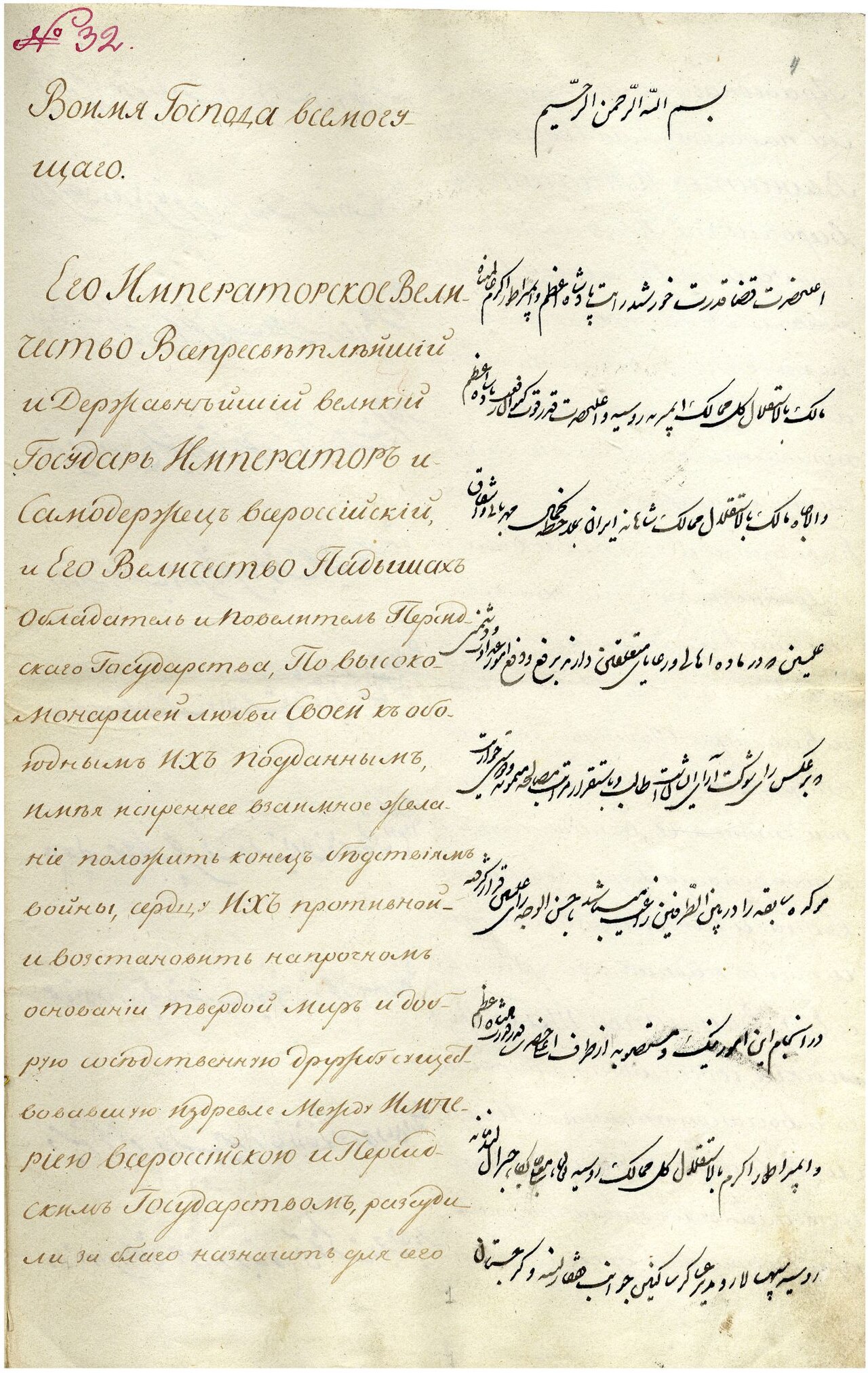

What the treaty said
Territory
Iran recognised as Russian the whole of Georgia, including the western Georgian lands of Imereti, Guria, Mingrelia and Abkhazia, and the region of Dagestan. It also gave up the khanates of Ganja, Karabakh, Sheki, Shirvan, Quba, Derbent and Baku, and the northern part of Talesh with the fort of Lankaran. Most of what is today the Republic of Azerbaijan, together with eastern Georgia and Dagestan, passed out of the shah’s sphere.
Iran kept the khanates of Erivan and Nakhchivan, south of the new line, which Russia had twice failed to take by force.
The Caspian
Only Russia was to keep warships on the Caspian Sea. Persian merchant ships could still sail it, but Iran gave up any right to a navy on its own northern coast, a clause that would be repeated in 1828 and remain in force for about a century.
Trade and diplomacy
Merchants of both countries were allowed to trade freely in the other, paying a customs duty of 5 percent on the value of their goods. The two states agreed to exchange envoys.
The succession
Russia promised to recognise and support the heir chosen by the shah. This mattered because Fath-Ali Shah had many sons, and the choice of Abbas Mirza was not secure. It also gave Russia a recognised interest in Iran’s internal politics.
A border drawn too loosely
The treaty fixed the frontier according to who held what at the time of signing, a principle known as status quo ad praesentem, and it left the details to be settled by commissioners. In the mountains between Karabakh and Erivan, and around Lake Gokcha (Sevan), it was not clear where that line ran. Historians such as Muriel Atkin and Firuz Kazemzadeh describe the vague wording as one of the main causes of the next war.
Iranian leaders did not regard the settlement as final. In 1814–1815 Mirza Abolhasan Khan, the same envoy who had signed it, travelled to St Petersburg to ask for the return of some of the lost lands. He came back with nothing. The disputes over the frontier, together with Russian treatment of Muslims in the ceded khanates, led to the outbreak of the Russo-Persian War of 1826–1828.
Why Golestan still matters in Iran
In Iranian memory Golestan and the later Treaty of Turkmenchay are paired as the two treaties that cut away the Caucasus. School textbooks present them as national humiliations, and they are often cited when Iranians discuss the dangers of foreign pressure. For Russia, the treaty confirmed its arrival as the dominant power south of the Caucasus mountains.
The treaty also had a long afterlife in the region itself. The khanates that Russia acquired in 1813 and 1828 became the basis of the Russian provinces of the South Caucasus, and later of the Soviet republics of Azerbaijan and Armenia. Historians in Azerbaijan today often describe the 1813 and 1828 treaties as the moment the Azerbaijani-speaking population was divided between the Russian north and the Iranian south, a view that shapes how the two countries discuss their shared past.
The name itself carries an irony that Persian speakers notice at once. Golestan means “rose garden”, the title of Saadi’s famous book of prose and verse; here it names a small village where Iran signed away a large part of its northern lands. Readers interested in the court that accepted the treaty can turn to the page on Fath-Ali Shah, and those following the military story to the Russo-Persian War of 1804–1813.
Persian words from this page
| عهدنامه | ahdnâme | treaty |
| گلستان | Golestân | rose garden; the village and the treaty |
| دریای خزر | Daryâ-ye Khazar | the Caspian Sea |
| مرز | marz | border |
| قرهباغ | Qarebâgh | Karabakh |
| ایلچی | ilchi | envoy |
Sources and further reading
- Encyclopaedia Iranica, “Golestān Treaty”.
- Muriel Atkin, Russia and Iran, 1780–1828 (University of Minnesota Press, 1980).
- Firuz Kazemzadeh, “Iranian relations with Russia and the Soviet Union, to 1921”, in The Cambridge History of Iran, vol. 7 (1991).
- J. C. Hurewitz (ed.), The Middle East and North Africa in World Politics: A Documentary Record, vol. 1 (Yale, 1975), for an English text.
- Abbas Amanat, Iran: A Modern History (Yale, 2017).
Want to learn Persian? Get the free Starter Pack
Get the 14-page printable Starter Pack (all 32 letters, a 7-day reading plan, 100 core words and 20 survival phrases) and a short 5-email course. Free.
More in The Qajar Dynasty (1789–1925)
- Agha Mohammad Khan Qajar
- The Battle of Krtsanisi and Sack of Tiflis (1795)
- Fath-Ali Shah Qajar
- The Qajar Court and Harem
- The Russo-Persian War of 1804–1813
- The Battle of Aslanduz (1812)
- The Treaty of Golestan (1813)
- Abbas Mirza and the First Reforms
- The Russo-Persian War of 1826–1828
- The Treaty of Turkmenchay (1828)
- The Death of Griboyedov (1829)
- Mohammad Shah and the Siege of Herat
- The Bab and the Babi Movement
- Tahirih (Qurrat al-Ayn)
- Naser al-Din Shah Qajar
- Amir Kabir
- Dar al-Funun: Iran’s First Modern School
- The Anglo-Persian War (1856–1857)
- How Iran Lost Herat
- The Great Persian Famine of 1870–1872
- The Reuter Concession (1872)
- Naser al-Din Shah’s Journeys to Europe
- The Tobacco Protest (1891–1892)
- Mirza Malkam Khan and Early Reformers
- The Assassination of Naser al-Din Shah (1896)
- Photography in Qajar Iran
- Mozaffar ad-Din Shah
- Taj al-Saltaneh
- The D’Arcy Concession and the Discovery of Oil (1908)
- The Persian Constitutional Revolution (1905–1911)
- The First Majlis and the Constitution of 1906
- The Anglo-Russian Convention of 1907
- Mohammad Ali Shah and the Bombardment of the Majlis
- The Siege of Tabriz and Sattar Khan
- The Constitutionalists Take Tehran (1909)
- The Bakhtiari and the Revolution
- Morgan Shuster and the Russian Ultimatum (1911)
- Women in the Constitutional Revolution
- Iran in the First World War
- The Persian Famine of 1917–1919
- Mirza Kuchik Khan and the Jangali Movement
- The Anglo-Persian Agreement of 1919
- The 1921 Coup: Reza Khan and Seyyed Zia
- The End of the Qajar Dynasty (1925)
- Qajar Art, Photography and Society