Mirza Taqi Khan Farahani, known as Amir Kabir (“the great commander”), was chief minister of Iran from 1848 to 1851, at the start of Naser al-Din Shah’s reign. In just over three years he cut court spending, rebuilt the army, launched Iran’s first regular newspaper and founded the Dar al-Funun, before he was dismissed and put to death at the Fin garden near Kashan in January 1852. Iranians still remember him as the model of an honest reforming minister.
| Born | c. 1807, Hazaveh, Farahan district (near modern Arak) |
|---|---|
| Office | Chief minister (amir-e nezam, then atabak and amir kabir), 1848–1851 |
| Served | Naser al-Din Shah |
| Wife | Ezzat al-Dowleh, the shah’s full sister |
| Died | January 1852, killed in the bathhouse of the Fin garden, Kashan |
| Persian name | میرزا تقی خان امیرکبیر |
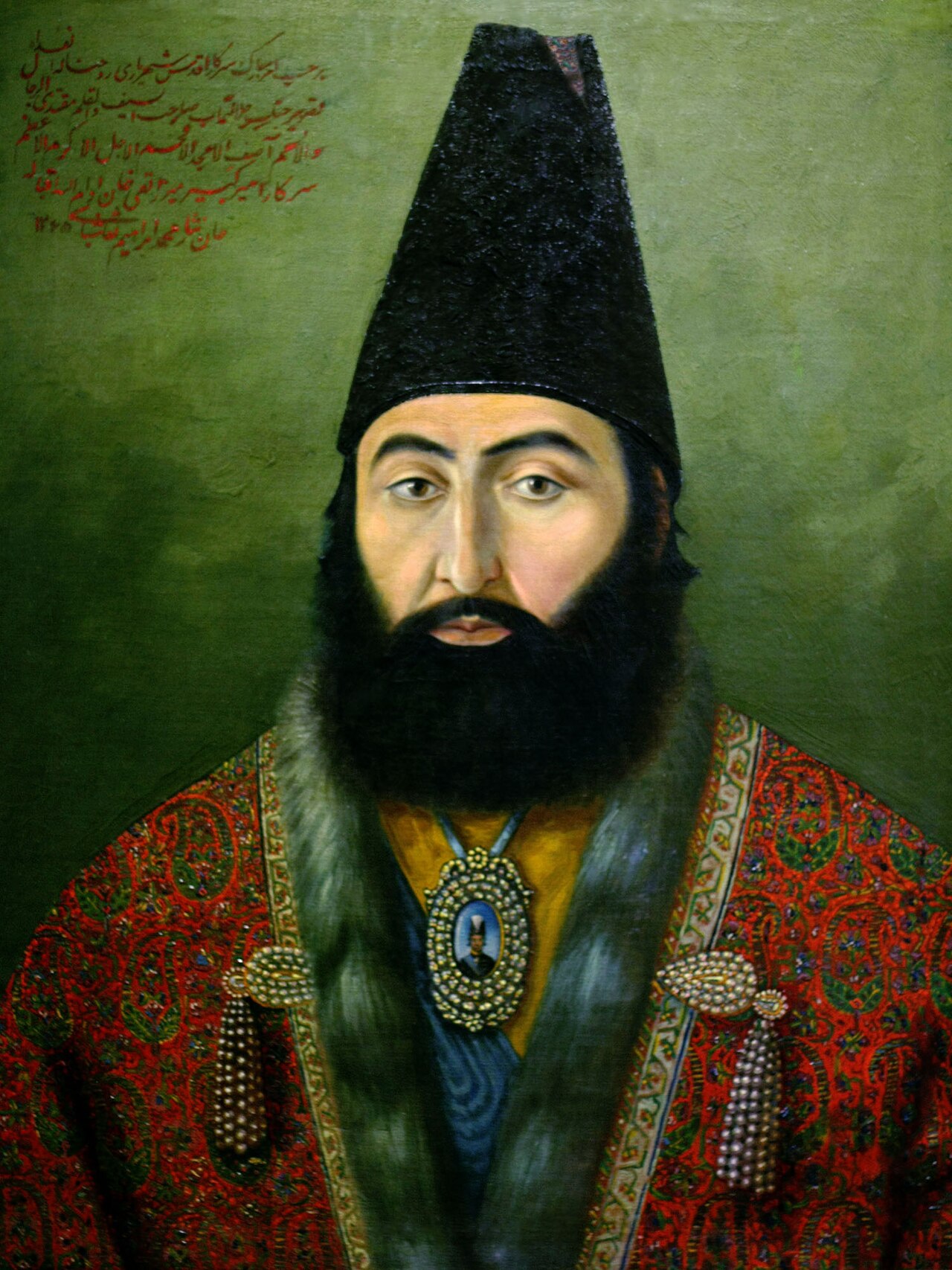

From a cook’s son to the Tabriz chancery
Amir Kabir was not born into the elite. His father, Karbala’i Mohammad Qorban, was a cook in the household of Mirza Abolqasem Qaem-Maqam, the minister of crown prince Abbas Mirza in Tabriz. The boy grew up around the Qaem-Maqam’s sons, picked up reading and writing alongside them, and caught the minister’s eye. He entered the administration of the army of Azerbaijan as a secretary and accountant.
Two foreign missions shaped him. In 1829 he travelled to St Petersburg with Prince Khosrow Mirza, who went to apologise to Tsar Nicholas I for the killing of the Russian envoy in Tehran (see the death of Griboyedov). There he saw a modern state with factories, schools and a professional army. From 1843 to 1847 he led the Iranian delegation at the long Ottoman–Iranian border talks at Erzurum, which ended in the Second Treaty of Erzurum of 1847. Those years taught him how European diplomats worked and how weak Iran’s position was.
Taking power in 1848
When Mohammad Shah died in September 1848, Mirza Taqi Khan was in charge of the army of Azerbaijan under the seventeen-year-old crown prince, Naser al-Din. He organised the young shah’s march from Tabriz to Tehran and was rewarded with the post of chief minister and the titles amir-e nezam and later amir-e kabir. In early 1849 he married Ezzat al-Dowleh, the shah’s only full sister, which tied him to the royal family.
The first months were spent putting down challenges to the new reign. The most serious was the revolt of the Qajar prince Hasan Khan Salar in Khorasan, ended with the fall of Mashhad in 1850. The minister also crushed the armed Babi risings at Zanjan and Nayriz, and it was under his government that the Bab was executed at Tabriz in July 1850, as told on the page about the Bab and the Babi movement. Baha’i writers and many modern historians hold him responsible for that harsh policy.
What Amir Kabir changed
Money and the court
The treasury was empty when he took office. He cut the pensions and salaries paid to princes and courtiers, collected taxes more strictly, and pressed provincial governors to send revenue to Tehran instead of keeping it. He tried to stop the selling of offices and the presents (pishkesh) that officials expected for every favour. These measures balanced the budget for a short time, and they made him many enemies.
The army and industry
He paid soldiers regularly, which had rarely happened before, and set up workshops to make muskets and uniforms in Iran. Factories for textiles, paper, sugar and glass were started, some with imported machinery, and craftsmen were sent to Russia and Istanbul to learn new techniques. Most did not survive long after his fall, but they show what he had in mind: an Iran that could arm and clothe itself.
A newspaper, vaccination and a college
In February 1851 the government began publishing Vaqaye’-e Ettefaqiyeh وقایع اتفاقیه, a weekly that printed official news, foreign reports and notices; it is counted as Iran’s first regular newspaper. He organised smallpox vaccination, though many people distrusted it. His most lasting project was a college in Tehran with European teachers, which opened on 29 December 1851 as the Dar al-Funun. By then Amir Kabir had already been dismissed and never saw it at work.
Dealing with Britain and Russia
He tried to keep both powers at a distance. He refused their requests for special favours, resisted the custom by which Iranians took refuge (bast) in the foreign legations to escape the law, and looked to Austria for teachers because it had no ambitions in Iran. This earned him the respect of later nationalists, but it also meant he had no foreign protector when the court turned against him.
Enemies at court and the fall
The cuts hurt powerful people. His leading opponents were the queen mother, Mahd-e Olia, who resented his control over her son, and Mirza Aqa Khan Nuri, an ambitious official who had British support and who succeeded him. Rumours were spread that Amir Kabir planned to put another prince on the throne. The shah, now twenty, also wanted to rule for himself.
In November 1851 Naser al-Din dismissed him. When the Russian minister in Tehran offered him protection, the offer made things worse, because it allowed his enemies to say he was a foreign client. He was sent with his wife and children to the Fin garden near Kashan, a royal garden with pavilions and a bathhouse.
Death in the bathhouse at Fin
In January 1852 (10 January in most accounts) a court officer, Hajj Ali Khan, arrived at Fin with the shah’s order. Amir Kabir was taken into the bathhouse and his veins were cut, and he bled to death. Ezzat al-Dowleh had tried to protect him by never leaving his side, and the order was carried out when he went to the bath. He was buried at Karbala. Visitors to the Fin Garden in Kashan are still shown the bath where he died, with figures recreating the scene.
The shah’s later attitude is debated. Some historians think he regretted the order; others point out that he never brought Amir Kabir’s enemies to account and that Nuri ruled for the next seven years.
How historians see Amir Kabir
For Iranian writers of the twentieth century, especially Fereydun Adamiyat in his book Amir Kabir va Iran, he was the great patriot whose murder cost Iran its chance to modernise in time, a figure to compare with the Ottoman reformers of the Tanzimat. His name is now on Amir Kabir University of Technology in Tehran and on streets and schools across the country.
Other historians are more cautious. Abbas Amanat notes that his reforms were imposed from the top by an authoritarian minister, depended on one man and on the shah’s trust, and did not create institutions that could survive him. His government was also severe towards religious dissidents and rebels. Both views agree on one point: no later Qajar minister combined his energy, honesty and independence from the foreign powers. The page on Naser al-Din Shah follows the reign that continued without him.
Persian words from this page
| امیرکبیر | Amir Kabir | the great commander (title) |
| صدراعظم | sadr-e a’zam | chief minister |
| پیشکش | pishkesh | gift to a superior |
| بست | bast | sanctuary, sit-in refuge |
| باغ فین | Bâgh-e Fin | Fin garden |
| کاشان | Kâshân | Kashan |
| روزنامه | ruznâme | newspaper |
Sources and further reading
- Encyclopaedia Iranica, “Amir Kabir, Mirza Mohammad Taqi Khan” (iranicaonline.org).
- Abbas Amanat, Pivot of the Universe: Nasir al-Din Shah Qajar and the Iranian Monarchy, 1831–1896 (University of California Press, 1997).
- Fereydun Adamiyat, Amir Kabir va Iran (Persian; first published 1944, many later editions).
- Abbas Amanat, Iran: A Modern History (Yale University Press, 2017).
- The Cambridge History of Iran, vol. 7: From Nadir Shah to the Islamic Republic (1991).
Want to learn Persian? Get the free Starter Pack
Get the 14-page printable Starter Pack (all 32 letters, a 7-day reading plan, 100 core words and 20 survival phrases) and a short 5-email course. Free.
More in The Qajar Dynasty (1789–1925)
- Agha Mohammad Khan Qajar
- The Battle of Krtsanisi and Sack of Tiflis (1795)
- Fath-Ali Shah Qajar
- The Qajar Court and Harem
- The Russo-Persian War of 1804–1813
- The Battle of Aslanduz (1812)
- The Treaty of Golestan (1813)
- Abbas Mirza and the First Reforms
- The Russo-Persian War of 1826–1828
- The Treaty of Turkmenchay (1828)
- The Death of Griboyedov (1829)
- Mohammad Shah and the Siege of Herat
- The Bab and the Babi Movement
- Tahirih (Qurrat al-Ayn)
- Naser al-Din Shah Qajar
- Amir Kabir
- Dar al-Funun: Iran’s First Modern School
- The Anglo-Persian War (1856–1857)
- How Iran Lost Herat
- The Great Persian Famine of 1870–1872
- The Reuter Concession (1872)
- Naser al-Din Shah’s Journeys to Europe
- The Tobacco Protest (1891–1892)
- Mirza Malkam Khan and Early Reformers
- The Assassination of Naser al-Din Shah (1896)
- Photography in Qajar Iran
- Mozaffar ad-Din Shah
- Taj al-Saltaneh
- The D’Arcy Concession and the Discovery of Oil (1908)
- The Persian Constitutional Revolution (1905–1911)
- The First Majlis and the Constitution of 1906
- The Anglo-Russian Convention of 1907
- Mohammad Ali Shah and the Bombardment of the Majlis
- The Siege of Tabriz and Sattar Khan
- The Constitutionalists Take Tehran (1909)
- The Bakhtiari and the Revolution
- Morgan Shuster and the Russian Ultimatum (1911)
- Women in the Constitutional Revolution
- Iran in the First World War
- The Persian Famine of 1917–1919
- Mirza Kuchik Khan and the Jangali Movement
- The Anglo-Persian Agreement of 1919
- The 1921 Coup: Reza Khan and Seyyed Zia
- The End of the Qajar Dynasty (1925)
- Qajar Art, Photography and Society