The Qajar royal harem, the andaruni or inner quarters of the palace, was home to the shah’s wives, mothers, daughters, young sons, servants and eunuchs, often several hundred people. From the reign of Fath-Ali Shah (1797–1834) to the end of the nineteenth century it was not only a private household but a political arena, where queen mothers and favourite wives could make and break ministers.

Inner and outer: how the palace was divided
Every elite Iranian house of the period had two parts. The بیرونی (biruni), the outer quarter, was where men received guests and did business. The اندرونی (andaruni), the inner quarter, belonged to the women and children of the family, and unrelated men did not enter it. The royal palace at Tehran, today the Golestan Palace, followed the same plan on a vast scale. The shah held audiences and ceremonies in the outer halls and went “inside” to his family, while summer palaces such as those at Shemiran and Shahrestanak had their own inner gardens.
The Persian word حرمسرا (haramsarâ) means the “sanctuary house”: a protected space, not, as European fantasy painting suggested, a place of idle pleasure. It had its own budget, kitchens, storerooms and staff, and the women who ran it controlled real money.
Wives, permanent and temporary
Qajar shahs married on a scale that astonished foreign visitors. The page on Fath-Ali Shah describes his enormous family; his grandson Naser al-Din Shah (r. 1848–1896) also took dozens of wives over his long reign. Twelver Shi’i law allowed two kinds of marriage. A permanent marriage (aqdi) was limited to four wives at a time; a temporary marriage, صیغه (sigheh), was not limited in number and could last for any agreed term. Most royal wives were sigheh, and their standing depended on the shah’s favour and on whether they bore sons.
Rank mattered greatly. A wife of Qajar princely birth, whose son could inherit the throne, stood far above a wife from a modest family. Under Qajar custom the crown prince was expected to have a Qajar mother, which made the marriages of the royal clan a matter of state.
Queen mothers and favourites
The most powerful woman of the nineteenth-century court was Malek Jahan Khanom, the mother of Naser al-Din Shah, known by the title مهد علیا (Mahd-e Olyâ, “the exalted cradle”). When her son came to the throne at seventeen she ran a court network of her own, and the historian Abbas Amanat counts her among the opponents whose hostility helped bring down the reforming minister Amir Kabir in 1851. She remained a force at court until her death in 1873.
The best known favourite was Anis al-Dowleh, a woman of humble village origin who rose to become Naser al-Din’s chief wife and manager of the harem. She began the shah’s first European tour with him in 1873 but was sent home from Russia, and contemporaries believed she then worked against the chief minister who had arranged the trip; the story is told on the page on Naser al-Din Shah’s journeys to Europe.
Eunuchs, servants and slaves
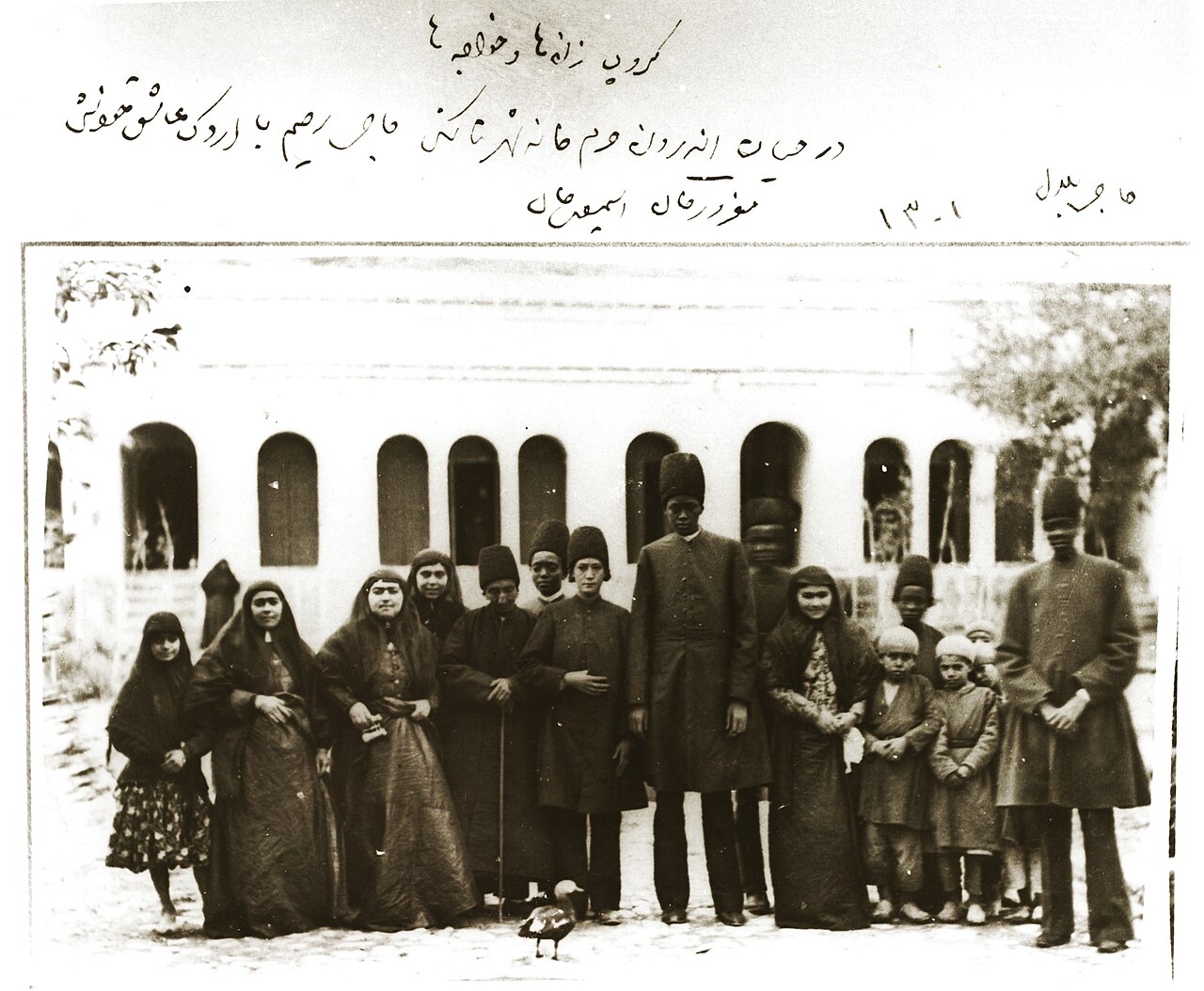
Only the shah, boys and the eunuchs (خواجه, khâjeh) moved freely between the two worlds of the palace. The eunuchs guarded the doors, carried messages and handled the harem’s dealings with the outside, which gave senior eunuchs influence of their own. Many were Africans brought through the slave trade of the Persian Gulf and the Red Sea; others came from Georgia and the Caucasus. The founder of the dynasty, Agha Mohammad Khan, had himself been castrated as a boy by a rival ruler.
Below the wives were hundreds of maids, nurses, cooks, musicians and enslaved women, many of them African. Their lives are poorly documented, but photographs taken inside the harem, including those of the shah himself, show them alongside the royal women.
Daily life inside
Life in the andaruni followed the calendar of the court. Women received visitors from other elite households, held religious gatherings and readings, and in Muharram attended the ta’ziyeh passion plays, staged on a grand scale from the late 1860s at the royal theatre, the Takyeh Dowlat. They went on picnics and travelled with the shah to his summer camps. Girls of the family were taught to read the Qur’an and Persian poetry; some were given a wider education by private tutors.
The harem was also a place of rivalry. Wives competed for the shah’s attention, for allowances and for the future of their sons, and quarrels were reported to the shah through eunuchs and servants. Taj al-Saltaneh, who grew up there in the 1880s and 1890s, described it as crowded, gossip-filled and lonely for a child raised mostly by nurses; her life and memoir have their own page.
How we know about the harem
Because outsiders could not enter, sources are limited. A few European women visited and wrote about it, most famously Lady Mary Sheil, wife of the British envoy, in Glimpses of Life and Manners in Persia (1856). Courtiers left memoirs: Dust-Ali Khan Mo’ayyer al-Mamalek, a grandson of Naser al-Din Shah, wrote about the private life of the shah, and the minister Etemad al-Saltaneh’s diary records daily court gossip. The richest inside view is Taj al-Saltaneh’s memoir, written around 1914. Naser al-Din’s own photographs of his wives, kept in the Golestan Palace albums, are a unique visual record (see photography in Qajar Iran).
Historians now read these sources against older European stereotypes. Scholars such as Abbas Amanat and Afsaneh Najmabadi show the harem as an institution with its own hierarchy, economy and politics, and women there as actors, not only as ornaments. The wider picture of women’s lives in the period is on the page on Qajar art, photography and society.
Persian words from this page
| اندرونی | andaruni | inner (women’s) quarters |
| بیرونی | biruni | outer (men’s) quarters |
| حرمسرا | haramsarâ | harem |
| صیغه | sigheh | temporary marriage; temporary wife |
| خواجه | khâjeh | eunuch |
| مهد علیا | Mahd-e Olyâ | title of the shah’s mother |
| تعزیه | ta’ziyeh | Muharram passion play |
Sources and further reading
- Abbas Amanat, Pivot of the Universe: Nasir al-Din Shah Qajar and the Iranian Monarchy, 1831–1896 (University of California Press, 1997)
- Taj al-Saltana, Crowning Anguish: Memoirs of a Persian Princess from the Harem to Modernity, 1884–1914, ed. Abbas Amanat, trans. Anna Vanzan and Amin Neshati (Mage, 1993)
- Lady Mary Leonora Sheil, Glimpses of Life and Manners in Persia (London, 1856)
- Dust-Ali Khan Mo’ayyer al-Mamalek, Yâddâsht-hâ’i az zendegâni-ye khosusi-ye Nâser al-Din Shâh (memoir, in Persian)
- Afsaneh Najmabadi, Women with Mustaches and Men without Beards: Gender and Sexual Anxieties of Iranian Modernity (University of California Press, 2005)
Want to learn Persian? Get the free Starter Pack
Get the 14-page printable Starter Pack (all 32 letters, a 7-day reading plan, 100 core words and 20 survival phrases) and a short 5-email course. Free.
More in The Qajar Dynasty (1789–1925)
- Agha Mohammad Khan Qajar
- The Battle of Krtsanisi and Sack of Tiflis (1795)
- Fath-Ali Shah Qajar
- The Qajar Court and Harem
- The Russo-Persian War of 1804–1813
- The Battle of Aslanduz (1812)
- The Treaty of Golestan (1813)
- Abbas Mirza and the First Reforms
- The Russo-Persian War of 1826–1828
- The Treaty of Turkmenchay (1828)
- The Death of Griboyedov (1829)
- Mohammad Shah and the Siege of Herat
- The Bab and the Babi Movement
- Tahirih (Qurrat al-Ayn)
- Naser al-Din Shah Qajar
- Amir Kabir
- Dar al-Funun: Iran’s First Modern School
- The Anglo-Persian War (1856–1857)
- How Iran Lost Herat
- The Great Persian Famine of 1870–1872
- The Reuter Concession (1872)
- Naser al-Din Shah’s Journeys to Europe
- The Tobacco Protest (1891–1892)
- Mirza Malkam Khan and Early Reformers
- The Assassination of Naser al-Din Shah (1896)
- Photography in Qajar Iran
- Mozaffar ad-Din Shah
- Taj al-Saltaneh
- The D’Arcy Concession and the Discovery of Oil (1908)
- The Persian Constitutional Revolution (1905–1911)
- The First Majlis and the Constitution of 1906
- The Anglo-Russian Convention of 1907
- Mohammad Ali Shah and the Bombardment of the Majlis
- The Siege of Tabriz and Sattar Khan
- The Constitutionalists Take Tehran (1909)
- The Bakhtiari and the Revolution
- Morgan Shuster and the Russian Ultimatum (1911)
- Women in the Constitutional Revolution
- Iran in the First World War
- The Persian Famine of 1917–1919
- Mirza Kuchik Khan and the Jangali Movement
- The Anglo-Persian Agreement of 1919
- The 1921 Coup: Reza Khan and Seyyed Zia
- The End of the Qajar Dynasty (1925)
- Qajar Art, Photography and Society