The Anglo-Persian War was a short conflict fought between November 1856 and April 1857, after Iran captured the city of Herat in western Afghanistan. Britain, which saw Herat as a gateway to India, answered not in Afghanistan but in southern Iran, landing troops on the Persian Gulf coast. The Treaty of Paris of March 1857 forced Iran to give up all claims to Herat, a loss that shaped the border with Afghanistan to this day.
| Dates | 1 November 1856 (British declaration) – April 1857 |
|---|---|
| Cause | Iran’s capture of Herat, 25 October 1856 |
| Main fighting | Kharg, Bushehr, Khushab, Mohammareh (Khorramshahr), Ahvaz |
| Commanders | Sir James Outram (British); Shoja al-Molk, Prince Khanlar Mirza (Iranian) |
| Ended by | Treaty of Paris, 4 March 1857 |
| Shah | Naser al-Din Shah; chief minister Mirza Aqa Khan Nuri |

Herat between Iran and Britain
Herat had been one of the great cities of Khorasan under the Timurids and Safavids, and the Qajar shahs regarded it as theirs. Mohammad Shah had besieged it for ten months in 1837–1838 and withdrawn only when Britain landed troops on Kharg Island, as told in Mohammad Shah and the siege of Herat. For British India the question was strategic: an Iran under strong Russian influence, holding Herat, would bring Russia within reach of the Afghan passes.
In January 1853 Iran had promised the British envoy not to send troops to Herat unless a foreign power attacked it. Two changes undid that promise. Herat’s ruler, Yar Mohammad Khan, died in 1851, and his successors were weak while the Afghan amir Dost Mohammad of Kabul pressed from the east. At the same time the Crimean War (1853–1856) occupied Britain and Russia, and the chief minister Mirza Aqa Khan Nuri saw an opening.
A quarrel in Tehran
Relations with Britain had already broken down over a personal affair. The British minister, Charles Murray, wanted to appoint Mirza Hashem Khan, an Iranian, as a secretary of his mission, which would have placed him under British protection. The court refused, and rumours spread about Murray and Hashem Khan’s wife, who was a sister of one of the shah’s wives. When the Iranians detained her and would not release her, Murray broke off relations and left Tehran in December 1855. The incident made the court less willing to listen to British warnings over Herat.
The fall of Herat
In 1856 an Iranian army under Morad Mirza, governor of Khorasan, marched on Herat, and the city surrendered on 25 October 1856 after a siege of several months. The khotbe, the Friday sermon, was read in the shah’s name. News of the capture reached Calcutta and London quickly, and on 1 November 1856 the governor-general of India declared war.
The war on the Persian Gulf coast
Rather than march across Afghanistan, the British sent an expedition from Bombay to the Iranian side of the Persian Gulf, where ships could support it and where Iran’s southern revenues could be threatened.
- 4 December 1856 British forces occupy Kharg Island.
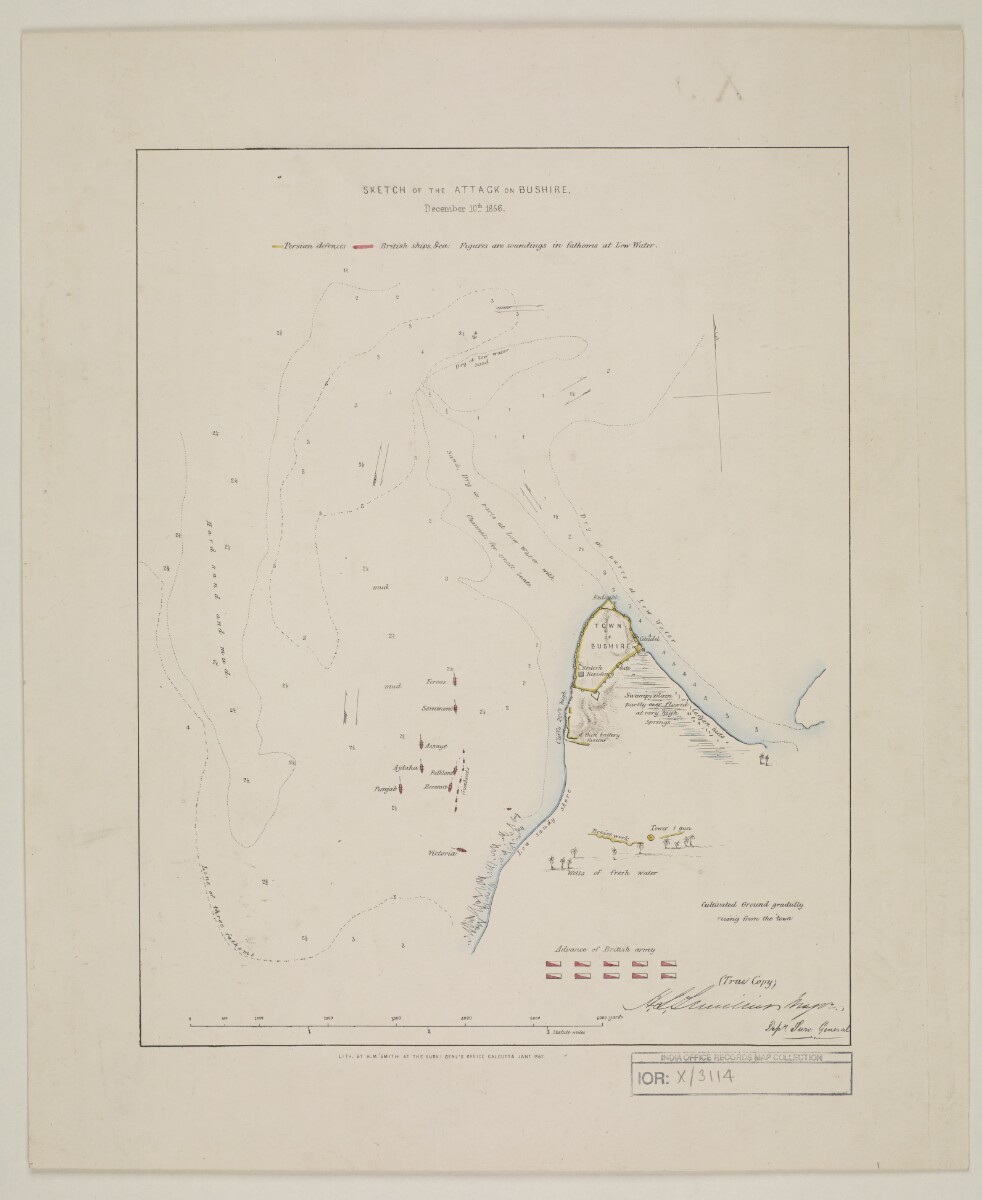
- Early December 1856 Troops land south of Bushehr, storm the old fort at Reshahr and take Bushehr, the main Iranian port, around 10 December.
- January 1857 Sir James Outram arrives from India to command a reinforced expedition.
- 8 February 1857 At Khushab, inland from Bushehr, British forces defeat an Iranian army under Shoja al-Molk.
- 4 March 1857 The Treaty of Paris is signed; the news takes weeks to reach the Gulf.
- 26–27 March 1857 A river force under Henry Havelock takes Mohammareh (modern Khorramshahr) on the Shatt al-Arab, defended by Prince Khanlar Mirza.
- 1 April 1857 A small flotilla reaches Ahvaz on the Karun; the Iranian force there withdraws.
Casualty figures differ by source. At Khushab the British reported very light losses of their own and around 700 Iranian killed and wounded; Iranian reports claimed far heavier British losses. The campaign also had a strange end for two British commanders: General Foster Stalker and Commodore Richard Ethersey both took their own lives at Bushehr in March 1857.
The Treaty of Paris
Iran had already looked for a negotiated way out. Talks in Istanbul failed because Britain demanded the dismissal of Nuri, but in Paris, with Napoleon III’s government as a friendly host, the Iranian envoy Farrokh Khan Amin al-Molk and the British ambassador Lord Cowley signed a peace treaty on 4 March 1857. Its main terms were:
- Iran would withdraw its troops from Herat and from all Afghan territory, and give up any claim to sovereignty over Herat or Afghanistan.
- In any future dispute with the Afghans, Iran would first ask Britain to mediate before using force.
- Britain would withdraw its forces from Iranian territory.
- Britain would receive the same commercial rights as the most favoured nation, and the British mission would be received back in Tehran with apologies.
- Iran would cooperate against the slave trade in the Persian Gulf.
Britain dropped its demand that Nuri be dismissed. British troops left Iran soon after, partly because they were needed in India, where the great rebellion of 1857 broke out in May.
What the war meant for Iran
The war was brief and its battles small, but its consequences were long. Herat was lost for good and the eastern border began to take its modern form, a story followed in how Iran lost Herat. The ease with which a seaborne force had taken Bushehr and Mohammareh showed how exposed the south was, and the shah drew the lesson that he could not defy Britain over Afghanistan.
The defeat also changed politics in Tehran. Nuri’s position weakened, and in 1858 the shah dismissed him and experimented with a council of ministers, described on the page about Naser al-Din Shah. Farrokh Khan, the envoy in Paris, brought back ideas about European government that fed the early reform movement. Historians of the Great Game treat the war as a classic case of Britain defending India by pressure on Iran; Iranian historians often see it as the moment when the frontier in the east was decided by a foreign power. For the longer story see Iran and Britain through history, and the city pages on Bushehr and Abadan and Khorramshahr.
Persian words from this page
| هرات | Herât | Herat |
| بوشهر | Bushehr | Bushehr |
| خارک | Khârk | Kharg Island |
| محمره | Mohammare | old name of Khorramshahr |
| معاهده | mo’âhede | treaty |
| خطبه | khotbe | Friday sermon |
Sources and further reading
- Encyclopaedia Iranica, “Anglo-Iranian relations ii. Qajar period“.
- Abbas Amanat, Pivot of the Universe: Nasir al-Din Shah Qajar and the Iranian Monarchy, 1831–1896 (1997), chapters on the Herat crisis.
- J. B. Kelly, Britain and the Persian Gulf, 1795–1880 (Oxford, 1968).
- Peter Hopkirk, The Great Game (1990).
- Abbas Amanat, Iran: A Modern History (2017).
Want to learn Persian? Get the free Starter Pack
Get the 14-page printable Starter Pack (all 32 letters, a 7-day reading plan, 100 core words and 20 survival phrases) and a short 5-email course. Free.
More in The Qajar Dynasty (1789–1925)
- Agha Mohammad Khan Qajar
- The Battle of Krtsanisi and Sack of Tiflis (1795)
- Fath-Ali Shah Qajar
- The Qajar Court and Harem
- The Russo-Persian War of 1804–1813
- The Battle of Aslanduz (1812)
- The Treaty of Golestan (1813)
- Abbas Mirza and the First Reforms
- The Russo-Persian War of 1826–1828
- The Treaty of Turkmenchay (1828)
- The Death of Griboyedov (1829)
- Mohammad Shah and the Siege of Herat
- The Bab and the Babi Movement
- Tahirih (Qurrat al-Ayn)
- Naser al-Din Shah Qajar
- Amir Kabir
- Dar al-Funun: Iran’s First Modern School
- The Anglo-Persian War (1856–1857)
- How Iran Lost Herat
- The Great Persian Famine of 1870–1872
- The Reuter Concession (1872)
- Naser al-Din Shah’s Journeys to Europe
- The Tobacco Protest (1891–1892)
- Mirza Malkam Khan and Early Reformers
- The Assassination of Naser al-Din Shah (1896)
- Photography in Qajar Iran
- Mozaffar ad-Din Shah
- Taj al-Saltaneh
- The D’Arcy Concession and the Discovery of Oil (1908)
- The Persian Constitutional Revolution (1905–1911)
- The First Majlis and the Constitution of 1906
- The Anglo-Russian Convention of 1907
- Mohammad Ali Shah and the Bombardment of the Majlis
- The Siege of Tabriz and Sattar Khan
- The Constitutionalists Take Tehran (1909)
- The Bakhtiari and the Revolution
- Morgan Shuster and the Russian Ultimatum (1911)
- Women in the Constitutional Revolution
- Iran in the First World War
- The Persian Famine of 1917–1919
- Mirza Kuchik Khan and the Jangali Movement
- The Anglo-Persian Agreement of 1919
- The 1921 Coup: Reza Khan and Seyyed Zia
- The End of the Qajar Dynasty (1925)
- Qajar Art, Photography and Society