The Dar al-Funun (“house of sciences and arts”) was the first modern institution of higher learning in Iran. Planned by the chief minister Amir Kabir, it opened in Tehran on 29 December 1851 with European teachers and about a hundred students, and for half a century it trained the officers, doctors, engineers and translators of Qajar Iran.
| Opened | 29 December 1851 (5 Rabi I 1268) |
|---|---|
| Founder | Amir Kabir, under Naser al-Din Shah |
| Place | Beside the royal citadel (Arg), on today’s Naser Khosrow Street, Tehran |
| First students | About 105 |
| Teaching language | Mostly French, through interpreters |
| Later | Turned into a secondary school in the 1920s; building rebuilt around 1930 |
| Persian name | دارالفنون |

Why Amir Kabir wanted a college
Since the wars with Russia, Iranian reformers had tried to learn European military science. Abbas Mirza had sent small groups of students to England in 1811 and 1815, but they were few, the trips were expensive, and the knowledge left with the people who had it. Amir Kabir wanted something permanent: a school at home where European instructors would train young Iranians in the skills a modern state needed.
He chose to hire teachers from Austria rather than from Britain or Russia, because Austria had no interests in Iran and could not use the teachers for influence. His agent Jan Dawud Khan, an Armenian-Iranian official, went to Vienna and signed contracts with a group of officers and specialists in August 1851. Work on a building beside the royal citadel began at the same time.
The teachers arrive too late for their patron
The Austrians reached Tehran on 24 November 1851, just after Amir Kabir had been dismissed. For a time it was unclear whether the new government wanted them at all. The college opened anyway on 29 December, under the direction of the foreign minister, Mirza Mohammad Ali Khan Shirazi. Thirteen days later Amir Kabir was killed at Kashan. The school survived its founder because the shah had come to see it as his own.
The first staff, according to the Encyclopaedia Iranica, included:
- Alfred von Gumoëns, infantry, and Johann von Nemiro, cavalry
- Lieutenant August Křiž, artillery
- Captain Zatti, engineering, and Captain Joseph Czarnotta, mineralogy
- Dr Jakob Eduard Polak, medicine and surgery
- Focchetti, an Italian, for pharmacy, physics and chemistry
- The Frenchman Jules Richard for French, and Iranian scholars for Persian and Arabic
How the teaching worked
The students, about 105 in the first year, came mostly from the families of princes, officials and notables. They were divided by subject, and each group wore a uniform of its own colour. The government paid for food and gave allowances.
Language was the first problem. The Austrians taught in German, which almost nobody in Iran knew, so lessons were given through interpreters, and French soon became the working language of the college because more translators knew it. An interpreter sat in each class and put the teacher’s words into Persian. One of them was the young Mirza Malkam Khan, who translated for the engineering teacher and taught mathematics; he later became one of the best-known reformers of the era (see Mirza Malkam Khan and early reformers).
Because there were no textbooks in Persian, the teachers wrote them. Lecture notes were translated, printed at a government press attached to the college, and became some of the first modern scientific books in Persian. Polak alone wrote eleven works on medicine, anatomy and related subjects. Prizes and medals in copper, silver and gold were awarded at examinations held before the shah.
What the college produced
The Dar al-Funun never became a full university, but its influence spread through the state:
- Medicine. Polak’s pupils were among the first Iranian doctors trained in European medicine, and some went on to study in Paris. The medical classes were the root of the later Tehran school of medicine.
- Maps and the telegraph. Křiž drew one of the first detailed maps of Tehran and in 1857 ran an experimental telegraph line from the citadel to the Lalehzar garden, a first step towards the national network.
- Photography. Several teachers and students experimented with cameras, and the college helped spread a craft that the shah himself loved; see photography in Qajar Iran.
- Study abroad. In 1859 about forty-two students were sent to Europe for further training.
- Music. A military music section trained bands in European style, an early channel for Western music in Iran.
Many of the officials and writers who later supported reform, and some who led the Constitutional Revolution, had studied there or been taught by its graduates. Later alumni include the scholar and prime minister Mohammad Ali Foroughi.
Decline, rivals and a new building
From 1857 the college was run for over twenty years by the prince Ali-Qoli Mirza E’tezad al-Saltaneh, who was also minister of sciences, and it was reorganised in 1860. Its fortunes followed the shah’s moods: periods of support alternated with neglect. By the 1880s and 1890s other schools had appeared, such as a military college (1885) and the School of Political Sciences (1899), and private “new method” schools spread in the cities. Enrolment stood at about 316 in 1905–06.
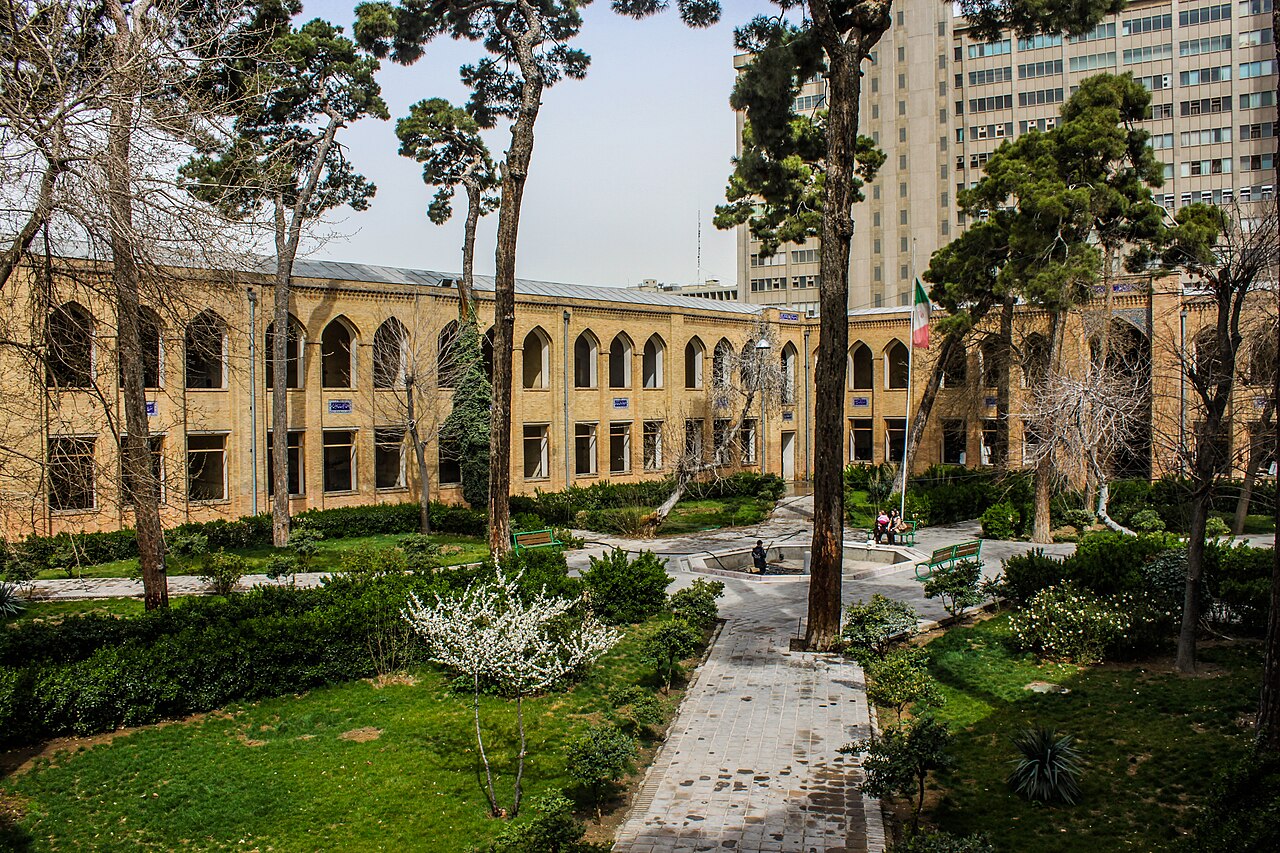
In the twentieth century its higher sections were separated: a medical college in 1918 and separate schools for other subjects soon after, which later fed into the University of Tehran, founded in 1934. During the education reforms of the 1920s the Dar al-Funun itself became a secondary school (dabirestan). The original building was pulled down around 1930 and replaced with the present one, a brick building around a courtyard; a decorated gate on Naser Khosrow Street remains from the older complex.
The Dar al-Funun today
The building stands a short walk from the Golestan Palace in central Tehran. It has undergone restoration in recent years and has been opened to visitors at times; anyone planning a visit should check current information locally. For Iranians the name remains a symbol of the first serious attempt to bring modern science into the country, and of the minister who did not live to see it open.
Persian words from this page
| دارالفنون | Dâr ol-Fonun | house of sciences and arts |
| مدرسه | madrese | school |
| معلم | mo’allem | teacher |
| مترجم | motarjem | translator, interpreter |
| پزشکی | pezeshki | medicine |
| دبیرستان | dabirestân | secondary school |
Sources and further reading
- Encyclopaedia Iranica, “Dar al-Fonun” (iranicaonline.org).
- Abbas Amanat, Pivot of the Universe: Nasir al-Din Shah Qajar and the Iranian Monarchy, 1831–1896 (1997).
- Jakob Eduard Polak, Persien: Das Land und seine Bewohner (Leipzig, 1865), the memoir of the college’s medical teacher.
- David Menashri, Education and the Making of Modern Iran (Cornell University Press, 1992).
- Monica Ringer, Education, Religion, and the Discourse of Cultural Reform in Qajar Iran (Mazda, 2001).
Want to learn Persian? Get the free Starter Pack
Get the 14-page printable Starter Pack (all 32 letters, a 7-day reading plan, 100 core words and 20 survival phrases) and a short 5-email course. Free.
More in The Qajar Dynasty (1789–1925)
- Agha Mohammad Khan Qajar
- The Battle of Krtsanisi and Sack of Tiflis (1795)
- Fath-Ali Shah Qajar
- The Qajar Court and Harem
- The Russo-Persian War of 1804–1813
- The Battle of Aslanduz (1812)
- The Treaty of Golestan (1813)
- Abbas Mirza and the First Reforms
- The Russo-Persian War of 1826–1828
- The Treaty of Turkmenchay (1828)
- The Death of Griboyedov (1829)
- Mohammad Shah and the Siege of Herat
- The Bab and the Babi Movement
- Tahirih (Qurrat al-Ayn)
- Naser al-Din Shah Qajar
- Amir Kabir
- Dar al-Funun: Iran’s First Modern School
- The Anglo-Persian War (1856–1857)
- How Iran Lost Herat
- The Great Persian Famine of 1870–1872
- The Reuter Concession (1872)
- Naser al-Din Shah’s Journeys to Europe
- The Tobacco Protest (1891–1892)
- Mirza Malkam Khan and Early Reformers
- The Assassination of Naser al-Din Shah (1896)
- Photography in Qajar Iran
- Mozaffar ad-Din Shah
- Taj al-Saltaneh
- The D’Arcy Concession and the Discovery of Oil (1908)
- The Persian Constitutional Revolution (1905–1911)
- The First Majlis and the Constitution of 1906
- The Anglo-Russian Convention of 1907
- Mohammad Ali Shah and the Bombardment of the Majlis
- The Siege of Tabriz and Sattar Khan
- The Constitutionalists Take Tehran (1909)
- The Bakhtiari and the Revolution
- Morgan Shuster and the Russian Ultimatum (1911)
- Women in the Constitutional Revolution
- Iran in the First World War
- The Persian Famine of 1917–1919
- Mirza Kuchik Khan and the Jangali Movement
- The Anglo-Persian Agreement of 1919
- The 1921 Coup: Reza Khan and Seyyed Zia
- The End of the Qajar Dynasty (1925)
- Qajar Art, Photography and Society