The Reuter Concession was an agreement signed on 25 July 1872 by which Naser al-Din Shah granted Baron Julius de Reuter, the British founder of the Reuters news agency, exclusive rights over Iran’s railways, mines, forests, irrigation and customs for decades to come. It caused an outcry at home and alarm in Russia, was cancelled in late 1873, and became the first great symbol of the danger of selling the country’s resources to foreigners.
| Signed | 25 July 1872, Tehran |
|---|---|
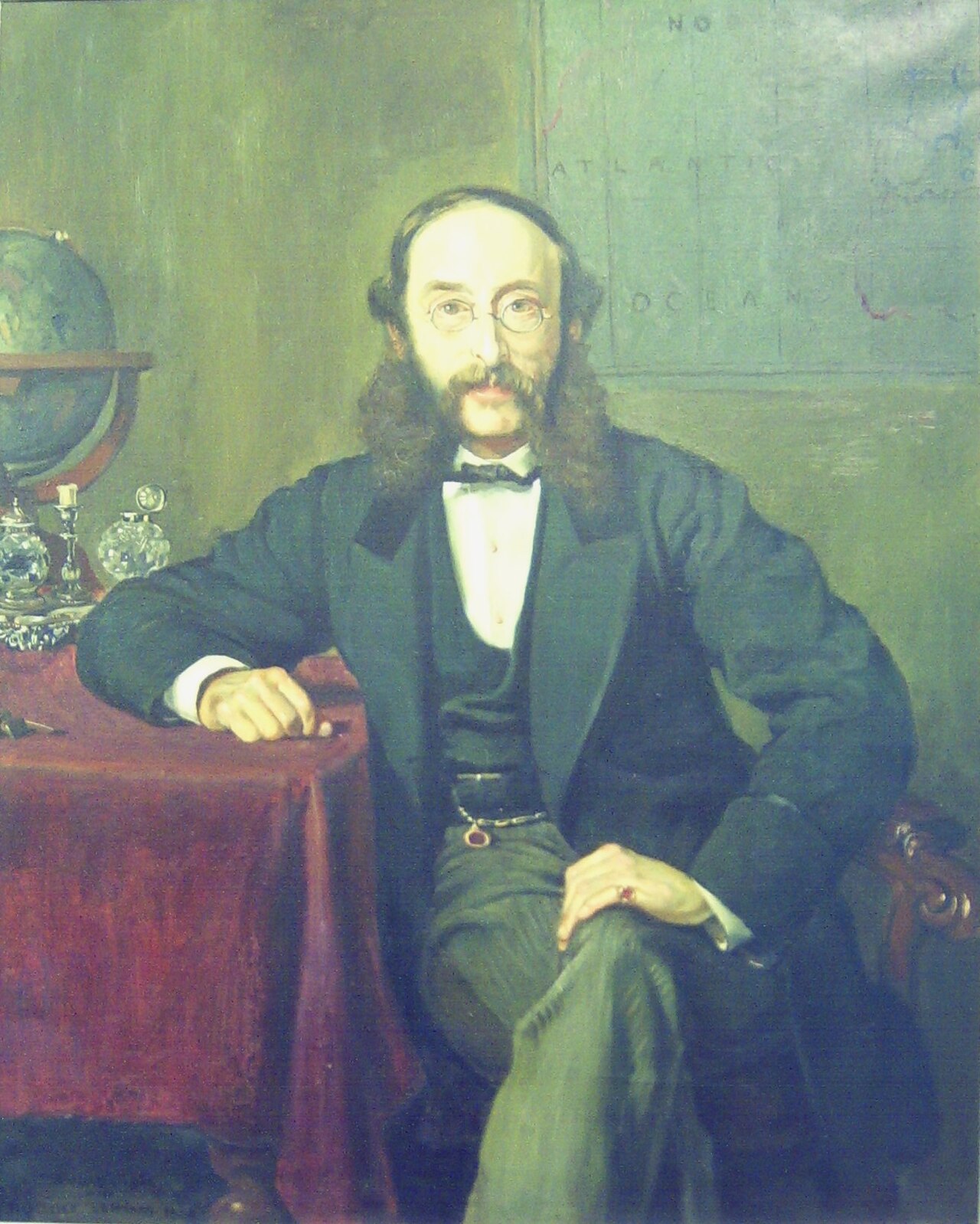
| Granted to | Paul Julius de Reuter (1816–1899) |
| Iranian sponsors | Chief minister Mirza Hosayn Khan Sepahsalar; Mirza Malkam Khan |
| Length | 70 years (railways and mines); customs for 25 years |
| Cancelled | Late 1873, after the shah’s return from Europe |
| Sequel | Imperial Bank of Persia, chartered 1889 |
| Persian term | امتیاز رویتر emtiyâz-e Royter |

Why the shah wanted it
By 1871 Naser al-Din Shah had a new chief minister, Mirza Hosayn Khan Moshir al-Dowleh, later called Sepahsalar, who had spent years as ambassador in Istanbul and admired the Ottoman reforms. He believed Iran needed railways, roads and modern industry, and that the state had neither the money nor the expertise to build them. The country had just been through the great famine of 1870–1872, and the treasury was weak.
The solution Sepahsalar and the shah chose was to bring in a single foreign capitalist who would take on the whole task in return for monopolies and a share of profits. A British investor was also expected to draw Britain into defending Iran against Russian pressure. Mirza Malkam Khan, a reformer and diplomat with many contacts in London (see Mirza Malkam Khan and early reformers), helped arrange the deal, and later accounts say he and other officials received large payments.
What Reuter was given
The terms were extraordinary even by the standards of the age. Reuter received:
- the exclusive right for 70 years to build and run railways and tramways throughout Iran, starting with a line from the Caspian Sea to the Persian Gulf;
- exclusive rights to work all mines except gold, silver and precious stones;
- a monopoly over state forests and uncultivated land;
- the exclusive right to build canals, qanats and all kinds of irrigation works;
- the farm of all Iran’s customs for 25 years from 1874, paying the government a fixed sum and later 60 per cent of net revenue;
- first refusal on a national bank and on future projects such as roads, telegraphs, mills and factories.
In return the government was to receive 20 per cent of railway profits and 15 per cent of profits from the other enterprises. Reuter deposited a security of £40,000, to be lost if work did not begin within fifteen months. Lord Curzon, writing in 1892, called it the “most complete and extraordinary surrender” of a kingdom’s industrial resources into foreign hands.
The storm against it
Opposition came from several directions at once.
At court and among the clergy
Many courtiers disliked Sepahsalar’s reforms and his control of government, and they used the concession against him. The opposition was led by figures around the shah’s favourite wife, Anis al-Dowleh, and by princes and officials who had lost influence. The leading Tehran cleric, Hajj Molla Ali Kani, wrote to the shah warning that foreigners would gain control over Muslim lands and people.
From Russia
The Russian government saw the concession as a British takeover of Iran’s economy and protested strongly. Russia had no intention of allowing a British-controlled railway to run from the Caspian to the Persian Gulf.
From London
Reuter had hoped for British government backing, but the Foreign Office kept its distance. It did not want to guarantee a private venture that might lead to conflict with Russia, and investors in London were cautious.
Cancellation in 1873
In the spring of 1873 the shah set out on his first journey to Europe, with Sepahsalar at his side. In London Reuter pressed for support, but little came of it. While the shah was abroad, his opponents in Tehran organised. When the royal party landed at Anzali on the Caspian in September 1873, the shah found the court and clergy united against his minister, and he dismissed Sepahsalar at Rasht before returning to the capital.
Later that year the government declared the concession void, on the grounds that Reuter had not started work on the railway within the agreed time. Reuter’s agents had in fact begun some preparatory work near Rasht. The £40,000 deposit was kept. Reuter protested for years and asked the British government to support his claims.
The long sequel
The affair did not end in 1873. Reuter’s claims were finally settled in 1889, when, with British support, he received a new concession to found the Imperial Bank of Persia. The bank, registered in London, gained the right to issue Iran’s banknotes and some mining rights, and it became one of the main channels of British influence until it was turned into the British Bank of Iran and the Middle East in the twentieth century.
For Iranians the Reuter episode set a pattern. Concessions became the main way the Qajar state raised money from abroad, and each one brought protest. The most important of them, the tobacco monopoly of 1890, led to the first successful national movement against the crown, the Tobacco Protest. Later the oil concession of 1901, described in the D’Arcy concession, would shape Iran’s twentieth century.
How historians judge it
Older nationalist histories present the concession as a sale of the country by a corrupt court. More recent work, such as that of Abbas Amanat and of Guity Nashat, who studied Sepahsalar’s reforms, sees a reforming minister who believed that a single large foreign enterprise could jump-start development, and who misjudged the reaction at home, in Russia and in Britain. Most agree that the concession was both too sweeping to succeed and politically fatal to the reform programme of the 1870s. The page on Naser al-Din Shah places it in the wider reign.
Persian words from this page
| امتیاز | emtiyâz | concession, privilege |
| راهآهن | râh-âhan | railway |
| معدن | ma’dan | mine |
| گمرک | gomrok | customs |
| بانک شاهنشاهی | Bânk-e Shâhanshâhi | Imperial Bank |
| سپهسالار | Sepahsâlâr | commander-in-chief (title) |
Sources and further reading
- George N. Curzon, Persia and the Persian Question, 2 vols (London, 1892).
- Firuz Kazemzadeh, Russia and Britain in Persia, 1864–1914: A Study in Imperialism (Yale, 1968).
- Guity Nashat, The Origins of Modern Reform in Iran, 1870–80 (University of Illinois Press, 1982).
- Abbas Amanat, Pivot of the Universe: Nasir al-Din Shah Qajar and the Iranian Monarchy, 1831–1896 (1997).
- Encyclopaedia Iranica, “Concessions” (iranicaonline.org).
Want to learn Persian? Get the free Starter Pack
Get the 14-page printable Starter Pack (all 32 letters, a 7-day reading plan, 100 core words and 20 survival phrases) and a short 5-email course. Free.
More in The Qajar Dynasty (1789–1925)
- Agha Mohammad Khan Qajar
- The Battle of Krtsanisi and Sack of Tiflis (1795)
- Fath-Ali Shah Qajar
- The Qajar Court and Harem
- The Russo-Persian War of 1804–1813
- The Battle of Aslanduz (1812)
- The Treaty of Golestan (1813)
- Abbas Mirza and the First Reforms
- The Russo-Persian War of 1826–1828
- The Treaty of Turkmenchay (1828)
- The Death of Griboyedov (1829)
- Mohammad Shah and the Siege of Herat
- The Bab and the Babi Movement
- Tahirih (Qurrat al-Ayn)
- Naser al-Din Shah Qajar
- Amir Kabir
- Dar al-Funun: Iran’s First Modern School
- The Anglo-Persian War (1856–1857)
- How Iran Lost Herat
- The Great Persian Famine of 1870–1872
- The Reuter Concession (1872)
- Naser al-Din Shah’s Journeys to Europe
- The Tobacco Protest (1891–1892)
- Mirza Malkam Khan and Early Reformers
- The Assassination of Naser al-Din Shah (1896)
- Photography in Qajar Iran
- Mozaffar ad-Din Shah
- Taj al-Saltaneh
- The D’Arcy Concession and the Discovery of Oil (1908)
- The Persian Constitutional Revolution (1905–1911)
- The First Majlis and the Constitution of 1906
- The Anglo-Russian Convention of 1907
- Mohammad Ali Shah and the Bombardment of the Majlis
- The Siege of Tabriz and Sattar Khan
- The Constitutionalists Take Tehran (1909)
- The Bakhtiari and the Revolution
- Morgan Shuster and the Russian Ultimatum (1911)
- Women in the Constitutional Revolution
- Iran in the First World War
- The Persian Famine of 1917–1919
- Mirza Kuchik Khan and the Jangali Movement
- The Anglo-Persian Agreement of 1919
- The 1921 Coup: Reza Khan and Seyyed Zia
- The End of the Qajar Dynasty (1925)
- Qajar Art, Photography and Society