Naser al-Din Shah was the first ruler of Iran to visit Europe, travelling there three times, in 1873, 1878 and 1889. He kept detailed diaries of each journey, which were printed in Persian and translated into European languages, and the tours had real consequences at home: a minister’s fall, new concessions to foreign businessmen and the founding of the Persian Cossack Brigade.
| First tour | April to September 1873: Russia, Germany, Belgium, Britain, France, Switzerland, Italy, Austria, the Ottoman Empire |
|---|---|
| Second tour | 1878: Russia, Germany, Austria and France, including the Paris Exposition |
| Third tour | 1889: Russia, Germany, Britain, France and other countries |
| Diaries | Printed in Tehran as Ruznâmeh-ye safar-e Farangestân and similar titles; 1873 diary translated into English by J. W. Redhouse (1874) |

Why a shah went to Farang
Europe, called فرنگ (Farang) in Qajar Persian, was known at court through envoys, students and books, but no reigning shah had seen it. The idea of a royal tour came from the chief minister Mirza Hosayn Khan Moshir al-Dowleh, known as Sepahsalar, who had served as ambassador in Istanbul and hoped the shah would return convinced of the need for reform. The trip also had diplomatic aims: to meet the rulers of Russia and Britain, the two powers pressing on Iran, and to show that the Qajar monarchy belonged among the courts of the world.
The tour of 1873
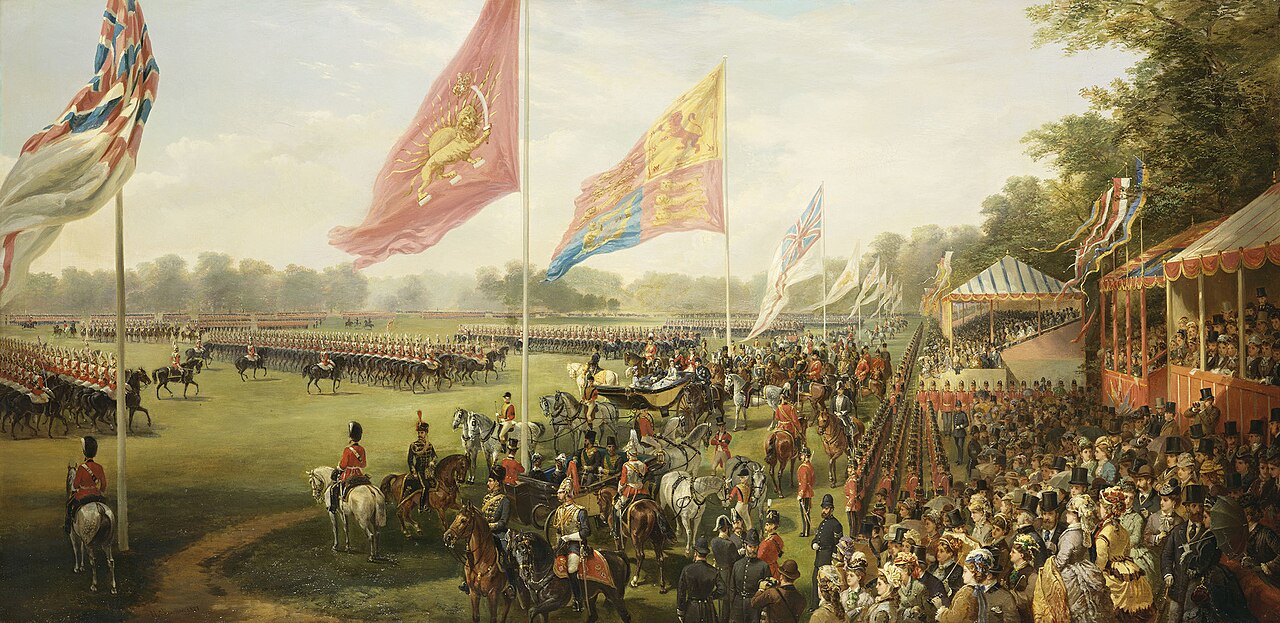
The shah left Tehran on 19 April 1873 with a large suite of princes, ministers and servants, crossed the Caspian from Anzali and travelled up the Volga to Moscow and St Petersburg. He went on to Berlin, Belgium and, in June, Britain, where Queen Victoria received him at Windsor and gave him the Order of the Garter. In London he was taken to the docks, the Crystal Palace, the Houses of Parliament and the zoo, and he visited the railway works at Crewe and factories in Manchester and Liverpool. He then saw Paris and Versailles, the Alps, northern Italy and the World’s Fair in Vienna, where Iran had its own pavilion, and returned through Istanbul and the Caucasus in September.
The British press followed him everywhere. Newspapers printed pictures of his jewelled coat, and a music-hall song asked “Have you seen the Shah?”. He in turn wrote down what struck him: the size of London, gas lighting, ironclad warships at Portsmouth, opera and ballet, the freedom with which European women went about in public.
A minister falls on the way home
The tour had an immediate political cost. His favourite wife Anis al-Dowleh had set out with him, but she was sent home from Russia because European courts were not prepared to receive a royal wife in the Persian manner. While the shah was away, courtiers, clerics and women of the harem built up a party against Sepahsalar and the sweeping concession he had granted in 1872 to Baron Julius de Reuter. When the shah landed at Anzali in September 1873, he was met with demands for the minister’s dismissal and gave way. Sepahsalar lost the premiership, and the shah cancelled the Reuter Concession. Historians such as Abbas Amanat see the episode as typical of the reign: interest in Europe, followed by retreat when reform threatened established interests.
1878: the Paris Exposition and the Cossacks
The second tour took the shah again to Russia, Germany and Austria, and to the Exposition Universelle in Paris. Its most lasting result was military. Impressed by the Cossack cavalry he had seen in the Russian Caucasus, he asked the tsar for officers to train a similar force. In 1879 the Persian Cossack Brigade was founded under Russian command. It became the best-disciplined unit in the country and a channel of Russian influence; in 1921 one of its officers, Reza Khan, used it to take Tehran (see the 1921 coup).
1889: concessions and the Eiffel Tower
On the third tour the shah travelled with his chief minister Mirza Ali Asghar Khan Amin al-Soltan and spent several weeks in Britain, where he toured country houses and industrial towns, and visited the Paris Exposition of 1889, with its newly built Eiffel Tower. The trip was closely linked to the hunt for money. In London the Iranian minister, Mirza Malkam Khan, obtained the shah’s signature on a lottery concession that soon ended in scandal. Discussions with British businessmen during the visit also prepared the tobacco monopoly granted to Major G. F. Talbot in March 1890, which provoked the Tobacco Protest.
The diaries
The shah wrote, or dictated, a daily record of each tour, in plain and often lively Persian. The diaries were lithographed in Tehran and copies sent to foreign courts. The British government had the 1873 diary translated by the orientalist James Redhouse, and the 1878 diary also appeared in English. Later Persian editions have restored passages that were cut from the first printed versions.
Readers have judged them differently. European reviewers of the 1870s found them long and repetitive, full of lists of dinners and parades. Modern historians value them as a rare record of how a Persian ruler saw industrial Europe: his curiosity about machines and museums, his comments on European women and manners, and his anxious comparisons with home. The سفرنامه (safarnâmeh), or travel account, was an old Persian genre, but the shah’s diaries brought it into the age of railways and photography. His own photographic interests are covered in photography in Qajar Iran, and his reign as a whole on the page on Naser al-Din Shah.
Persian words from this page
| فرنگ | Farang | Europe (Qajar usage) |
| سفرنامه | safarnâmeh | travel account |
| روزنامه | ruznâmeh | diary; later, newspaper |
| امتیاز | emtiyâz | concession |
| قزاق | qazzâq | Cossack |
| سپهسالار | Sepahsâlâr | commander-in-chief (a title) |
Sources and further reading
- Naser al-Din Shah, The Diary of H.M. the Shah of Persia during his Tour through Europe in A.D. 1873, trans. J. W. Redhouse (London, 1874; reprinted Mazda, 1995)
- Naser al-Din Shah, A Diary Kept by His Majesty the Shah of Persia during his Journey to Europe in 1878, trans. A. Houtum-Schindler and L. de Norman (London, 1879)
- Abbas Amanat, Pivot of the Universe: Nasir al-Din Shah Qajar and the Iranian Monarchy, 1831–1896 (University of California Press, 1997)
- Abbas Amanat, Iran: A Modern History (Yale University Press, 2017)
Want to learn Persian? Get the free Starter Pack
Get the 14-page printable Starter Pack (all 32 letters, a 7-day reading plan, 100 core words and 20 survival phrases) and a short 5-email course. Free.
More in The Qajar Dynasty (1789–1925)
- Agha Mohammad Khan Qajar
- The Battle of Krtsanisi and Sack of Tiflis (1795)
- Fath-Ali Shah Qajar
- The Qajar Court and Harem
- The Russo-Persian War of 1804–1813
- The Battle of Aslanduz (1812)
- The Treaty of Golestan (1813)
- Abbas Mirza and the First Reforms
- The Russo-Persian War of 1826–1828
- The Treaty of Turkmenchay (1828)
- The Death of Griboyedov (1829)
- Mohammad Shah and the Siege of Herat
- The Bab and the Babi Movement
- Tahirih (Qurrat al-Ayn)
- Naser al-Din Shah Qajar
- Amir Kabir
- Dar al-Funun: Iran’s First Modern School
- The Anglo-Persian War (1856–1857)
- How Iran Lost Herat
- The Great Persian Famine of 1870–1872
- The Reuter Concession (1872)
- Naser al-Din Shah’s Journeys to Europe
- The Tobacco Protest (1891–1892)
- Mirza Malkam Khan and Early Reformers
- The Assassination of Naser al-Din Shah (1896)
- Photography in Qajar Iran
- Mozaffar ad-Din Shah
- Taj al-Saltaneh
- The D’Arcy Concession and the Discovery of Oil (1908)
- The Persian Constitutional Revolution (1905–1911)
- The First Majlis and the Constitution of 1906
- The Anglo-Russian Convention of 1907
- Mohammad Ali Shah and the Bombardment of the Majlis
- The Siege of Tabriz and Sattar Khan
- The Constitutionalists Take Tehran (1909)
- The Bakhtiari and the Revolution
- Morgan Shuster and the Russian Ultimatum (1911)
- Women in the Constitutional Revolution
- Iran in the First World War
- The Persian Famine of 1917–1919
- Mirza Kuchik Khan and the Jangali Movement
- The Anglo-Persian Agreement of 1919
- The 1921 Coup: Reza Khan and Seyyed Zia
- The End of the Qajar Dynasty (1925)
- Qajar Art, Photography and Society