The siege of Tabriz was an eleven-month struggle, from June 1908 to April 1909, in which the people of Tabriz, led by Sattar Khan and Baqer Khan, refused to accept Mohammad Ali Shah’s closure of the Majlis and held out against royalist armies. Their resistance kept the constitutional movement alive while the rest of Iran submitted, and gave time for the revolts in Gilan and Isfahan that brought the shah down.
| Dates | June 1908 – late April 1909 |
|---|---|
| Place | Tabriz, capital of Azerbaijan province |
| Defenders | Constitutionalist fighters (mojâhed) under Sattar Khan and Baqer Khan, with volunteers from the Caucasus |
| Besiegers | Royal troops under Ein al-Dowleh; tribal forces of Rahim Khan Chalabianlu and Samad Khan Shoja al-Dowleh |
| End | Russian troops enter the city, 29 April 1909 |
| Titles | Sattar Khan: Sardâr-e Melli (National Commander); Baqer Khan: Sâlâr-e Melli |
Why Tabriz
Tabriz was Iran’s largest commercial city in 1908 and its gateway to Russia, the Caucasus and the Ottoman Empire. Thousands of men from Azerbaijan worked in the oil fields of Baku and the towns of the Russian Caucasus, where they met socialist and revolutionary ideas during the Russian revolution of 1905. Tabriz had one of the most active provincial councils of the constitutional era, the Anjoman of Azerbaijan, and its deputies, led by Sayyed Hasan Taqizadeh, were the radical wing of the First Majlis. The city also had a long record of political organisation in its quarters, each with its own leaders and armed men.
Sattar Khan and the quarter of Amirkhiz
When news arrived of the bombardment of the Majlis on 23 June 1908, royalists in Tabriz moved against the constitutionalists. The Davachi quarter and the clerics of the Islamiyyeh society backed the shah, and within days most of the city’s quarters had raised white flags of surrender.
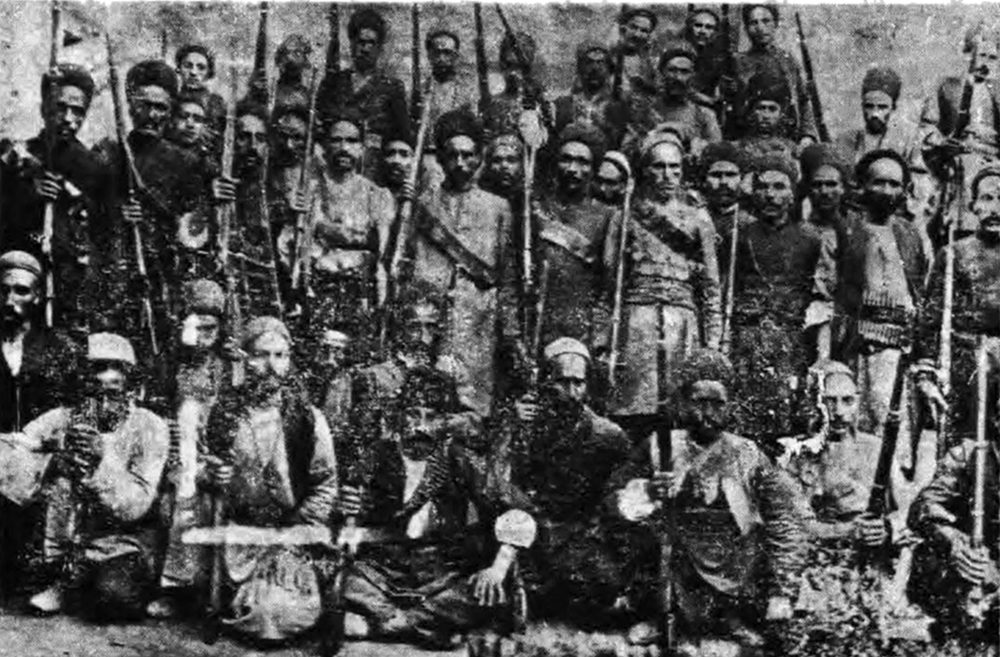
Sattar Khan held out in the Amirkhiz quarter. He came from the Qaradagh region north of Tabriz, had worked as a horse dealer and was known as a luti, a strongman of the neighbourhood with a following of armed young men. According to the story told by the historian Ahmad Kasravi, himself a Tabrizi who witnessed these years as a young man, Sattar Khan went through the streets tearing down the white flags. Baqer Khan, a bricklayer and leader of the Khiaban quarter, joined him. Over the summer their fighters drove the royalists out quarter by quarter, and by October 1908 the constitutionalists controlled the city.

The siege
The shah sent an army under Ein al-Dowleh, the former chief minister whom the protesters of 1906 had forced from office. Alongside the regular troops came the horsemen of Rahim Khan, chief of the Chalabianlu tribe of Qaradagh, and the forces of Samad Khan Shoja al-Dowleh of Maragheh. They camped outside the city and attacked the suburbs, while the defenders dug trenches and built barricades.
The defence drew on unusual resources. Volunteers came across the border from the Caucasus: Iranian workers from Baku, Georgian and Armenian revolutionaries, members of Social Democratic groups and of the Armenian Dashnak party. They brought experience of street fighting and the making of bombs. Local workshops made cartridges. The anjoman raised money, ran the city and published newspapers. Tabriz came to see itself, and to be seen across Iran, as the last place where the constitution still held.
From early 1909 the royalists cut the roads, and the siege turned into a blockade. Food ran out. By March and April people were eating grass and horses, and the death toll from hunger rose. In April a group of young men made a sortie to break through the lines and bring in supplies.
Howard Baskerville
One of them was Howard Baskerville, a 24-year-old American from Nebraska who taught at the American Presbyterian mission school in Tabriz. He had trained a company of his students and others to fight. He was shot dead during the sortie of 19 April 1909. He is buried in the Armenian cemetery in Tabriz, and Iranians still remember him as an American who died for the constitution: a bust of him stands in the Constitution House of Tabriz.
Russian troops enter Tabriz
Russia, citing danger to foreign residents, sent troops from Julfa. Under pressure from Britain and Russia the shah agreed to an armistice so that food could enter the city, and on 29 April 1909 Russian soldiers under General Snarsky marched into Tabriz. The siege was over, but the Russians stayed. Their presence, intended in part to stop the city becoming a revolutionary base, lasted with interruptions until 1917.
By the time the siege ended, the balance had shifted elsewhere. Bakhtiari tribesmen had taken Isfahan in January 1909 and revolutionaries had seized Rasht in February. In July both forces converged on the capital (see the constitutionalists take Tehran).
- 23 Jun 1908 Majlis bombarded in Tehran; royalists move against Tabriz constitutionalists
- Summer 1908 Sattar Khan holds Amirkhiz and retakes the city quarter by quarter
- Oct 1908 Constitutionalists control Tabriz; royal army under Ein al-Dowleh besieges it
- Early 1909 Roads cut; famine in the city
- 19 Apr 1909 Howard Baskerville killed in a sortie
- 29 Apr 1909 Russian troops enter Tabriz
- Dec 1911 Russian forces crush the Tabriz fighters and carry out executions
After the siege
Sattar Khan and Baqer Khan were welcomed in Tehran in 1910 as national heroes. Their fame did not save them from the new government’s fear of armed irregulars. In August 1910 government forces, led by the police chief Yeprem Khan and Bakhtiari horsemen, disarmed the fighters camped in Atabak Park in Tehran. Sattar Khan was shot in the leg in the clash. He never fully recovered and died in Tehran in 1914. Baqer Khan was killed in 1916 during the upheavals of the First World War.
Tabriz paid a heavy price for its role. When Russia forced the closure of the second Majlis in December 1911, Russian troops fought the city’s fighters and then hanged a number of constitutionalists, among them the cleric Seqat al-Eslam, executed on the day of Ashura, at the start of January 1912.
Memory and interpretation
For Kasravi, whose history of the constitution remains the fullest account of the siege, Tabriz was the heart of the revolution and Sattar Khan an ordinary man who rose to the moment. Later historians add other emphases. Janet Afary stresses the role of the Caucasian social democrats and the Tabriz anjoman in organising the defence. Others point out that Tabriz itself was divided, and that the royalist quarters and the tribal forces outside were Azerbaijanis too, so the siege was a civil war within the province as much as a fight between Tabriz and Tehran.
Today the house where the Tabriz leaders met, the Khaneh-ye Mashruteh (Constitution House), is a museum, and Sattar Khan’s statue and his title, Sardar-e Melli, are part of the city’s identity. More on the city is on the page on Tabriz, and on its people in Azerbaijanis in Iranian history.
Persian words from this page
| ستارخان | Sattâr Khân | Sattar Khan |
| سردار ملی | sardâr-e melli | national commander |
| مجاهد | mojâhed | fighter (for the constitution) |
| محاصره | mohâsereh | siege |
| تبریز | Tabriz | Tabriz |
| خانه مشروطه | Khâneh-ye Mashruteh | Constitution House |
Sources and further reading
- Ahmad Kasravi, Tarikh-e mashruteh-ye Iran and Tarikh-e hejdah-saleh-ye Azarbayjan (Eighteen-Year History of Azerbaijan).
- Edward G. Browne, The Persian Revolution of 1905–1909 (Cambridge University Press, 1910).
- Janet Afary, The Iranian Constitutional Revolution, 1906–1911 (Columbia University Press, 1996).
- Encyclopaedia Iranica, “Sattar Khan”: iranicaonline.org
- Ervand Abrahamian, Iran Between Two Revolutions (Princeton University Press, 1982).
Want to learn Persian? Get the free Starter Pack
Get the 14-page printable Starter Pack (all 32 letters, a 7-day reading plan, 100 core words and 20 survival phrases) and a short 5-email course. Free.
More in The Qajar Dynasty (1789–1925)
- Agha Mohammad Khan Qajar
- The Battle of Krtsanisi and Sack of Tiflis (1795)
- Fath-Ali Shah Qajar
- The Qajar Court and Harem
- The Russo-Persian War of 1804–1813
- The Battle of Aslanduz (1812)
- The Treaty of Golestan (1813)
- Abbas Mirza and the First Reforms
- The Russo-Persian War of 1826–1828
- The Treaty of Turkmenchay (1828)
- The Death of Griboyedov (1829)
- Mohammad Shah and the Siege of Herat
- The Bab and the Babi Movement
- Tahirih (Qurrat al-Ayn)
- Naser al-Din Shah Qajar
- Amir Kabir
- Dar al-Funun: Iran’s First Modern School
- The Anglo-Persian War (1856–1857)
- How Iran Lost Herat
- The Great Persian Famine of 1870–1872
- The Reuter Concession (1872)
- Naser al-Din Shah’s Journeys to Europe
- The Tobacco Protest (1891–1892)
- Mirza Malkam Khan and Early Reformers
- The Assassination of Naser al-Din Shah (1896)
- Photography in Qajar Iran
- Mozaffar ad-Din Shah
- Taj al-Saltaneh
- The D’Arcy Concession and the Discovery of Oil (1908)
- The Persian Constitutional Revolution (1905–1911)
- The First Majlis and the Constitution of 1906
- The Anglo-Russian Convention of 1907
- Mohammad Ali Shah and the Bombardment of the Majlis
- The Siege of Tabriz and Sattar Khan
- The Constitutionalists Take Tehran (1909)
- The Bakhtiari and the Revolution
- Morgan Shuster and the Russian Ultimatum (1911)
- Women in the Constitutional Revolution
- Iran in the First World War
- The Persian Famine of 1917–1919
- Mirza Kuchik Khan and the Jangali Movement
- The Anglo-Persian Agreement of 1919
- The 1921 Coup: Reza Khan and Seyyed Zia
- The End of the Qajar Dynasty (1925)
- Qajar Art, Photography and Society