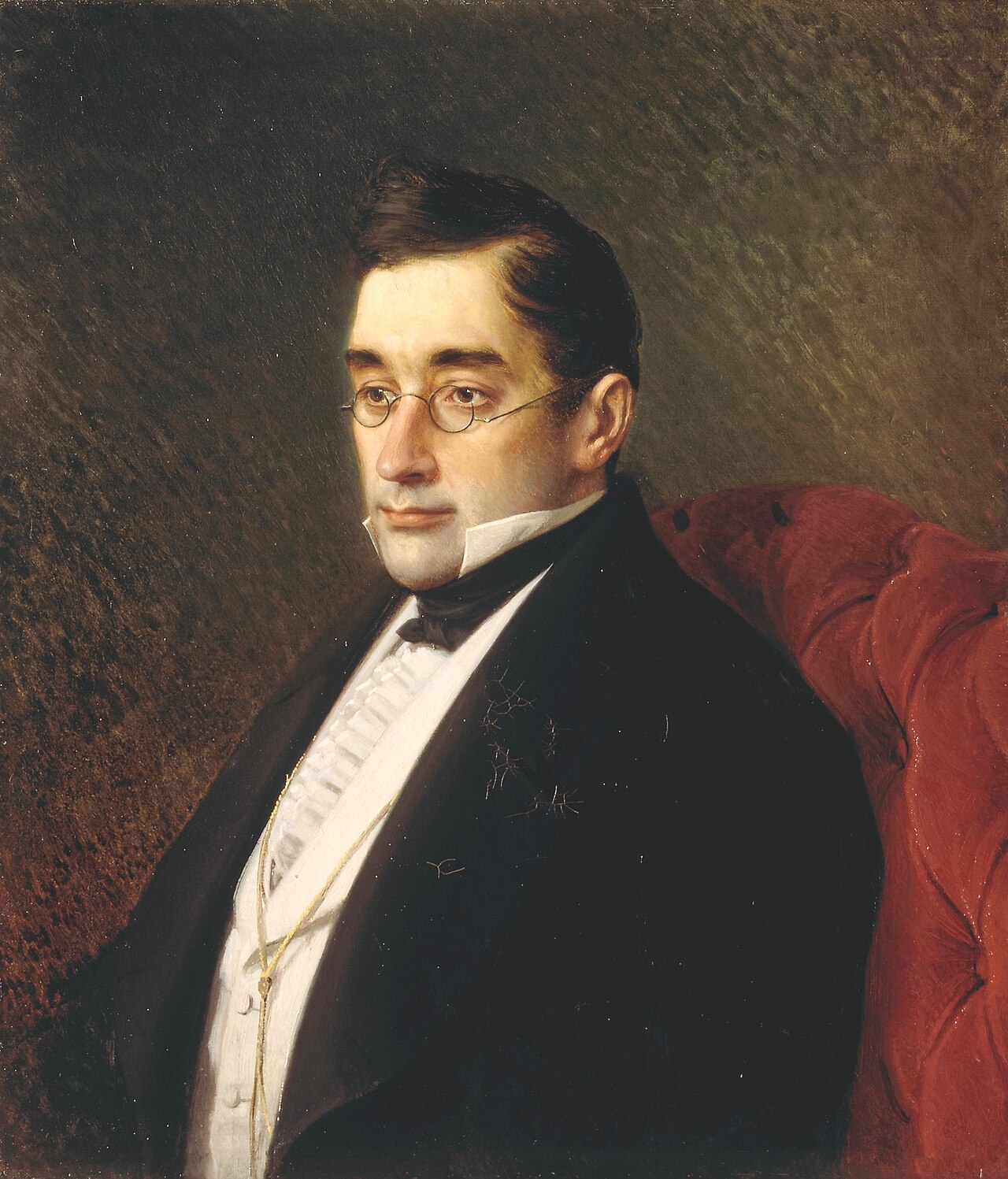
On 11 February 1829 a crowd in Tehran stormed the Russian legation and killed the Russian minister, the playwright Alexander Griboyedov, together with almost all of his mission. The riot grew out of anger at the Treaty of Turkmenchay and at the legation’s sheltering of Armenians from Muslim households who wanted to leave for Russian territory; it brought Iran close to a new war, which the shah avoided with an apology mission and the gift of a famous diamond.
| Date | 11 February 1829 (30 January Old Style) |
|---|---|
| Place | The Russian legation, Tehran |
| Victim | Alexander Sergeyevich Griboyedov (1795–1829), Russian minister plenipotentiary |
| Dead | About 37 members of the mission; many attackers also died. Figures vary. |
| Survivor | Ivan Maltsov, the legation’s secretary |
| Aftermath | Apology mission of Khosrow Mirza to St Petersburg, 1829 |
The ambassador who wrote Woe from Wit
Griboyedov was one of the most gifted Russians of his generation. His verse comedy Woe from Wit, a satire on Moscow society, circulated in manuscript and became a classic of Russian literature, though it was not staged in full during his lifetime. He was also a professional diplomat who knew Persian and had served in Tabriz in the years after the Treaty of Golestan.
During the war of 1826–1828 he worked on the staff of his relative General Paskevich and helped draft the Treaty of Turkmenchay. He was rewarded with the post of minister plenipotentiary to Iran. On the way south he married the young Georgian princess Nino Chavchavadze in Tiflis, left her at Tabriz, and travelled on to Tehran, arriving at the beginning of 1829.

A treaty enforced to the letter
Griboyedov’s instructions were to insist on the terms of Turkmenchay, above all the payment of the indemnity and Article 15, which allowed people from the ceded lands to return to Russian territory. Many Armenian and Georgian captives, taken in earlier wars and raids, lived in Iranian households, some of them converted to Islam. Under the treaty, Russian officials claimed the right to repatriate them.
Two cases brought matters to a head. Two women, described as Armenians, were taken from the household of Allahyar Khan Asaf al-Dowleh, the former chief minister and commander of Tabriz, to the legation. Then Mirza Yaqub, an Armenian from Erivan who had been made a eunuch as a boy and had risen to a senior post in the royal household, came to the legation and asked to go home. He knew the finances of the shah’s harem, and the court regarded his flight as both a scandal and a danger.
The attack on the legation
The shah’s government asked for Mirza Yaqub to be returned and Griboyedov refused. In the bazaars, the story spread that Muslim women were being held by the Russians and forced back to Christianity. A leading cleric of Tehran, Mirza Masih Astarabadi, was asked whether it was lawful to free them, and his answer was taken as permission to act. On the morning of 11 February the bazaars closed and a large crowd marched on the legation.
The Cossack guard was small. Accounts say the attackers broke in over the walls and roofs, the Russians fired back, and the death of a young man in the crowd turned the protest into a massacre. Griboyedov was killed with almost all of his staff and guards, about 37 people in the most cited count, and dozens of attackers also died. The secretary, Ivan Maltsov, survived by hiding in another part of the compound. Griboyedov’s mutilated body was later identified by an old wound to his hand from a duel.
Who was responsible
The causes are still argued over. Persian sources and the Qajar court blamed the envoy’s own conduct: his staff’s behaviour in the city and his refusal to compromise over the women and Mirza Yaqub. Russian writers often blamed British agents who feared Russian influence in Tehran, or court factions opposed to the treaty. Historians such as Laurence Kelly and George Bournoutian conclude that no single plot is proven. The anger of the city at a humiliating peace, the role of the clergy, and Griboyedov’s rigid enforcement of the treaty all played a part. Whether the shah’s government could have stopped the crowd, and whether some at court let it happen, remains uncertain.
An apology and a diamond
Fath-Ali Shah and Abbas Mirza feared that Russia would use the killing as a reason to resume the war. They sent one of Abbas Mirza’s sons, Khosrow Mirza, at the head of an embassy to St Petersburg in 1829. He apologised to Nicholas I, stated that the government had no part in the killings, and presented gifts. The best known was the Shah diamond, a long yellowish stone of almost 90 carats engraved with the names of three rulers, including Fath-Ali Shah. It is kept today in the Diamond Fund in the Moscow Kremlin.
Nicholas I accepted the apology. Russia was then at war with the Ottoman Empire and had no wish to reopen a front in Iran. He also reduced the remaining indemnity owed under Turkmenchay. The affair was closed without a new war, and Russian influence at the Qajar court continued to grow.
A grave in Tbilisi
Griboyedov’s body was carried back to Tiflis and buried at the monastery of St David on Mtatsminda hill, above the city. Nino Chavchavadze, widowed at sixteen, never remarried. The inscription she placed on his tomb, saying that his mind and works would remain immortal in Russian memory but asking why her love had outlived him, is one of the most quoted epitaphs in the Caucasus.
The incident is still remembered differently in each country. In Russia it is the tragedy of a great writer killed abroad; in Iran it is usually told as a popular reaction to foreign arrogance after a lost war. For the wider background, see the page about the Russo-Persian War of 1826–1828 and the reign of Fath-Ali Shah.
Persian words from this page
| سفارت | sefârat | embassy, legation |
| سفیر | safir | ambassador |
| مجتهد | mojtahed | senior Shi’i jurist |
| بازار | bâzâr | bazaar |
| خسرو میرزا | Khosrow Mirzâ | Khosrow Mirza |
| الماس | almâs | diamond |
Sources and further reading
- George A. Bournoutian, “Griboedov, Alexander Sergeevich”, Encyclopaedia Iranica (2002).
- Laurence Kelly, Diplomacy and Murder in Tehran: Alexander Griboyedov and Imperial Russia’s Mission to the Shah of Persia (I. B. Tauris, 2002).
- Firuz Kazemzadeh, “Iranian relations with Russia and the Soviet Union, to 1921”, in The Cambridge History of Iran, vol. 7 (1991).
- Abbas Amanat, Iran: A Modern History (Yale, 2017).
Want to learn Persian? Get the free Starter Pack
Get the 14-page printable Starter Pack (all 32 letters, a 7-day reading plan, 100 core words and 20 survival phrases) and a short 5-email course. Free.
More in The Qajar Dynasty (1789–1925)
- Agha Mohammad Khan Qajar
- The Battle of Krtsanisi and Sack of Tiflis (1795)
- Fath-Ali Shah Qajar
- The Qajar Court and Harem
- The Russo-Persian War of 1804–1813
- The Battle of Aslanduz (1812)
- The Treaty of Golestan (1813)
- Abbas Mirza and the First Reforms
- The Russo-Persian War of 1826–1828
- The Treaty of Turkmenchay (1828)
- The Death of Griboyedov (1829)
- Mohammad Shah and the Siege of Herat
- The Bab and the Babi Movement
- Tahirih (Qurrat al-Ayn)
- Naser al-Din Shah Qajar
- Amir Kabir
- Dar al-Funun: Iran’s First Modern School
- The Anglo-Persian War (1856–1857)
- How Iran Lost Herat
- The Great Persian Famine of 1870–1872
- The Reuter Concession (1872)
- Naser al-Din Shah’s Journeys to Europe
- The Tobacco Protest (1891–1892)
- Mirza Malkam Khan and Early Reformers
- The Assassination of Naser al-Din Shah (1896)
- Photography in Qajar Iran
- Mozaffar ad-Din Shah
- Taj al-Saltaneh
- The D’Arcy Concession and the Discovery of Oil (1908)
- The Persian Constitutional Revolution (1905–1911)
- The First Majlis and the Constitution of 1906
- The Anglo-Russian Convention of 1907
- Mohammad Ali Shah and the Bombardment of the Majlis
- The Siege of Tabriz and Sattar Khan
- The Constitutionalists Take Tehran (1909)
- The Bakhtiari and the Revolution
- Morgan Shuster and the Russian Ultimatum (1911)
- Women in the Constitutional Revolution
- Iran in the First World War
- The Persian Famine of 1917–1919
- Mirza Kuchik Khan and the Jangali Movement
- The Anglo-Persian Agreement of 1919
- The 1921 Coup: Reza Khan and Seyyed Zia
- The End of the Qajar Dynasty (1925)
- Qajar Art, Photography and Society