The Russo-Persian War of 1804–1813 was the first of two wars in which Qajar Iran tried to stop the Russian Empire from taking over Georgia and the Muslim khanates of the southern Caucasus. It began when Russian troops stormed Ganja in January 1804, dragged on for nine years while Russia was also fighting Napoleon and the Ottomans, and ended after the Persian defeats at Aslanduz and Lankaran with the Treaty of Golestan in 1813.
| Dates | 1804–1813 |
|---|---|
| Theatre | Georgia, the khanates of Ganja, Erivan, Karabakh, Shirvan, Baku and Talesh, and the Aras frontier |
| Iranian commander | Crown Prince Abbas Mirza, from Tabriz |
| Russian commanders | Pavel Tsitsianov, Ivan Gudovich, Alexander Tormasov, Pyotr Kotlyarevsky and others |
| Key battles | Ganja 1804, Erivan 1804 and 1808, Aslanduz 1812, Lankaran 1813 |
| Result | Russian victory; Treaty of Golestan, October 1813 |
How the war started
In 1801 Russia annexed the Georgian kingdom of Kartli-Kakheti, whose capital Agha Mohammad Khan had sacked in 1795 (see the Battle of Krtsanisi and Sack of Tiflis). The new Russian commander in the Caucasus, Prince Pavel Tsitsianov, a Georgian by descent, set out to bring the neighbouring khanates under Russian rule. These khanates, ruled by local Muslim dynasties, had long recognised the shah as overlord.
In January 1804 Tsitsianov stormed Ganja. Its khan, Javad Khan, was killed in the fighting and the town was renamed Elisavetpol after the tsar’s wife. For Fath-Ali Shah this was an attack on Iranian territory, and when Russian troops moved on toward Erivan the shah sent his army north.

The first years: Erivan and Baku
The opening campaign showed the limits of both sides. Tsitsianov besieged the fortress of Erivan in the summer of 1804 but could not take it, and withdrew after heavy losses from fighting, heat and lack of supplies. Abbas Mirza, still a teenager, commanded the Iranian forces, with the shah leading the main army himself in some seasons.
Russian pressure worked better through diplomacy and threat. In 1805 the khans of Karabakh and Sheki accepted Russian protection, and Shirvan followed. In February 1806 Tsitsianov rode up to Baku to receive the town’s surrender and was shot dead by the khan’s men during the meeting. His head was sent to the shah in Tehran. His successor, Ivan Gudovich, took Derbent, Quba and Baku that year, but failed in a second attack on Erivan in 1808.
A war inside a world war
The war was long because Russia was rarely able to give it full attention. From 1806 to 1812 it was also at war with the Ottoman Empire, and throughout the period its main concern was Napoleon. The Caucasus corps was small and often short of men and money.
Iran tried to use these European rivalries. In 1807 Napoleon promised help in the Treaty of Finkenstein and sent officers under General Gardane to train Persian troops, but he made peace with Russia at Tilsit within weeks. Britain then took over the role of patron: from 1809 British officers drilled Abbas Mirza’s infantry and artillery, and British money and guns arrived. The irony was that from 1812 Britain and Russia were allies against Napoleon, and the British, while still serving in the Persian army, pressed the shah to make peace.
Holy war and a new army
The Qajar court sought religious backing for the war. At the request of the minister Mirza Bozorg Qaem-Maqam, leading Shi’i scholars in Iran and Iraq issued rulings declaring the defence of Muslim lands against Russia a jihad, and these texts were collected and circulated. It was an early example of the clergy lending their authority to a state war, a role they would play again in 1826.
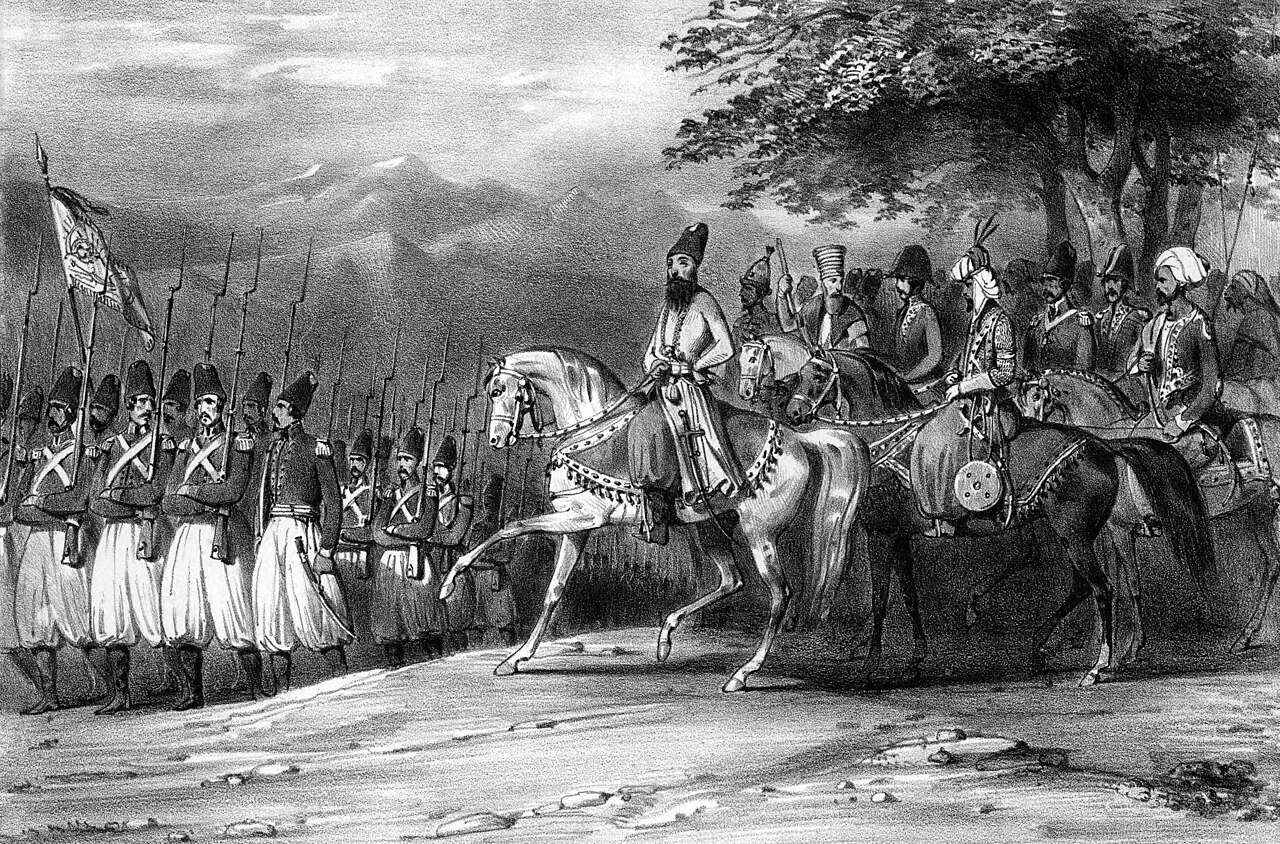
On the battlefield, Abbas Mirza built a new infantry trained and dressed on European lines, the Nezam-e Jadid or “new order”, alongside the traditional tribal cavalry. It fought better than older Persian units, but it was still small, its officers were inexperienced, and it depended on foreign instructors. The story of these reforms is told on the page about Abbas Mirza and the first reforms.
Aslanduz and Lankaran: the collapse of 1812–1813
After years of raids and indecisive fighting, the end came quickly. The Treaty of Bucharest in May 1812 ended Russia’s Ottoman war, and Napoleon’s defeat in Russia that winter freed more troops. On 31 October 1812 General Pyotr Kotlyarevsky crossed the Aras with a small force and surprised Abbas Mirza’s camp at Aslanduz at night. The Persian army broke up, losing its guns and many men; Captain Charles Christie, one of the British officers serving with it, was among those killed. That battle is covered in detail on its own page, the Battle of Aslanduz.
Kotlyarevsky then stormed the new Persian fort at Lankaran on the Caspian coast in January 1813. The assault cost both sides heavily, and the Persian garrison was nearly wiped out. With its army broken and its British allies now urging peace, the Qajar government opened negotiations.
The peace and its weaknesses
Peace was signed at the village of Golestan in Karabakh in October 1813, with the British ambassador Sir Gore Ouseley acting as mediator. Iran recognised Russian rule over Georgia, Dagestan and most of the eastern Caucasian khanates, and lost the right to keep warships on the Caspian. The terms and their consequences are explained on the page about the Treaty of Golestan.
Historians usually see the war as the moment when Iran learned that it could not match a modern European army with tribal cavalry and a few trained regiments. The treaty also left the border poorly defined, especially around Lake Gokcha (Sevan), and that vagueness helped bring on the second war of 1826–1828.
- 1801 Russia annexes Kartli-Kakheti
- Jan 1804 Tsitsianov storms Ganja
- 1804 Russian siege of Erivan fails
- 1805 Karabakh, Sheki and Shirvan accept Russian rule
- Feb 1806 Tsitsianov killed at Baku
- 1807 Treaty of Finkenstein with France
- 1808 Second Russian attack on Erivan fails
- Oct 1812 Battle of Aslanduz
- Jan 1813 Fall of Lankaran
- Oct 1813 Treaty of Golestan
Persian words from this page
| روس | Rus | Russia, the Russians |
| جنگ | jang | war |
| گنجه | Ganje | Ganja |
| ایروان | Iravân | Erivan, Yerevan |
| نظام جدید | Nezâm-e Jadid | the “new order” army |
| جهاد | jahâd | jihad, holy war |
Sources and further reading
- Muriel Atkin, Russia and Iran, 1780–1828 (University of Minnesota Press, 1980).
- Firuz Kazemzadeh, “Iranian relations with Russia and the Soviet Union, to 1921”, in The Cambridge History of Iran, vol. 7 (1991).
- Encyclopaedia Iranica, “Russia i. Russo-Iranian relations up to the Bolshevik Revolution”.
- Abbas Amanat, Iran: A Modern History (Yale, 2017).
- Alexander Mikaberidze, Conflict and Conquest in the Islamic World: A Historical Encyclopedia (ABC-CLIO, 2011).
Want to learn Persian? Get the free Starter Pack
Get the 14-page printable Starter Pack (all 32 letters, a 7-day reading plan, 100 core words and 20 survival phrases) and a short 5-email course. Free.
More in The Qajar Dynasty (1789–1925)
- Agha Mohammad Khan Qajar
- The Battle of Krtsanisi and Sack of Tiflis (1795)
- Fath-Ali Shah Qajar
- The Qajar Court and Harem
- The Russo-Persian War of 1804–1813
- The Battle of Aslanduz (1812)
- The Treaty of Golestan (1813)
- Abbas Mirza and the First Reforms
- The Russo-Persian War of 1826–1828
- The Treaty of Turkmenchay (1828)
- The Death of Griboyedov (1829)
- Mohammad Shah and the Siege of Herat
- The Bab and the Babi Movement
- Tahirih (Qurrat al-Ayn)
- Naser al-Din Shah Qajar
- Amir Kabir
- Dar al-Funun: Iran’s First Modern School
- The Anglo-Persian War (1856–1857)
- How Iran Lost Herat
- The Great Persian Famine of 1870–1872
- The Reuter Concession (1872)
- Naser al-Din Shah’s Journeys to Europe
- The Tobacco Protest (1891–1892)
- Mirza Malkam Khan and Early Reformers
- The Assassination of Naser al-Din Shah (1896)
- Photography in Qajar Iran
- Mozaffar ad-Din Shah
- Taj al-Saltaneh
- The D’Arcy Concession and the Discovery of Oil (1908)
- The Persian Constitutional Revolution (1905–1911)
- The First Majlis and the Constitution of 1906
- The Anglo-Russian Convention of 1907
- Mohammad Ali Shah and the Bombardment of the Majlis
- The Siege of Tabriz and Sattar Khan
- The Constitutionalists Take Tehran (1909)
- The Bakhtiari and the Revolution
- Morgan Shuster and the Russian Ultimatum (1911)
- Women in the Constitutional Revolution
- Iran in the First World War
- The Persian Famine of 1917–1919
- Mirza Kuchik Khan and the Jangali Movement
- The Anglo-Persian Agreement of 1919
- The 1921 Coup: Reza Khan and Seyyed Zia
- The End of the Qajar Dynasty (1925)
- Qajar Art, Photography and Society