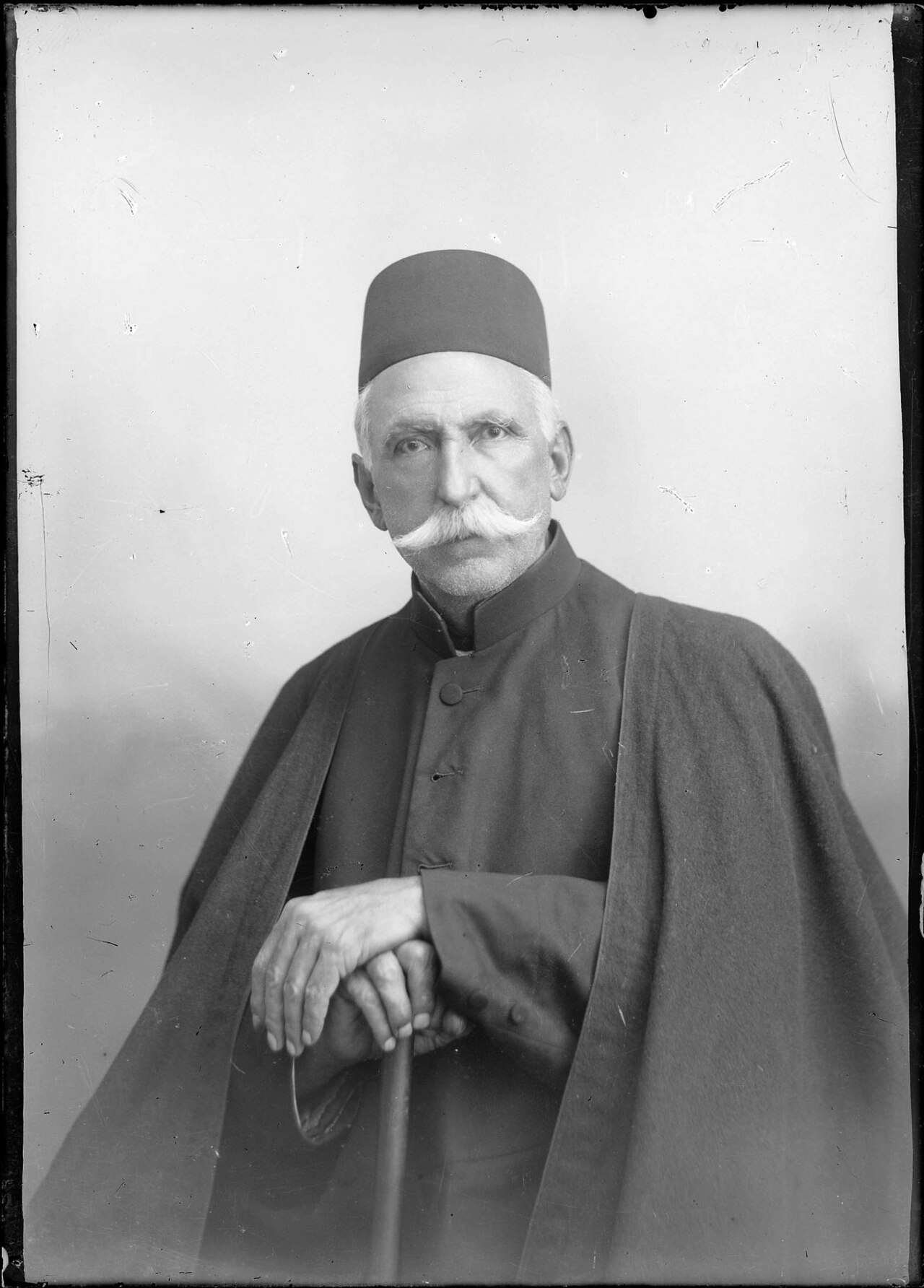
Photography reached Iran in the early 1840s, only a few years after its invention in Europe, and under Naser al-Din Shah (r. 1848–1896) the Qajar court became one of its most enthusiastic patrons anywhere. The shah photographed his own family and court, appointed official photographers and kept tens of thousands of prints in albums, while studio photographers such as Antoin Sevruguin recorded the country’s people and monuments.

The first cameras, 1840s–1850s
Daguerreotype equipment reached the court of Mohammad Shah in the early 1840s. In 1844 a French tutor at the court, Jules Richard, is reported to have made daguerreotypes of the shah and of the young crown prince, Naser al-Din Mirza; none of them has been found. After 1851 the new Dar al-Funun college became a centre for experiment. An Austrian artillery instructor, August Krziz, tried the calotype paper process, and an Italian teacher named Focchetti is credited with bringing the wet collodion process on glass, which made sharp, repeatable prints possible.
Some of the earliest surviving photographs of Iran were made by Europeans in state service. Luigi Pesce, an Italian officer who came in 1852 to train troops, photographed Persepolis and other sites in the late 1850s. Luigi Montabone, who came with an Italian diplomatic mission in 1862, produced an album of the court and of Tehran.
A shah who took pictures
Naser al-Din Shah was not just a patron. He learned the technique himself, set up a darkroom and studio in the Golestan Palace, and photographed courtiers, servants, eunuchs, his travelling camp and, above all, the women of his harem, whom no outsider could photograph. He often wrote captions on the prints in his own hand. In 1863 he had Aqa Reza, later honoured as Eqbal al-Saltaneh, trained as the first official court photographer, the عکاسباشی (akkâs-bâshi). From 1883 to the end of the reign the post was held by Abdollah Mirza Qajar, a prince who had studied photography and photolithography in Europe.
The result is an archive without parallel among nineteenth-century monarchies: the albums of the Golestan Palace hold tens of thousands of images. The shah’s own pictures of his wives, many of them informal and even humorous, are a rare inside view of the royal household (see the Qajar court and harem). His wider reign is covered on the page on Naser al-Din Shah.
Studios in Tehran and Tabriz
From the 1870s commercial studios, or عکاسخانه (akkâs-khâneh), opened for anyone who could pay. Many of the early professionals were Armenians and Georgians with links to the Caucasus, where photography had spread through Russian Tiflis. Joseph Papazian opened a studio in Tehran around 1875. The German telegraph engineer Ernst Hoeltzer, who worked in Isfahan from the 1860s to the 1880s, made thousands of glass negatives of the city’s streets, crafts and people.
Antoin Sevruguin
The best known of the studio photographers was Antoin Sevruguin (آنتوان سوریوگین), born in Tehran into an Armenian-Georgian family and trained in Tiflis. He opened a studio in Tabriz in the early 1870s and moved to Tehran later in that decade, where he worked until his death in 1933. Sevruguin photographed shahs and ministers, dervishes and water carriers, Zoroastrians and Armenian families, Persepolis and Isfahan. Trained as a painter, he composed his pictures carefully and sometimes worked on the negatives for effect.
Much of his work was lost. According to the Smithsonian’s Freer and Sackler Archives, most of his glass negatives were destroyed in 1908, when a bomb aimed at a neighbouring house during the political violence of that year damaged his studio. Hundreds of surviving negatives and prints are now in the Myron Bement Smith Collection in Washington and in the Golestan Palace.
What the photographs were for
Qajar photography served many purposes. The court used it to project royal power, with formal portraits of the shah in uniform and jewels sent abroad and copied by painters. Ministers and officials had their portraits taken as marks of status. European travellers and scholars bought views of ruins and “types” of people, and Sevruguin’s studio sold such prints widely, which has led some historians to debate how far his staged scenes reflect European tastes. Painters used photographs as models: Qajar painting changed as artists such as Kamal-ol-Molk learned to imitate photographic realism.
By the time of the Constitutional Revolution, photographs of fighters, deputies and street scenes were circulating as political images, and portraits of revolutionaries such as Sattar Khan became widely known. Today Qajar photographs are among the most important sources for social historians of the period. Many of them can be seen at the Golestan Palace in Tehran.
Persian words from this page
| عکس | aks | photograph |
| عکاس | akkâs | photographer |
| عکاسباشی | akkâs-bâshi | chief court photographer |
| عکاسخانه | akkâs-khâneh | photographic studio |
| دوربین | durbin | camera |
| آنتوان سوریوگین | Ântuân Sevriugin | Antoin Sevruguin |
Sources and further reading
- Freer Gallery of Art and Arthur M. Sackler Gallery Archives, “Iran in Photographs: History of Photography in Iran”, Smithsonian Institution: archive.asia.si.edu
- Frederick N. Bohrer (ed.), Sevruguin and the Persian Image: Photographs of Iran, 1870–1930 (Arthur M. Sackler Gallery and University of Washington Press, 1999)
- Abbas Amanat, Pivot of the Universe: Nasir al-Din Shah Qajar and the Iranian Monarchy, 1831–1896 (University of California Press, 1997)
- Carmen Pérez González, Local Portraiture: Through the Lens of the 19th-Century Iranian Photographers (Leiden University Press, 2012)
Want to learn Persian? Get the free Starter Pack
Get the 14-page printable Starter Pack (all 32 letters, a 7-day reading plan, 100 core words and 20 survival phrases) and a short 5-email course. Free.
More in The Qajar Dynasty (1789–1925)
- Agha Mohammad Khan Qajar
- The Battle of Krtsanisi and Sack of Tiflis (1795)
- Fath-Ali Shah Qajar
- The Qajar Court and Harem
- The Russo-Persian War of 1804–1813
- The Battle of Aslanduz (1812)
- The Treaty of Golestan (1813)
- Abbas Mirza and the First Reforms
- The Russo-Persian War of 1826–1828
- The Treaty of Turkmenchay (1828)
- The Death of Griboyedov (1829)
- Mohammad Shah and the Siege of Herat
- The Bab and the Babi Movement
- Tahirih (Qurrat al-Ayn)
- Naser al-Din Shah Qajar
- Amir Kabir
- Dar al-Funun: Iran’s First Modern School
- The Anglo-Persian War (1856–1857)
- How Iran Lost Herat
- The Great Persian Famine of 1870–1872
- The Reuter Concession (1872)
- Naser al-Din Shah’s Journeys to Europe
- The Tobacco Protest (1891–1892)
- Mirza Malkam Khan and Early Reformers
- The Assassination of Naser al-Din Shah (1896)
- Photography in Qajar Iran
- Mozaffar ad-Din Shah
- Taj al-Saltaneh
- The D’Arcy Concession and the Discovery of Oil (1908)
- The Persian Constitutional Revolution (1905–1911)
- The First Majlis and the Constitution of 1906
- The Anglo-Russian Convention of 1907
- Mohammad Ali Shah and the Bombardment of the Majlis
- The Siege of Tabriz and Sattar Khan
- The Constitutionalists Take Tehran (1909)
- The Bakhtiari and the Revolution
- Morgan Shuster and the Russian Ultimatum (1911)
- Women in the Constitutional Revolution
- Iran in the First World War
- The Persian Famine of 1917–1919
- Mirza Kuchik Khan and the Jangali Movement
- The Anglo-Persian Agreement of 1919
- The 1921 Coup: Reza Khan and Seyyed Zia
- The End of the Qajar Dynasty (1925)
- Qajar Art, Photography and Society