Fath-Ali Shah Qajar ruled Iran from 1797 to 1834, the second Qajar king and the nephew of the dynasty’s founder. His 37-year reign gave the dynasty its court style, its famous image of a shah with a waist-long beard and jewelled robes, and its first sustained contact with European diplomacy, but it also saw the loss of Georgia and the khanates of the southern Caucasus to Russia in two wars.
| Birth name | Baba Khan (باباخان) |
|---|---|
| Born | c. 1772 |
| Reigned | 1797–1834 |
| Capital | Tehran |
| Wars | Russia 1804–1813 and 1826–1828; Ottoman Empire 1821–1823 |
| Died | October 1834, Isfahan; buried at Qom |
| Successor | His grandson Mohammad Shah |

From Baba Khan to Shah
Baba Khan was the son of Hosayn Qoli Khan, a brother of Agha Mohammad Khan. Because his uncle was a eunuch with no children, Baba Khan was raised as heir and served as governor of Fars at Shiraz. When Agha Mohammad was murdered at Shusha in June 1797, Baba Khan hurried to Tehran, beat off rival claimants, including the Shaqaqi chief Sadeq Khan, and took the throne as Fath-Ali Shah.
He kept his uncle’s administration at first, including the grand vizier Hajji Ebrahim Khan Kalantar, the Shirazi official who had betrayed the Zands. In 1801 the shah turned on him: Hajji Ebrahim was killed and members of his family blinded or put to death. From then on no minister held comparable power for long, and the shah relied on his own sons as governors of the provinces.
A king between Napoleon and Britain
Fath-Ali Shah’s reign was the first in which Iran became a piece in European rivalries. The British, worried about threats to India from Afghanistan and France, sent Captain John Malcolm to Tehran in 1800, and an agreement followed in 1801. When Russia annexed eastern Georgia that same year and war broke out in 1804, the shah looked for a European ally who would help him against the Russians.
Napoleon offered one. By the Treaty of Finkenstein in May 1807 France promised help against Russia, and a military mission under General Gardane arrived to train Persian troops. Within weeks, however, Napoleon made peace with the tsar at Tilsit, and French support evaporated. Britain moved back in: Sir Harford Jones signed a preliminary treaty in 1809, Sir Gore Ouseley arrived as ambassador in 1811, and a Definitive Treaty in 1814 promised a British subsidy if Iran were attacked by a European power. The Persian envoy Mirza Abolhasan Khan Ilchi spent 1809–1810 in London, one of the first Iranians to describe Britain for a Persian audience.
Wars with Russia and the Ottomans
The fighting against Russia was led mainly by the crown prince Abbas Mirza from Tabriz. The first war ended with the Treaty of Golestan in 1813, which gave up Georgia and most of the eastern Caucasus. The second, from 1826, ended with the much harsher Treaty of Turkmenchay in 1828, which moved the border to the Aras river and imposed a heavy indemnity that the shah, famous for hoarding, paid only reluctantly.
Against the Ottomans the record was better. In the war of 1821–1823, Persian forces under the shah’s sons won a victory near Erzurum, and the First Treaty of Erzurum in 1823 restored the earlier frontier. Cholera, which reached Iran in these years, did more damage to both armies than battle.
The image of a king
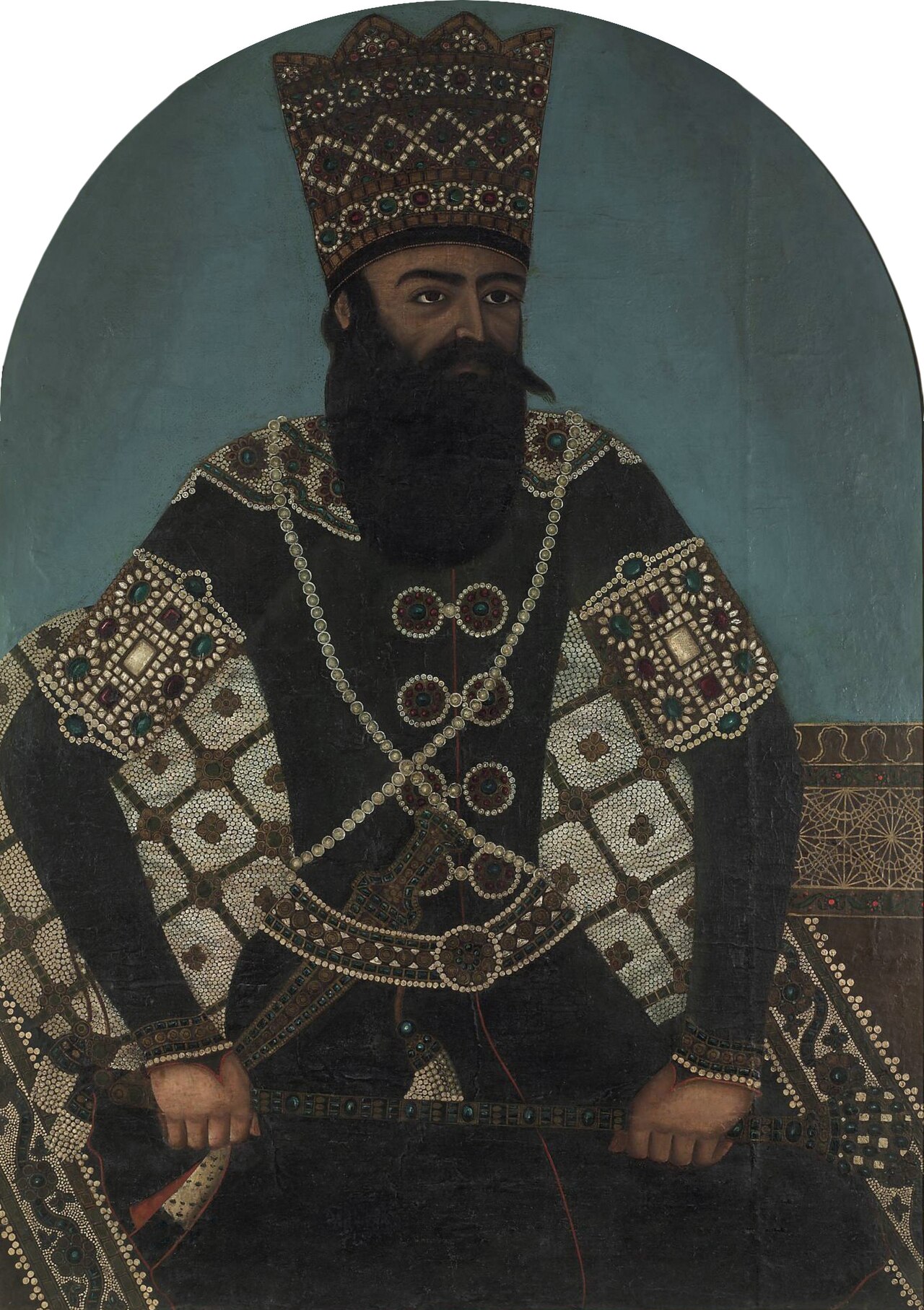
Fath-Ali Shah is the Qajar ruler whose face is best known, because he took great care over how he was seen. Court painters, above all Mihr Ali, produced life-size oil portraits of him seated or standing, with a black beard reaching to the waist, a slim figure, a crown of pearls and rubies, and armbands set with the great diamonds of the treasury. These portraits hung in palaces across the country and were sent as gifts to foreign rulers and to the East India Company.
He used older Iranian forms too. Rock reliefs in the manner of the Sasanian kings were carved in his name; one at Cheshmeh Ali, near the historic city of Rey, shows him enthroned among his sons. In Tehran he built the Takht-e Marmar, the Marble Throne, set up in 1806 on a terrace of what is now the Golestan Palace, held up by carved figures of women and demons. Court life followed elaborate rules of rank and ceremony, and the poet Fath-Ali Khan Saba wrote a dynastic epic, the Shahanshahnameh, in imitation of Ferdowsi. The shah himself wrote verse under the pen name Khaqan.
A very large family
Fath-Ali Shah had many wives and an enormous number of children. Contemporary and later counts disagree, but he is usually credited with well over a hundred children, and his descendants soon numbered in the thousands. Sons were placed as governors of provinces such as Fars, Kermanshah, Khorasan and Azerbaijan, which kept power in the family but also created rival princely courts. Life inside the royal household, and the women who ran much of it, is the subject of the page on the Qajar court and harem.
Death and a disputed succession
Abbas Mirza, the chosen heir, died in 1833, a year before his father. Fath-Ali Shah named Abbas Mirza’s son Mohammad Mirza as the new crown prince, a choice Britain and Russia had both promised to support. When the old shah died at Isfahan in October 1834, two of his sons tried to seize the throne: Ali Mirza Zell al-Soltan in Tehran and Hosayn Ali Mirza Farmanfarma in Shiraz. Both were defeated within months, and Mohammad Shah began a new reign, covered on the page about Mohammad Shah and the siege of Herat.
How historians judge him
For a long time Fath-Ali Shah was dismissed as a vain and greedy ruler who lost the Caucasus while admiring his own portraits. Historians today, including Abbas Amanat and the art historian Layla Diba, give a more mixed picture. He kept Iran politically united for nearly four decades after a century of civil war, built the ceremonial culture that the Qajars would use until 1925, and faced a European great power with resources Iran could not match. The defeats were real, but they reflected Russia’s strength as much as the shah’s failings.
Persian words from this page
| فتحعلی شاه | Fath-‘Ali Shâh | Fath-Ali Shah |
| تخت مرمر | Takht-e Marmar | the Marble Throne |
| شاهزاده | shâhzâde | prince |
| خاقان | Khâqân | khagan, the shah’s pen name |
| ریش | rish | beard |
| قم | Qom | Qom, where he is buried |
Sources and further reading
- Encyclopaedia Iranica, “Fatḥ-ʿAli Shah Qājār”.
- Gavin R. G. Hambly, “Iran during the reigns of Fath ‘Alī Shāh and Muhammad Shāh”, in The Cambridge History of Iran, vol. 7 (1991).
- Layla S. Diba and Maryam Ekhtiar (eds), Royal Persian Paintings: The Qajar Epoch, 1785–1925 (Brooklyn Museum, 1998).
- Abbas Amanat, Iran: A Modern History (Yale, 2017).
- Mirza Abul Hassan Khan, A Persian at the Court of King George 1809–10, translated and edited by Margaret Morris Cloake (1988).
Want to learn Persian? Get the free Starter Pack
Get the 14-page printable Starter Pack (all 32 letters, a 7-day reading plan, 100 core words and 20 survival phrases) and a short 5-email course. Free.
More in The Qajar Dynasty (1789–1925)
- Agha Mohammad Khan Qajar
- The Battle of Krtsanisi and Sack of Tiflis (1795)
- Fath-Ali Shah Qajar
- The Qajar Court and Harem
- The Russo-Persian War of 1804–1813
- The Battle of Aslanduz (1812)
- The Treaty of Golestan (1813)
- Abbas Mirza and the First Reforms
- The Russo-Persian War of 1826–1828
- The Treaty of Turkmenchay (1828)
- The Death of Griboyedov (1829)
- Mohammad Shah and the Siege of Herat
- The Bab and the Babi Movement
- Tahirih (Qurrat al-Ayn)
- Naser al-Din Shah Qajar
- Amir Kabir
- Dar al-Funun: Iran’s First Modern School
- The Anglo-Persian War (1856–1857)
- How Iran Lost Herat
- The Great Persian Famine of 1870–1872
- The Reuter Concession (1872)
- Naser al-Din Shah’s Journeys to Europe
- The Tobacco Protest (1891–1892)
- Mirza Malkam Khan and Early Reformers
- The Assassination of Naser al-Din Shah (1896)
- Photography in Qajar Iran
- Mozaffar ad-Din Shah
- Taj al-Saltaneh
- The D’Arcy Concession and the Discovery of Oil (1908)
- The Persian Constitutional Revolution (1905–1911)
- The First Majlis and the Constitution of 1906
- The Anglo-Russian Convention of 1907
- Mohammad Ali Shah and the Bombardment of the Majlis
- The Siege of Tabriz and Sattar Khan
- The Constitutionalists Take Tehran (1909)
- The Bakhtiari and the Revolution
- Morgan Shuster and the Russian Ultimatum (1911)
- Women in the Constitutional Revolution
- Iran in the First World War
- The Persian Famine of 1917–1919
- Mirza Kuchik Khan and the Jangali Movement
- The Anglo-Persian Agreement of 1919
- The 1921 Coup: Reza Khan and Seyyed Zia
- The End of the Qajar Dynasty (1925)
- Qajar Art, Photography and Society