The Russo-Persian War of 1826–1828 was Qajar Iran’s attempt to win back the Caucasian lands lost in 1813. It opened with a fast Persian advance in the summer of 1826, turned after Russian victories at Shamkhor and Ganja, and ended in 1827 with the fall of Erivan and the Russian occupation of Tabriz, which forced Iran to accept the Treaty of Turkmenchay in February 1828.
| Dates | July 1826 – February 1828 |
|---|---|
| Iranian commander | Crown Prince Abbas Mirza |
| Russian commanders | Alexei Yermolov, then Ivan Paskevich; Valerian Madatov, Georgy Eristov |
| Key events | Siege of Shusha 1826; Shamkhor and Ganja (Elisavetpol) 1826; Abbasabad, Erivan and Tabriz 1827 |
| Result | Russian victory; Treaty of Turkmenchay, 1828 |
| Persian name | دوره دوم جنگهای ایران و روس |
Why Iran went back to war
The Treaty of Golestan had left the frontier between Karabakh and Erivan undefined. In 1825 Russian troops under General Alexei Yermolov, the commander in the Caucasus, occupied disputed ground on the shores of Lake Gokcha (Sevan), which Iran considered its own. Talks went nowhere, and Yermolov made no secret of his contempt for the Persian court.
Inside Iran, pressure for war came from several directions. Exiled khans from the lost territories wanted their lands back. Refugees and travellers reported harsh treatment of Muslims under Russian rule. Most important, leading Shi’i clerics, headed by Aqa Sayyed Mohammad Esfahani, came to the court and declared a holy war, warning that they would hold the shah responsible if he refused. At a council held at the summer camp of Soltaniyeh in 1826, the war party won. Abbas Mirza, who knew the army’s limits, had argued for caution, but he took command once the decision was made. A Russian envoy, Prince Alexander Menshikov, who had come to negotiate, was held back as hostilities began.
The summer offensive of 1826
Iranian forces crossed the border in July 1826 without a formal declaration. The first weeks went well. Local populations in Ganja, Shirvan, Sheki and Talesh rose against their Russian garrisons, Lankaran was retaken, and Russian troops withdrew from much of the eastern Caucasus. Abbas Mirza himself laid siege to the fortress of Shusha in Karabakh.
The siege was the turning point. The small Russian garrison under Colonel Iosif Reutt held out for about seven weeks, and the time it bought allowed Russian reinforcements to gather in Georgia. Iranian columns spread across the region lost momentum.
Shamkhor and Ganja
In September 1826 General Valerian Madatov routed a Persian force at Shamkhor, where its commander, Amir Khan Qajar, was killed, and then reoccupied Ganja. Abbas Mirza raised the siege of Shusha and marched to meet the Russians near Ganja, which the Russians called Elisavetpol. There a smaller Russian army, now under the rising general Ivan Paskevich, broke the Persian lines. The Persian regular infantry fought, but the cavalry gave way, and the army retreated across the Aras.
The tsar, Nicholas I, distrusted Yermolov, and in early 1827 Paskevich formally replaced him as commander in the Caucasus.

1827: Erivan and Tabriz fall
Paskevich began the new season with a methodical campaign against the khanates of Erivan and Nakhchivan. In July 1827 he took the fortress of Abbasabad on the Aras after defeating a relief force led by Abbas Mirza. In August Abbas Mirza won a local success near Oshakan, close to Etchmiadzin, but could not follow it up.
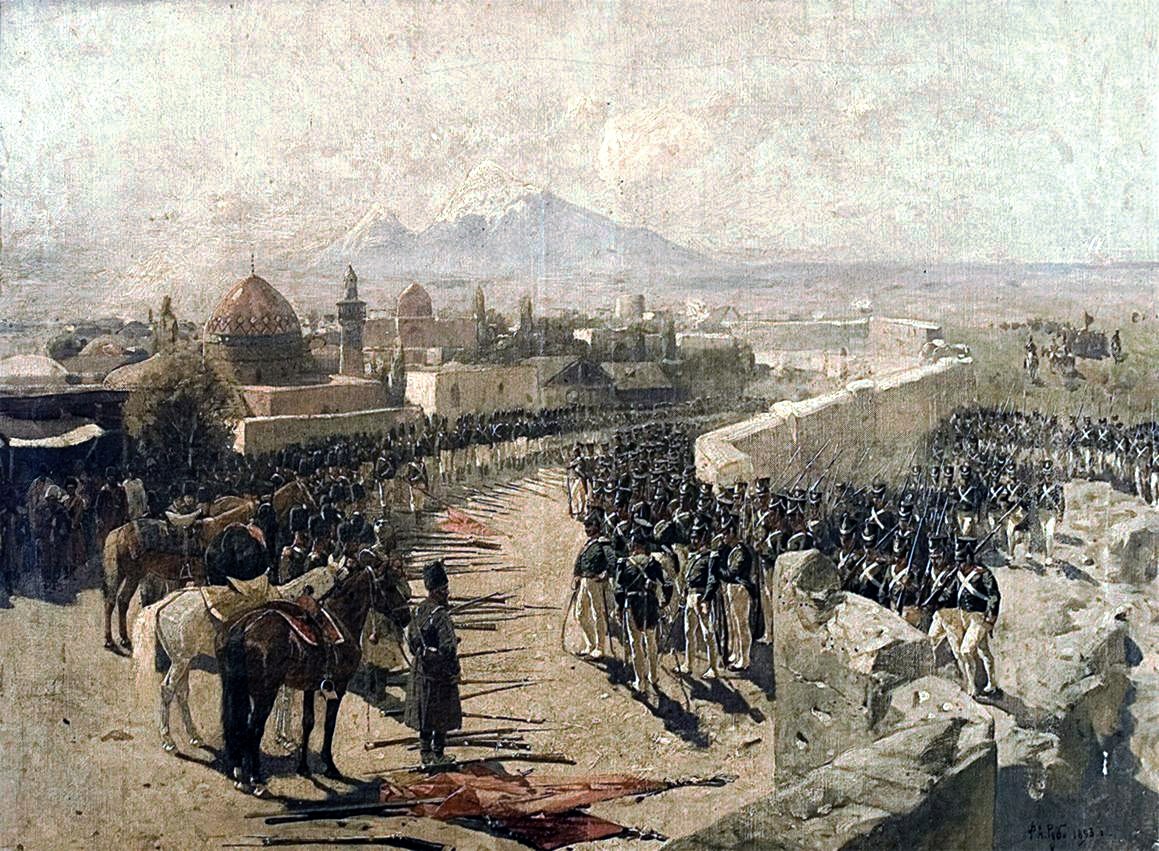
Erivan, which Russian armies had failed to take in 1804 and 1808, fell after a siege and bombardment in October 1827. Its governor, Hosayn Khan Sardar, escaped beforehand. Days later a Russian column under General Georgy Eristov entered Tabriz, the crown prince’s capital, almost without resistance, a humiliation that shocked the court. The commander of the city, Allahyar Khan Asaf al-Dowleh, was disgraced. Russian troops later raided Ardabil and Urmia, and Paskevich was ready to advance toward Tehran.
Peace at Turkmenchay
Talks began in November 1827. Fath-Ali Shah delayed over the size of the indemnity, and fighting resumed briefly, but the threat to the capital ended resistance. Abbas Mirza and Paskevich signed the peace at the village of Turkmenchay, south-east of Tabriz, in February 1828. The terms, including the Aras border, a large indemnity and legal privileges for Russian subjects, are explained on the page about the Treaty of Turkmenchay.
Why Iran lost again
Historians point to several causes. The decision for war was driven by religious and political pressure rather than by military readiness, and Abbas Mirza’s warnings were overruled. The Persian state could not pay or supply a large army for long, while Russia, unlike in the first war, was at peace in Europe and could concentrate on the Caucasus. British help was limited: by the treaty of 1814 Britain promised aid only if Iran was attacked, and London judged that Iran had started this war.
The war also left lasting resentments. The clergy who had called for jihad blamed the government for defeat; the court blamed the clergy for pushing it into war. A year after the peace, anger over its terms helped bring about the killing of the Russian envoy in Tehran, described on the page about the death of Griboyedov. Readers comparing the two conflicts can start with the Russo-Persian War of 1804–1813.
- 1825 Russian troops occupy land near Lake Gokcha
- 1826 Council of Soltaniyeh decides on war
- Jul 1826 Persian forces cross the border
- Aug–Sep 1826 Siege of Shusha
- Sep 1826 Battles of Shamkhor and Ganja
- Jul 1827 Russians take Abbasabad
- Oct 1827 Fall of Erivan; Russians enter Tabriz
- Feb 1828 Treaty of Turkmenchay
Persian words from this page
| شوشی | Shushi | Shusha |
| ارس | Aras | the Aras river |
| سلطانیه | Soltâniye | Soltaniyeh |
| سپاه | sepâh | army |
| شکست | shekast | defeat |
| صلح | solh | peace |
Sources and further reading
- Muriel Atkin, Russia and Iran, 1780–1828 (University of Minnesota Press, 1980).
- Firuz Kazemzadeh, “Iranian relations with Russia and the Soviet Union, to 1921”, in The Cambridge History of Iran, vol. 7 (1991).
- Hamid Algar, Religion and State in Iran, 1785–1906: The Role of the Ulama in the Qajar Period (University of California Press, 1969).
- Encyclopaedia Iranica, “Russia i. Russo-Iranian relations up to the Bolshevik Revolution”.
- Abbas Amanat, Iran: A Modern History (Yale, 2017).
Want to learn Persian? Get the free Starter Pack
Get the 14-page printable Starter Pack (all 32 letters, a 7-day reading plan, 100 core words and 20 survival phrases) and a short 5-email course. Free.
More in The Qajar Dynasty (1789–1925)
- Agha Mohammad Khan Qajar
- The Battle of Krtsanisi and Sack of Tiflis (1795)
- Fath-Ali Shah Qajar
- The Qajar Court and Harem
- The Russo-Persian War of 1804–1813
- The Battle of Aslanduz (1812)
- The Treaty of Golestan (1813)
- Abbas Mirza and the First Reforms
- The Russo-Persian War of 1826–1828
- The Treaty of Turkmenchay (1828)
- The Death of Griboyedov (1829)
- Mohammad Shah and the Siege of Herat
- The Bab and the Babi Movement
- Tahirih (Qurrat al-Ayn)
- Naser al-Din Shah Qajar
- Amir Kabir
- Dar al-Funun: Iran’s First Modern School
- The Anglo-Persian War (1856–1857)
- How Iran Lost Herat
- The Great Persian Famine of 1870–1872
- The Reuter Concession (1872)
- Naser al-Din Shah’s Journeys to Europe
- The Tobacco Protest (1891–1892)
- Mirza Malkam Khan and Early Reformers
- The Assassination of Naser al-Din Shah (1896)
- Photography in Qajar Iran
- Mozaffar ad-Din Shah
- Taj al-Saltaneh
- The D’Arcy Concession and the Discovery of Oil (1908)
- The Persian Constitutional Revolution (1905–1911)
- The First Majlis and the Constitution of 1906
- The Anglo-Russian Convention of 1907
- Mohammad Ali Shah and the Bombardment of the Majlis
- The Siege of Tabriz and Sattar Khan
- The Constitutionalists Take Tehran (1909)
- The Bakhtiari and the Revolution
- Morgan Shuster and the Russian Ultimatum (1911)
- Women in the Constitutional Revolution
- Iran in the First World War
- The Persian Famine of 1917–1919
- Mirza Kuchik Khan and the Jangali Movement
- The Anglo-Persian Agreement of 1919
- The 1921 Coup: Reza Khan and Seyyed Zia
- The End of the Qajar Dynasty (1925)
- Qajar Art, Photography and Society