The Jangali movement (نهضت جنگل, “movement of the forest”) was an armed uprising in the forests of Gilan, on Iran’s Caspian coast, led by Mirza Kuchik Khan from about 1915 until his death in December 1921. It began as a fight against foreign occupation and a weak government in Tehran, allied in 1920 with the Bolsheviks to proclaim a Soviet republic in Rasht, then broke apart and was crushed by the forces of Reza Khan.
| Leader | Mirza Kuchik Khan (Yunes), 1880–1921, born in Rasht |
|---|---|
| Region | The forests of Gilan, base first at Kasma, west of Rasht |
| Active | c. 1915 – December 1921 |
| Opponents | Russian troops, British forces (1918), Tehran governments |
| Soviet Republic | Proclaimed in Rasht, June 1920 |
| End | Government forces retake Gilan, autumn 1921; Kuchik Khan dies in the mountains, December 1921 |
A seminary student turned guerrilla
Mirza Yunes, known as Mirza Kuchik Khan (his name is pronounced Kuchak in Persian), was born in Rasht in 1880 and studied at religious schools in Rasht and Tehran. He joined the constitutional movement in Gilan, took part in the march on Tehran in 1909 (see the constitutionalists take Tehran) and fought the forces of the deposed shah in 1911. When Russian power returned to the north after the ultimatum of 1911, the Russian consulate had him expelled from Gilan.
During the First World War, with Russian troops in the province and the government in Tehran unable to act, Kuchik Khan returned and took to the dense forests of the Caspian slopes. With a small band he formed a committee called Ettehad-e Eslam, the Union of Islam, which combined Islamic, constitutional and patriotic language. Its newspaper Jangal called for the expulsion of foreign troops, the end of corruption and the restoration of the constitution. The Jangalis wore their hair and beards long, vowing not to cut them until their goals were won, and received some help from Ottoman and German officers.
Russians, British and the road to Baku
The Jangalis grew stronger as Russian power collapsed after 1917. By early 1918 they controlled most of Gilan, collected taxes and kept order, and Rasht’s merchants, landowners and peasants supported them in different degrees. Their position on the road between Qazvin and the Caspian port of Anzali brought them into conflict with Britain. In June 1918 the British column known as Dunsterforce, with White Russian troops under Colonel Bicherakhov, defeated the Jangalis at Manjil, using armoured cars, artillery and aircraft. Kuchik Khan made a truce with the British in August 1918 that let their forces pass to Baku (see Iran in the First World War).
In 1919 the government of Vosuq al-Dowleh, which had just signed the Anglo-Persian Agreement, sent troops against the movement. The Jangalis lost ground and some leaders surrendered; one of them, Dr Heshmat, was hanged in Rasht despite a promise of safety.

The Soviet Republic of Gilan, 1920
In May 1920 a Soviet naval force under Fyodor Raskolnikov, pursuing the remnants of a White Russian fleet, landed at Anzali. The British garrison withdrew. Kuchik Khan, who needed allies, met the Bolsheviks and agreed to cooperate, and in early June 1920 a Persian Soviet Socialist Republic was proclaimed in Rasht, with Kuchik Khan at the head of its Council of People’s Commissars. It declared war on the government in Tehran and on the British.
The alliance was uneasy from the start. Kuchik Khan was a Muslim nationalist who respected property and religion; the Iranian communists of the Edalat party and some Soviet officers wanted land seizures and attacks on the clergy. Within weeks he withdrew to the forest, and at the end of July 1920 his former ally Ehsanollah Khan and the communists took over Rasht. Their attempted march on Tehran that summer was beaten back by the Cossack Brigade.
The end of the movement
In 1921 everything changed. In Tehran, the coup of February 1921 brought Reza Khan to power, and the new government signed a treaty with Soviet Russia on 26 February 1921 in which Moscow renounced tsarist privileges. Moscow, now also seeking trade with Britain, lost interest in exporting revolution to Iran. A last attempt at unity, mediated by the veteran revolutionary Haydar Khan Amu-oghli, collapsed in violence: in the autumn of 1921 Haydar Khan was seized and killed in a clash with Jangali forces. Soviet troops left Gilan in September 1921.
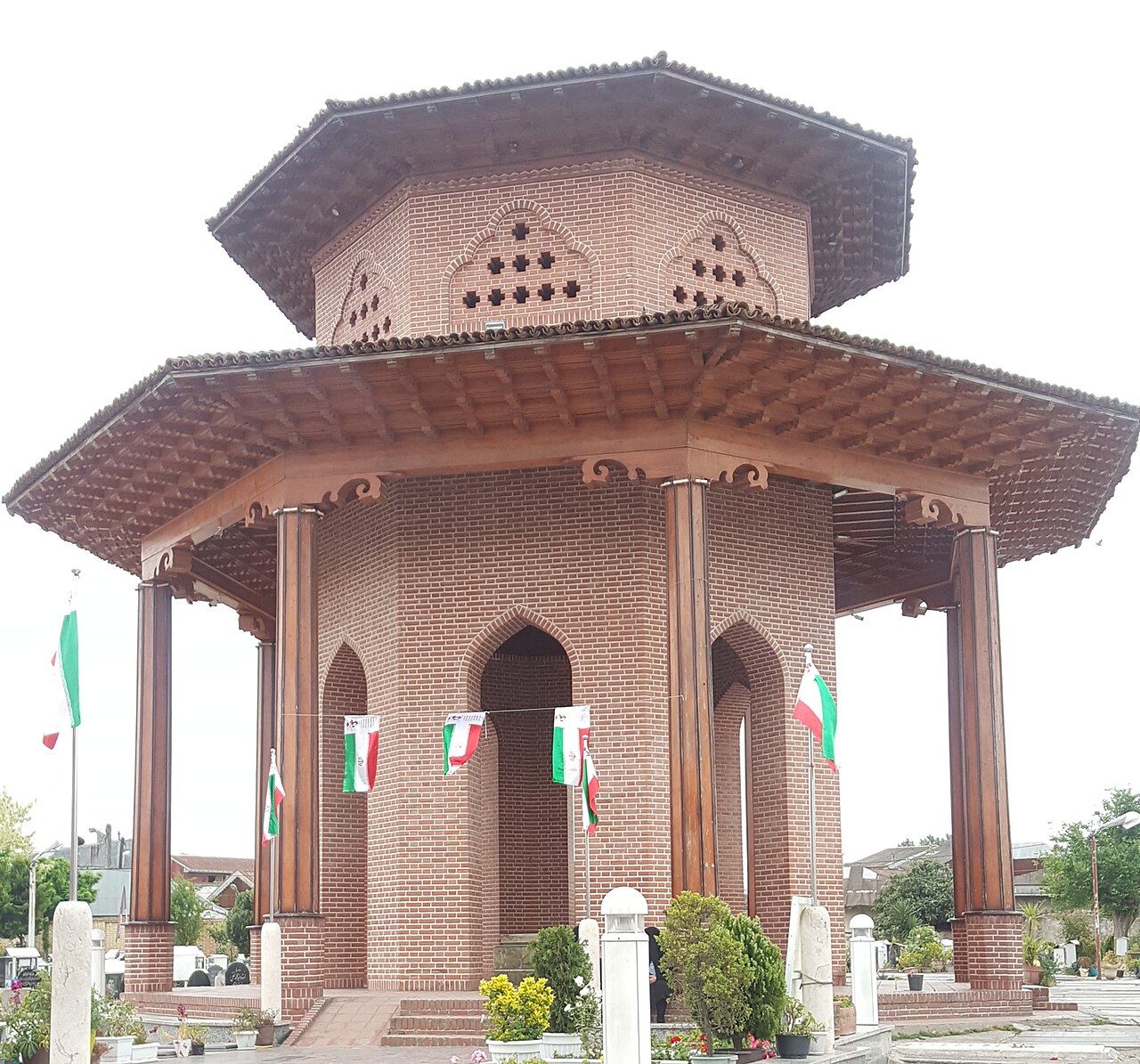
Government forces under Reza Khan then retook Rasht and the province. Kuchik Khan, with a few companions including a German comrade known as Gauk, tried to escape across the Talesh mountains towards Khalkhal. They were caught in a snowstorm and died of cold in early December 1921. His body was found by local men, who cut off the head; it was taken to Rasht and then to Tehran and shown to Reza Khan. His body was buried at Soleymandarab in Rasht; his head was later returned and buried with it.
- c. 1915 Kuchik Khan forms a guerrilla band in the forests of Gilan
- Jun 1918 Defeat by Dunsterforce at Manjil; truce with the British in August
- 1919 Government offensive against the Jangalis
- May 1920 Soviet fleet lands at Anzali
- Jun 1920 Persian Soviet Socialist Republic proclaimed in Rasht
- Jul 1920 Split with the communists
- Feb 1921 Coup in Tehran; Soviet-Iranian treaty
- Dec 1921 Kuchik Khan dies in the Talesh mountains
A contested hero
Few figures of the period are claimed by so many sides. Iranian nationalists remember Kuchik Khan as an incorruptible patriot who fought foreign armies; the Islamic Republic honours him as a Muslim fighter against imperialism, and streets and an expressway carry his name; leftist historians have seen the Gilan republic as Iran’s first attempt at socialist revolution, betrayed by Soviet policy. Historians such as Cosroe Chaqueri, who studied the Soviet archives, stress how far the republic’s fate was decided in Moscow. Pahlavi-era writing tended to portray the movement as rebellion and separatism, which Kuchik Khan himself always denied. More about the region is on the page on Rasht.
Persian words from this page
| جنگل | jangal | forest |
| جنگلی | jangali | “of the forest”, a Jangali fighter |
| میرزا کوچک خان | Mirzâ Kuchak Khân | Mirza Kuchik Khan |
| گیلان | Gilân | Gilan |
| نهضت | nehzat | movement |
| اتحاد اسلام | Ettehâd-e Eslâm | Union of Islam |
Sources and further reading
- Ebrahim Fakhrai, Sardar-e Jangal (Tehran, 1965), a history by a member of the movement.
- Cosroe Chaqueri, The Soviet Socialist Republic of Iran, 1920–1921: Birth of the Trauma (University of Pittsburgh Press, 1995).
- Encyclopaedia Iranica, “Jangali Movement”: iranicaonline.org
- L. C. Dunsterville, The Adventures of Dunsterforce (London, 1920).
- Ervand Abrahamian, Iran Between Two Revolutions (Princeton University Press, 1982).
Want to learn Persian? Get the free Starter Pack
Get the 14-page printable Starter Pack (all 32 letters, a 7-day reading plan, 100 core words and 20 survival phrases) and a short 5-email course. Free.
More in The Qajar Dynasty (1789–1925)
- Agha Mohammad Khan Qajar
- The Battle of Krtsanisi and Sack of Tiflis (1795)
- Fath-Ali Shah Qajar
- The Qajar Court and Harem
- The Russo-Persian War of 1804–1813
- The Battle of Aslanduz (1812)
- The Treaty of Golestan (1813)
- Abbas Mirza and the First Reforms
- The Russo-Persian War of 1826–1828
- The Treaty of Turkmenchay (1828)
- The Death of Griboyedov (1829)
- Mohammad Shah and the Siege of Herat
- The Bab and the Babi Movement
- Tahirih (Qurrat al-Ayn)
- Naser al-Din Shah Qajar
- Amir Kabir
- Dar al-Funun: Iran’s First Modern School
- The Anglo-Persian War (1856–1857)
- How Iran Lost Herat
- The Great Persian Famine of 1870–1872
- The Reuter Concession (1872)
- Naser al-Din Shah’s Journeys to Europe
- The Tobacco Protest (1891–1892)
- Mirza Malkam Khan and Early Reformers
- The Assassination of Naser al-Din Shah (1896)
- Photography in Qajar Iran
- Mozaffar ad-Din Shah
- Taj al-Saltaneh
- The D’Arcy Concession and the Discovery of Oil (1908)
- The Persian Constitutional Revolution (1905–1911)
- The First Majlis and the Constitution of 1906
- The Anglo-Russian Convention of 1907
- Mohammad Ali Shah and the Bombardment of the Majlis
- The Siege of Tabriz and Sattar Khan
- The Constitutionalists Take Tehran (1909)
- The Bakhtiari and the Revolution
- Morgan Shuster and the Russian Ultimatum (1911)
- Women in the Constitutional Revolution
- Iran in the First World War
- The Persian Famine of 1917–1919
- Mirza Kuchik Khan and the Jangali Movement
- The Anglo-Persian Agreement of 1919
- The 1921 Coup: Reza Khan and Seyyed Zia
- The End of the Qajar Dynasty (1925)
- Qajar Art, Photography and Society