Mozaffar ad-Din Shah (1853–1907) was the fifth Qajar shah, ruling Iran from May 1896, after his father Naser al-Din Shah was assassinated, until his death in January 1907. A sick and easy-going ruler, he financed his court and his journeys to Europe with large Russian loans and granted the D’Arcy oil concession of 1901; at the end of his life he signed the decree for a parliament and the country’s first constitution.
| Born | 23 March 1853, Tehran |
|---|---|
| Crown prince | Governor of Azerbaijan at Tabriz for over three decades |
| Reigned | 1 May 1896 – January 1907 |
| Chief ministers | Amin al-Soltan; Amin al-Dowleh (1897–1898); Amin al-Soltan again (1898–1903); Ein al-Dowleh (1904–1906); Moshir al-Dowleh (1906) |
| Journeys to Europe | 1900, 1902, 1905 |
| Buried | Karbala |
| Persian name | مظفرالدین شاه قاجار |
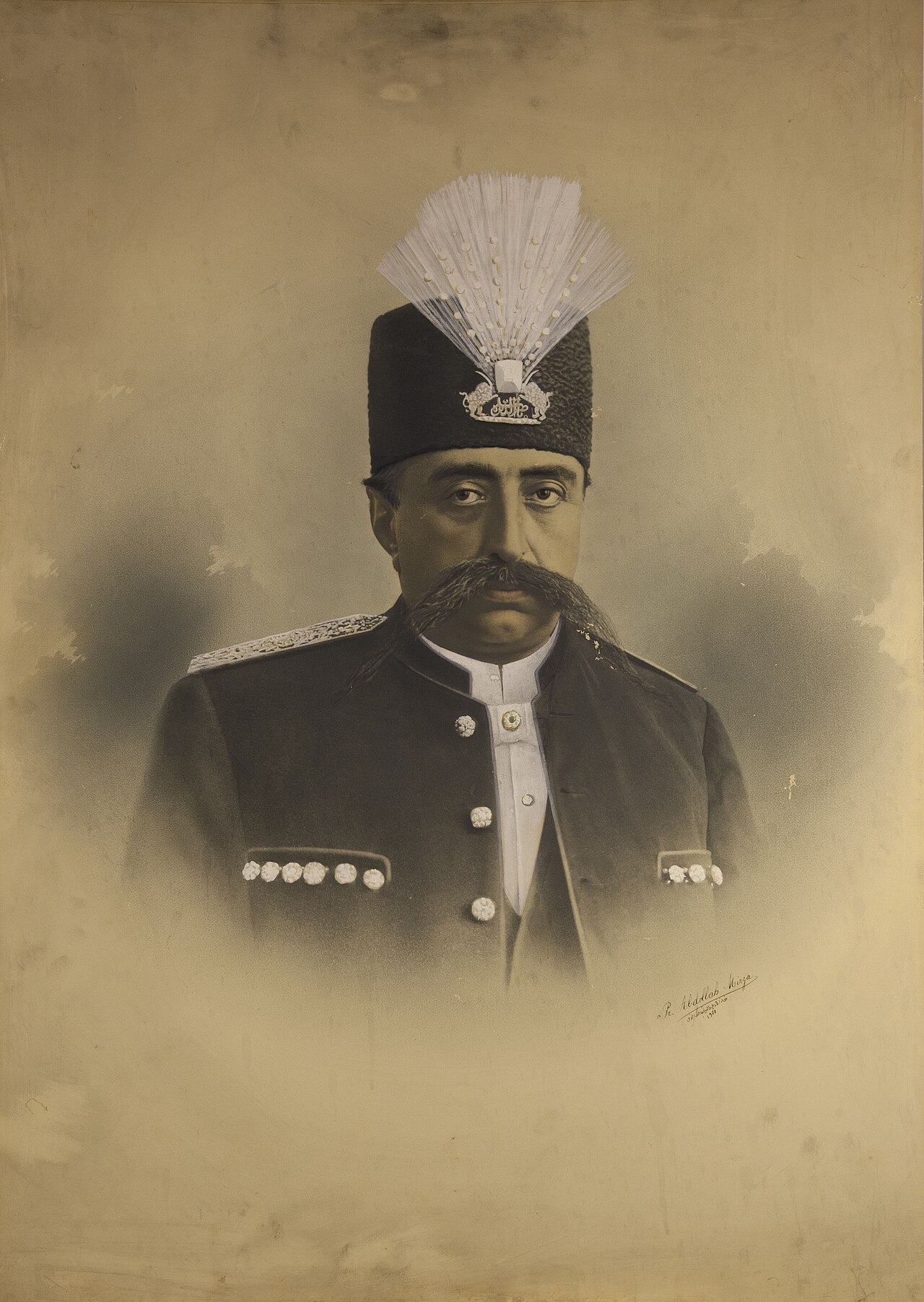

Thirty-five years as crown prince
Mozaffar al-Din was named heir as a child and sent to Tabriz, the traditional seat of the Qajar crown prince, in 1861. He stayed there until his father’s death in 1896. The post was meant as training, but Naser al-Din kept him away from real power, and the crown prince’s court in Tabriz became known for its debts, its favourites and its influence by Russian and Ottoman consuls. His health was poor from youth; he suffered from kidney disease and a weak heart, and was much given to worry about illness.
When his father was shot in May 1896 (see the assassination of Naser al-Din Shah), the chief minister Amin al-Soltan held the capital until Mozaffar al-Din arrived from Tabriz to take the throne. He was 43, and he brought with him a crowd of Tabriz courtiers who expected rewards.
An empty treasury
The new shah inherited a weak budget and the debt left by the Tobacco Protest. He was generous with pensions, gifts and titles, and the costs of the court rose. Reform-minded officials tried to put state finances in order. Amin al-Dowleh, chief minister from 1897 to 1898, encouraged new schools and tried to raise a loan in Europe, but failed and was dismissed.
The Belgian customs administration
One reform that did work was in the customs. From 1898 a team of Belgian officials led by Joseph Naus took over the collection of customs duties, first in some provinces and then across the country. Customs revenue rose sharply. But merchants resented the new strictness, and Naus, a foreign Christian who rose to control customs, posts and other offices, became one of the most disliked men in Iran.
Russian loans
Amin al-Soltan, back in office from 1898, turned to Russia. In 1900 Iran borrowed 22.5 million roubles from the Russian state-backed Discount and Loan Bank, and in 1902 a further 10 million. The conditions were heavy: the loans were secured on Iran’s customs (except those of Fars and the Persian Gulf ports, already pledged to Britain), the first loan was used partly to pay off the British loan of 1892, and Iran promised not to borrow elsewhere without Russian consent. A new customs tariff agreed with Russia in 1902–1903 favoured Russian goods and raised duties on many items Iranian merchants traded.
Three journeys to Europe
Much of the borrowed money paid for travel. Like his father, the shah went to Europe three times, in 1900, 1902 and 1905, visiting spas for his health as well as capitals. The journeys produced travel diaries in his name and some memorable moments. At the Paris Exposition of 1900 he saw the cinematograph and ordered equipment; his photographer Mirza Ebrahim Khan Akkasbashi filmed a flower festival at Ostend that summer, footage usually counted as the beginning of Iranian cinema. On his visit to Britain in 1902 he hoped for the Order of the Garter, which Edward VII at first refused to give to a non-Christian; it was awarded in 1903 after diplomatic pressure.
At home, the sight of foreign loans spent on royal tours became a powerful grievance.
The D’Arcy concession
The most consequential act of the reign was quieter. On 28 May 1901 the shah granted the British investor William Knox D’Arcy a sixty-year concession to explore for and extract oil across most of Iran, excluding the five northern provinces near Russia. Iran received a cash payment, shares, and 16 per cent of annual net profits. Little was expected from it at the time. Oil was struck at Masjed Soleyman in 1908, after the shah’s death; the story is told in the D’Arcy concession and the discovery of oil.
Protest and the constitution
From 1904 the chief minister was Ein al-Dowleh, a Qajar prince and the shah’s son-in-law, who firmly opposed reform. Merchants angry at Naus and the tariff, clerics who disliked foreign influence, and a new class of educated reformers came together in 1905–1906. After protests and the mass sit-ins (bast) at the shrine of Shah Abdol-Azim and then at the British legation, the shah dismissed Ein al-Dowleh and on 5 August 1906 signed a decree for an elected assembly.
The Majlis opened in October 1906. On 30 December 1906, already gravely ill, Mozaffar al-Din signed the Fundamental Law, the first part of Iran’s constitution. He died in early January 1907 and was buried at Karbala. His son Mohammad Ali Shah, who succeeded him, would try to undo what his father had signed. The events are told in the Constitutional Revolution and the First Majlis and the constitution of 1906.
How he is remembered
Mozaffar al-Din has had a mixed reputation. He is often portrayed as weak, extravagant and in the hands of his ministers and foreign creditors, and the loans of his reign tied Iran more closely to Russia. Yet he was also mild and less suspicious than his father; he allowed new schools and newspapers to spread, and in the end he accepted a constitution rather than fight his subjects. In Iran today he is remembered above all as the shah who signed the constitution.
Persian words from this page
| مظفرالدین شاه | Mozaffar od-Din Shâh | Mozaffar ad-Din Shah |
| وام | vâm | loan |
| گمرک | gomrok | customs |
| سینما | sinamâ | cinema |
| مشروطه | mashrute | constitutional (government) |
| تبریز | Tabriz | Tabriz |
Sources and further reading
- Encyclopaedia Iranica, “Mozaffar-al-Din Shah Qajar” (iranicaonline.org).
- Firuz Kazemzadeh, Russia and Britain in Persia, 1864–1914 (Yale, 1968), on the loans of 1900 and 1902.
- Ervand Abrahamian, Iran Between Two Revolutions (Princeton, 1982).
- Janet Afary, The Iranian Constitutional Revolution, 1906–1911 (Columbia University Press, 1996).
- Abbas Amanat, Iran: A Modern History (2017).
Want to learn Persian? Get the free Starter Pack
Get the 14-page printable Starter Pack (all 32 letters, a 7-day reading plan, 100 core words and 20 survival phrases) and a short 5-email course. Free.
More in The Qajar Dynasty (1789–1925)
- Agha Mohammad Khan Qajar
- The Battle of Krtsanisi and Sack of Tiflis (1795)
- Fath-Ali Shah Qajar
- The Qajar Court and Harem
- The Russo-Persian War of 1804–1813
- The Battle of Aslanduz (1812)
- The Treaty of Golestan (1813)
- Abbas Mirza and the First Reforms
- The Russo-Persian War of 1826–1828
- The Treaty of Turkmenchay (1828)
- The Death of Griboyedov (1829)
- Mohammad Shah and the Siege of Herat
- The Bab and the Babi Movement
- Tahirih (Qurrat al-Ayn)
- Naser al-Din Shah Qajar
- Amir Kabir
- Dar al-Funun: Iran’s First Modern School
- The Anglo-Persian War (1856–1857)
- How Iran Lost Herat
- The Great Persian Famine of 1870–1872
- The Reuter Concession (1872)
- Naser al-Din Shah’s Journeys to Europe
- The Tobacco Protest (1891–1892)
- Mirza Malkam Khan and Early Reformers
- The Assassination of Naser al-Din Shah (1896)
- Photography in Qajar Iran
- Mozaffar ad-Din Shah
- Taj al-Saltaneh
- The D’Arcy Concession and the Discovery of Oil (1908)
- The Persian Constitutional Revolution (1905–1911)
- The First Majlis and the Constitution of 1906
- The Anglo-Russian Convention of 1907
- Mohammad Ali Shah and the Bombardment of the Majlis
- The Siege of Tabriz and Sattar Khan
- The Constitutionalists Take Tehran (1909)
- The Bakhtiari and the Revolution
- Morgan Shuster and the Russian Ultimatum (1911)
- Women in the Constitutional Revolution
- Iran in the First World War
- The Persian Famine of 1917–1919
- Mirza Kuchik Khan and the Jangali Movement
- The Anglo-Persian Agreement of 1919
- The 1921 Coup: Reza Khan and Seyyed Zia
- The End of the Qajar Dynasty (1925)
- Qajar Art, Photography and Society