The Battle of Krtsanisi, fought outside Tiflis (Tbilisi) on 11 September 1795, was the victory of Agha Mohammad Khan Qajar over King Erekle II of Kartli-Kakheti, followed by a sack of the Georgian capital in which thousands were killed and some 15,000 people were carried off to Iran. It was meant to punish Georgia for accepting Russian protection, but it pushed Georgia further toward Russia and opened the long contest that cost Iran the Caucasus.
| Date | 9–11 September 1795 (battle); sack in the days that followed |
|---|---|
| Place | Krtsanisi, just south of Tiflis, and the city itself |
| Iranian side | Agha Mohammad Khan Qajar, roughly 35,000–40,000 men at the battle |
| Georgian side | Erekle II, about 5,000 men, including some 2,000 from Imereti |
| Result | Georgian defeat, sack of Tiflis, about 15,000 captives |
| Persian name of the city | تفلیس (Teflis) |
Why Georgia mattered to Tehran
Eastern Georgia had been part of the Iranian political world for most of the Safavid period. Its kings were often Christians who governed as vassals of the shah, and Georgian soldiers, administrators and converts served at the court in Isfahan. After Nader Shah’s death in 1747 the link loosened. Erekle II, who had risen as a vassal of Nader, united Kartli and Kakheti in 1762 and ruled more or less independently for over thirty years.
In 1783 Erekle signed the Treaty of Georgievsk with Catherine the Great. He renounced any dependence on Iran and accepted Russian protection, in return for a promise of Russian troops in case of attack. From Tehran this looked like a vassal changing masters. When Agha Mohammad Khan had secured the Iranian plateau and destroyed the last Zand prince in 1794, he wrote to Erekle demanding that he break with Russia and return to his old allegiance. Erekle, by then in his seventies, refused.
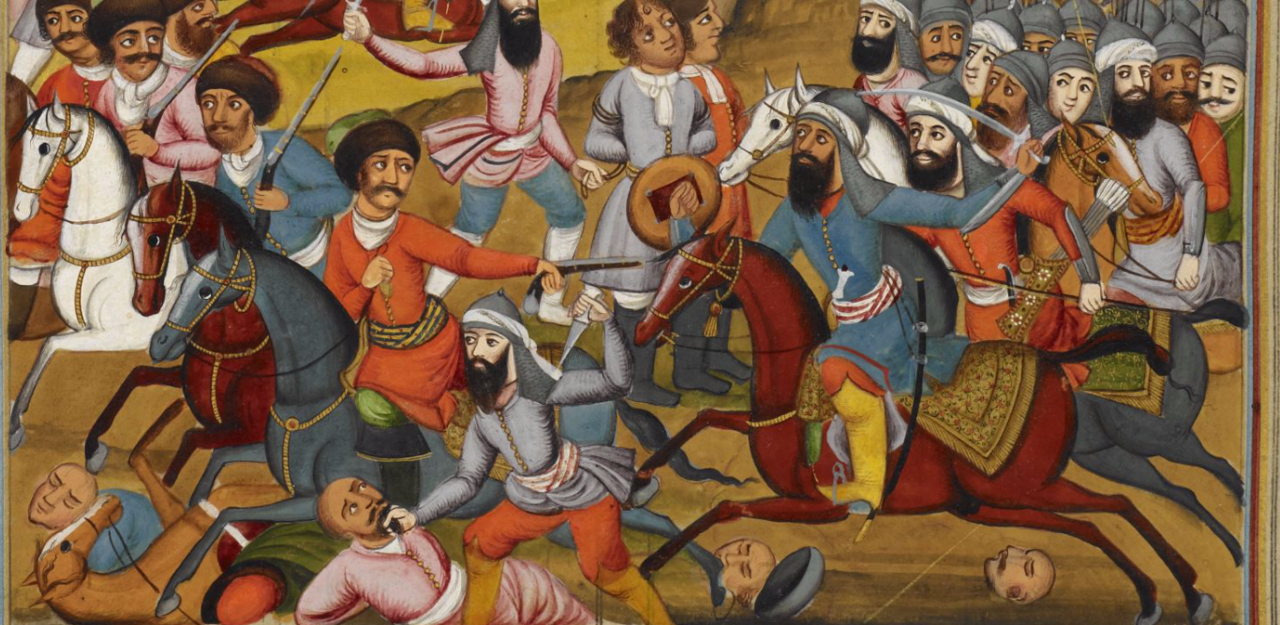

The march into the Caucasus
Agha Mohammad set out in the spring of 1795 with a large army, often estimated at around 60,000 men, divided into columns heading into the khanates of the eastern Caucasus. Some local khans submitted. Ebrahim Khalil Khan of Karabakh shut himself up in Shusha and held out, and the shah, after a failed siege, left the fortress behind and pushed on toward Georgia through Ganja.
The Russian help promised in 1783 did not come. Erekle appealed for it, and also to his neighbour Solomon II of Imereti, who sent about 2,000 men. With them, the Georgians could field around 5,000 troops against an attacking force estimated at 35,000 to 40,000.
Krtsanisi: three days of fighting
The Georgians took up a position at Krtsanisi, south of the city, where the ground between the hills and the Kura river narrowed the approach. On 9 and 10 September they held off the Iranian advance guard. On 11 September Agha Mohammad threw in his full force. Georgian accounts describe a hard day of fighting and an early Georgian success, followed by a collapse when the Iranians outflanked the defenders. Erekle was nearly captured and escaped into the mountains.
Georgian memory keeps the story of the “300 Aragvians”, mountaineers from the Aragvi valley who are said to have fought to the last man to cover the king’s retreat. Their stand is commemorated in Tbilisi, and like many such stories it is better documented as tradition than as a precisely counted event. Casualty figures are uncertain: one widely repeated estimate gives about 4,000 Georgian dead and far heavier Iranian losses, but these numbers come from late reconstructions rather than from records kept at the time.
The sack of Tiflis
The Iranian army entered Tiflis the same day. Over the following days the city was plundered and burned, churches were looted and many inhabitants were killed. Captives, men, women and children, were driven south to be sold or settled in Iran; the figure usually given is about 15,000. Agha Mohammad’s purpose was not to annex Georgia but to punish it and to show the Caucasus that Russian protection was worthless.
The Qajar court remembered the campaign as a triumph. Saba’s Shahanshahnameh, the verse epic of the dynasty, celebrated it, and it was among the victories that came before Agha Mohammad’s coronation on the Mughan plain in March 1796, described on the page about Agha Mohammad Khan Qajar. For Georgians it became one of the darkest memories of their history.
Russia’s answer and the road to annexation
Catherine the Great responded in 1796 by sending an army under Valerian Zubov along the Caspian coast. It took Derbent and Baku, but Catherine died in November 1796 and her son Paul recalled the troops. Agha Mohammad returned to the Caucasus in 1797 and was murdered at Shusha before he could reach Georgia again.
Erekle died in January 1798. His son George XII, faced with internal rivals and the threat of a new invasion, asked for even closer ties to Russia. After George’s death the kingdom of Kartli-Kakheti was annexed by the Russian Empire in 1801. Russian expansion from this new base into the khanates of the eastern Caucasus led directly to the Russo-Persian War of 1804–1813.
How the event is read today
Georgian historians treat Krtsanisi as a national tragedy and a heroic last stand, and see in it the failure of Russia to keep its word in 1783. Iranian accounts traditionally framed the campaign as the restoration of authority over a rebellious vassal. Western historians such as Donald Rayfield and Gavin Hambly stress the strategic outcome: the sack showed that Iran could still strike hard, but not that it could hold Georgia, and it turned the Georgian ruling house decisively toward St Petersburg.
Persian words from this page
| تفلیس | Teflis | Tiflis, Tbilisi |
| گرجستان | Gorjestân | Georgia |
| قفقاز | Qafqâz | the Caucasus |
| اسیر | asir | captive |
| شاهنشاهنامه | Shâhanshâh-nâme | the Book of the King of Kings, Saba’s epic |
Sources and further reading
- Donald Rayfield, Edge of Empires: A History of Georgia (Reaktion, 2012).
- Ronald Grigor Suny, The Making of the Georgian Nation, 2nd ed. (Indiana University Press, 1994).
- Gavin R. G. Hambly, “Āghā Muhammad Khān and the establishment of the Qājār dynasty”, in The Cambridge History of Iran, vol. 7 (1991).
- Firuz Kazemzadeh, “Iranian relations with Russia and the Soviet Union, to 1921”, in The Cambridge History of Iran, vol. 7 (1991).
- Abbas Amanat, Iran: A Modern History (Yale, 2017).
Want to learn Persian? Get the free Starter Pack
Get the 14-page printable Starter Pack (all 32 letters, a 7-day reading plan, 100 core words and 20 survival phrases) and a short 5-email course. Free.
More in The Qajar Dynasty (1789–1925)
- Agha Mohammad Khan Qajar
- The Battle of Krtsanisi and Sack of Tiflis (1795)
- Fath-Ali Shah Qajar
- The Qajar Court and Harem
- The Russo-Persian War of 1804–1813
- The Battle of Aslanduz (1812)
- The Treaty of Golestan (1813)
- Abbas Mirza and the First Reforms
- The Russo-Persian War of 1826–1828
- The Treaty of Turkmenchay (1828)
- The Death of Griboyedov (1829)
- Mohammad Shah and the Siege of Herat
- The Bab and the Babi Movement
- Tahirih (Qurrat al-Ayn)
- Naser al-Din Shah Qajar
- Amir Kabir
- Dar al-Funun: Iran’s First Modern School
- The Anglo-Persian War (1856–1857)
- How Iran Lost Herat
- The Great Persian Famine of 1870–1872
- The Reuter Concession (1872)
- Naser al-Din Shah’s Journeys to Europe
- The Tobacco Protest (1891–1892)
- Mirza Malkam Khan and Early Reformers
- The Assassination of Naser al-Din Shah (1896)
- Photography in Qajar Iran
- Mozaffar ad-Din Shah
- Taj al-Saltaneh
- The D’Arcy Concession and the Discovery of Oil (1908)
- The Persian Constitutional Revolution (1905–1911)
- The First Majlis and the Constitution of 1906
- The Anglo-Russian Convention of 1907
- Mohammad Ali Shah and the Bombardment of the Majlis
- The Siege of Tabriz and Sattar Khan
- The Constitutionalists Take Tehran (1909)
- The Bakhtiari and the Revolution
- Morgan Shuster and the Russian Ultimatum (1911)
- Women in the Constitutional Revolution
- Iran in the First World War
- The Persian Famine of 1917–1919
- Mirza Kuchik Khan and the Jangali Movement
- The Anglo-Persian Agreement of 1919
- The 1921 Coup: Reza Khan and Seyyed Zia
- The End of the Qajar Dynasty (1925)
- Qajar Art, Photography and Society