Mirza Malkam Khan (1833–1908) was a Qajar diplomat and writer who spent half a century urging Iran’s rulers to adopt “law”, by which he meant written rules binding the government. His secret society of 1859, his reform treatises and above all his London newspaper Qanun (1890–1898) made him, with a handful of other writers, one of the main intellectual forerunners of the Constitutional Revolution of 1906.
| Born | 1833 or 1834, New Julfa, Isfahan, to an Armenian family |
|---|---|
| Died | 1908, in Europe, while minister to Italy |
| Title | Nazem al-Dowleh |
| Posts | Teacher and translator at the Dar al-Funun; envoy in Istanbul; minister in London (1873–1889); minister in Rome (from about 1899) |
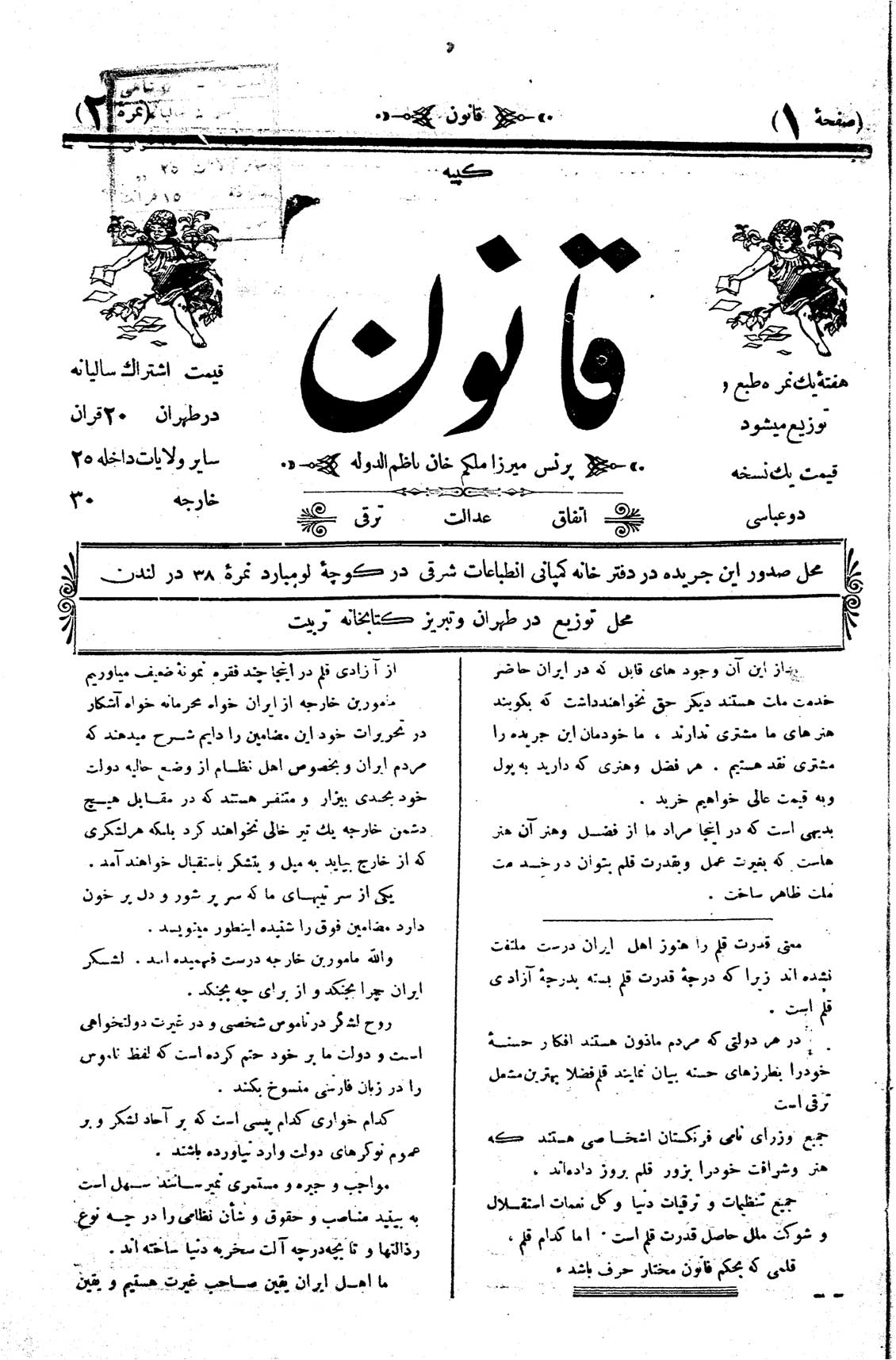
| Newspaper | Qanun (قانون, “Law”), London, first issue 20 February 1890; 42 issues |

An Armenian boy from Isfahan in Paris
Malkam was born in New Julfa, the Armenian quarter of Isfahan. His father, Mirza Yaqub, had converted to Islam and worked as an interpreter, and he sent his son to school in Paris in the 1840s. Malkam returned around 1851 fluent in French and full of the ideas of the French engineers, positivists and freemasons he had read. He was taken on as a translator and teacher at the new Dar al-Funun, and he is said to have impressed the young Naser al-Din Shah with demonstrations of the electric telegraph.
The “house of oblivion”
In about 1858 he wrote a treatise for the shah, often called the Ketâbcheh-ye gheybi (the “hidden booklet”), which proposed a council of ministers, separation of legislative and executive power and written laws. In 1859, with the shah’s consent, he founded a society on the model of a masonic lodge, the فراموشخانه (Farâmush-khâneh, “house of oblivion”). It met in the house of the Qajar prince Jalal al-Din Mirza and drew officials, princes and students of the Dar al-Funun. In 1861 the shah, alarmed by rumours that members wanted to overthrow him, closed the society and sent Malkam into exile.
Diplomat and dealmaker
After some time in Baghdad, Malkam was pardoned and joined the Iranian embassy in Istanbul under Mirza Hosayn Khan Moshir al-Dowleh, later the reforming chief minister Sepahsalar. There he watched the Ottoman Tanzimat reforms at close range. When Sepahsalar took power in Tehran he brought Malkam back as an adviser, and in 1873 sent him to London as Iran’s minister. He stayed for some sixteen years.
Malkam’s career in London mixed politics and business. He promoted European investment in Iran and was involved in several concession deals. The last of them ended it. During the shah’s visit of 1889 (see Naser al-Din Shah’s journeys to Europe) he obtained a concession for a state lottery. When the shah cancelled it under pressure at home, Malkam sold the rights to investors in London anyway. He was dismissed and stripped of his titles.
Qanun: a newspaper called “Law”
Out of office, Malkam turned on the government. On 20 February 1890 he published in London the first issue of Qanun, a short Persian newspaper in plain, forceful prose. It attacked the arbitrary rule of the shah’s ministers, especially the chief minister Amin al-Soltan, and the sale of concessions to foreigners, including the tobacco monopoly that provoked the Tobacco Protest. Malkam argued that Iran needed a consultative assembly and fixed laws, and he took care to frame these demands in Islamic language, calling on the clergy as natural leaders of the nation and appealing to a “league of humanity” (آدمیت, âdamiyat) of like-minded men.
Qanun was banned in Iran, and readers caught with it could be punished, but copies were smuggled in through Istanbul and the Caucasus and passed from hand to hand. Around 42 issues appeared before Malkam stopped publishing in 1898. The new shah, Mozaffar al-Din, restored his titles and made him minister to Italy, the post he held until his death in 1908, two years after the constitution he had argued for was granted.
Other early voices for reform
Malkam was the best known of a small group of nineteenth-century writers who called for law, education and limits on royal power:
- Mirza Fath-Ali Akhundzadeh (1812–1878), a playwright and official in Russian Tiflis, wrote satirical plays and sharp critiques of despotism and proposed reforming the Arabic-based alphabet.
- Mirza Yusof Khan Mostashar al-Dowleh wrote یک کلمه (Yek kalameh, “One Word”, 1871), arguing that the one word Iran needed was “law” and that European codes did not conflict with Islam. He was later imprisoned for his views.
- Abd al-Rahim Talebof (1834–1911), a merchant in the Caucasus, wrote popular books explaining science and civic duty to young Iranians.
- Mirza Aqa Khan Kermani, an exile in Istanbul who wrote for the Persian press there and worked with Malkam, was executed in Tabriz in 1896 after the assassination of Naser al-Din Shah.
Reformer or opportunist?
Historians disagree about Malkam. Iranian writers such as Fereydun Adamiyat presented him as a pioneer of modern political thought. Hamid Algar’s biography (1973) is more critical: it shows a man whose reform plans and business interests were closely entangled, and who used Islamic language for tactical reasons rather than conviction. Most accounts agree that, whatever his motives, his slogans about law and an assembly reached a wide audience and were taken up in 1905–1906 (see the Constitutional Revolution).
Persian words from this page
| قانون | qânun | law |
| ملکم خان | Malkam Khân | Malkam Khan |
| فراموشخانه | farâmush-khâneh | “house of oblivion”, the masonic-style society |
| آدمیت | âdamiyat | humanity |
| یک کلمه | yek kalameh | one word |
| امتیاز | emtiyâz | concession |
Sources and further reading
- Hamid Algar, Mirza Malkum Khan: A Biographical Study in Iranian Modernism (University of California Press, 1973)
- Fereydun Adamiyat, Fekr-e âzâdi va moqaddameh-ye nehzat-e mashrutiyat (Tehran, 1961, in Persian)
- Nikki R. Keddie, Modern Iran: Roots and Results of Revolution (Yale University Press, 2003)
- Ervand Abrahamian, Iran Between Two Revolutions (Princeton University Press, 1982)
- Edward Granville Browne, The Persian Revolution of 1905–1909 (Cambridge, 1910)
Want to learn Persian? Get the free Starter Pack
Get the 14-page printable Starter Pack (all 32 letters, a 7-day reading plan, 100 core words and 20 survival phrases) and a short 5-email course. Free.
More in The Qajar Dynasty (1789–1925)
- Agha Mohammad Khan Qajar
- The Battle of Krtsanisi and Sack of Tiflis (1795)
- Fath-Ali Shah Qajar
- The Qajar Court and Harem
- The Russo-Persian War of 1804–1813
- The Battle of Aslanduz (1812)
- The Treaty of Golestan (1813)
- Abbas Mirza and the First Reforms
- The Russo-Persian War of 1826–1828
- The Treaty of Turkmenchay (1828)
- The Death of Griboyedov (1829)
- Mohammad Shah and the Siege of Herat
- The Bab and the Babi Movement
- Tahirih (Qurrat al-Ayn)
- Naser al-Din Shah Qajar
- Amir Kabir
- Dar al-Funun: Iran’s First Modern School
- The Anglo-Persian War (1856–1857)
- How Iran Lost Herat
- The Great Persian Famine of 1870–1872
- The Reuter Concession (1872)
- Naser al-Din Shah’s Journeys to Europe
- The Tobacco Protest (1891–1892)
- Mirza Malkam Khan and Early Reformers
- The Assassination of Naser al-Din Shah (1896)
- Photography in Qajar Iran
- Mozaffar ad-Din Shah
- Taj al-Saltaneh
- The D’Arcy Concession and the Discovery of Oil (1908)
- The Persian Constitutional Revolution (1905–1911)
- The First Majlis and the Constitution of 1906
- The Anglo-Russian Convention of 1907
- Mohammad Ali Shah and the Bombardment of the Majlis
- The Siege of Tabriz and Sattar Khan
- The Constitutionalists Take Tehran (1909)
- The Bakhtiari and the Revolution
- Morgan Shuster and the Russian Ultimatum (1911)
- Women in the Constitutional Revolution
- Iran in the First World War
- The Persian Famine of 1917–1919
- Mirza Kuchik Khan and the Jangali Movement
- The Anglo-Persian Agreement of 1919
- The 1921 Coup: Reza Khan and Seyyed Zia
- The End of the Qajar Dynasty (1925)
- Qajar Art, Photography and Society