Hormuz is a small island of about 42 km² in the Strait of Hormuz, 8 km off the coast near Bandar Abbas, with a population of roughly 6,000. In the 14th and 15th centuries it was the capital of a rich trading kingdom that controlled the mouth of the Persian Gulf, then for over a century a Portuguese stronghold until 1622; today it is known for the red earth, coloured rocks and salt formations that have made it one of Iran’s most unusual places to visit.

The kingdom of Hormuz
The first Hormuz was on the mainland, near today’s Minab, and was already a busy port when Marco Polo passed through in the late 13th century. Around 1300, under pressure from raiders, its ruler moved the court to the barren island then called Jarun, and the name Hormuz moved with it. The island had almost no fresh water and little that grew, but it had a safe harbour on the main sea route between India, Arabia and Persia.
For the next two centuries Hormuz was one of the great markets of the Indian Ocean. Horses from Arabia and Persia, pearls from the Gulf, spices and textiles from India and silk from China passed through it. Ibn Battuta visited in the 1330s and described a large, handsome town on an island of salt. Its rulers paid tribute to whichever power ruled the mainland but were largely independent.
The Portuguese fort
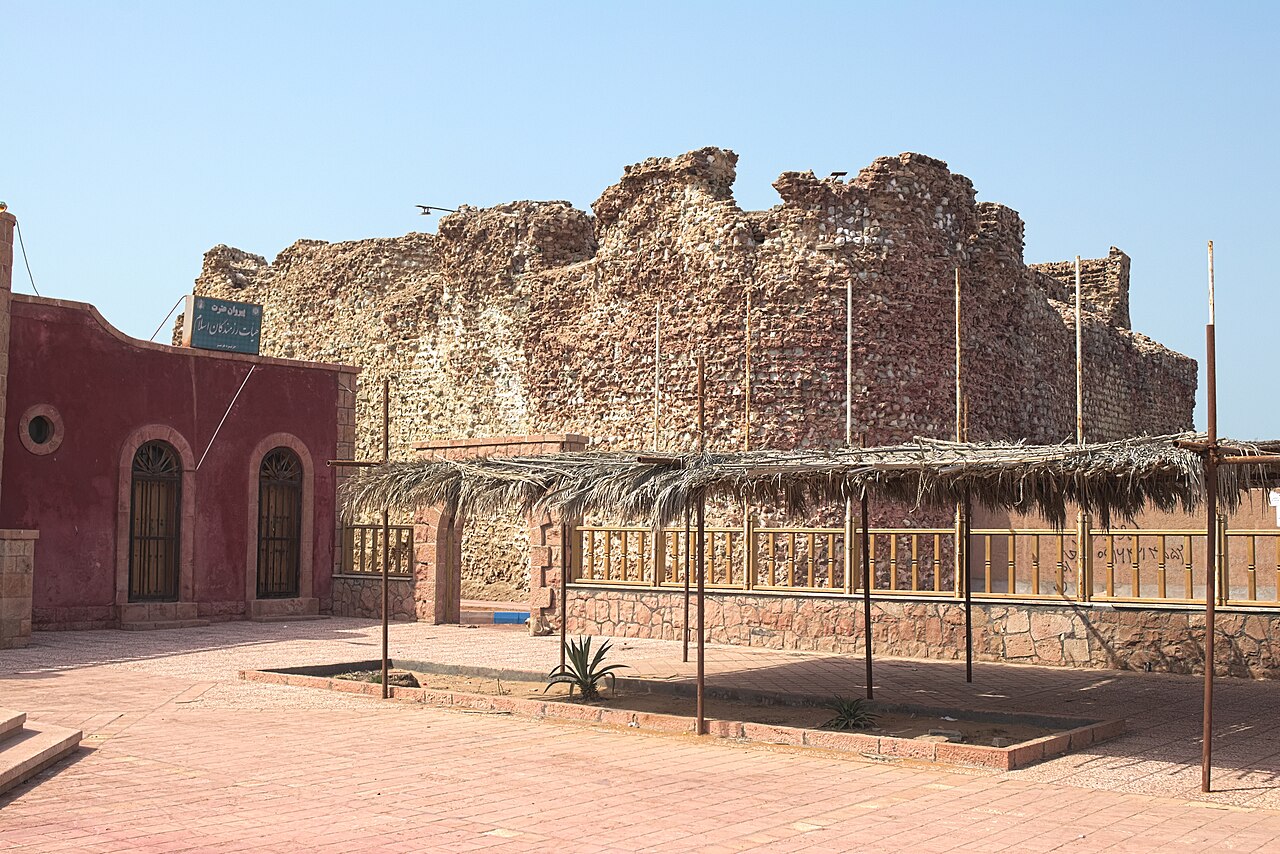
The Portuguese commander Afonso de Albuquerque attacked Hormuz in 1507, seeing it as a key to control of Asian sea trade. He returned in 1515 and took full control, leaving the local king on the throne as a vassal. The fortress the Portuguese built on the northern tip of the island, Our Lady of the Conception, is known locally as قلعه پرتغالیها (Qal’e-ye Porteghâli-hâ), “the castle of the Portuguese”. Its thick walls of local stone, cisterns, bastions and rusting cannons are the island’s main historic monument.
Portuguese rule lasted until 1622, when the Safavid governor of Fars, Imam Quli Khan, with the help of ships of the English East India Company, besieged and took the fortress. Shah Abbas I then moved the region’s trade to the mainland port of Gamrun, renamed Bandar Abbas, and Hormuz quickly declined to a fishing village. See the capture of Hormuz from the Portuguese for the full campaign.
An island made of salt and colour
Geologically, Hormuz is a salt dome: a plug of very old salt, laid down hundreds of millions of years ago, that has pushed up through the younger rocks above it. As it rose it carried with it layers of volcanic and sedimentary rock rich in iron and other minerals. Erosion has exposed them in bands of red, ochre, yellow, purple and white, which is why Iranians sometimes call Hormuz the “rainbow island”.
The best-known spots are around the coast and can be reached by the island’s one ring road:
- The red beach, where iron-rich soil washes into the sea and turns the shoreline red.
- Rainbow Valley, a small valley of multicoloured hills and soils.
- The Valley of Statues, sea cliffs eroded into shapes that visitors compare to animals and faces.
- The Salt Mountain and its salt cave, with white and pink salt walls.
Our page on Hormuz Island’s colours covers these sites in more detail.
Red earth in the kitchen and in art
The red ochre of Hormuz has been dug for centuries and was once exported as a pigment. Islanders also use it in their cooking: a sauce made with the red earth is spread on local bread, and visitors are often offered it to taste. Because tourists began carrying soil away in large amounts, Iran’s Department of Environment has put the island’s soils under protection, and taking earth, sand or stones is not allowed.
The island has also become a centre for land art. The artist Ahmad Nadalian opened an art centre in the village in 2009, now the Dr Nadalian Museum, and painted or carved images on rocks around the shore. Local women make crafts and paintings from the coloured soils.
Visiting Hormuz
Boats leave Bandar Abbas for Hormuz several times a day, and the crossing takes under an hour. On the island, people get around in tuk-tuks (motor rickshaws) driven by local men, or on hired bicycles and motorbikes. Facilities are simple: a handful of guesthouses and homestays, small restaurants serving fish, and very little shade. The comfortable season is November to March; summers are extremely hot and humid. Check current boat times locally and your own government’s travel advice before you go.
Hormuz is easily combined with Qeshm Island, and both are reached from Bandar Abbas.
Persian words from this page
| هرمز | Hormoz | Hormuz |
| قلعه | qal’e | castle, fort |
| پرتغالی | porteghâli | Portuguese |
| خاک سرخ | khâk-e sorkh | red earth |
| رنگینکمان | rangin-kamân | rainbow |
| نمک | namak | salt |
Sources and further reading
- Encyclopaedia Iranica, article “Hormuz”.
- Ibn Battuta, The Travels of Ibn Battuta, trans. H. A. R. Gibb (Hakluyt Society), section on Hormuz.
- Willem Floor, The Persian Gulf: A Political and Economic History of Five Port Cities, 1500–1730 (Mage, 2006).
- Roger Savory, Iran under the Safavids (Cambridge University Press, 1980).
Want to learn Persian? Get the free Starter Pack
Get the 14-page printable Starter Pack (all 32 letters, a 7-day reading plan, 100 core words and 20 survival phrases) and a short 5-email course. Free.
More in Cities of Iran
- Tehran: Iran’s Capital
- Mashhad
- Isfahan
- Shiraz
- Tabriz
- Yazd
- Kashan
- Kerman
- Hamadan
- Qom
- Ahvaz
- Rasht
- Kermanshah
- Urmia
- Ardabil
- Zanjan
- Qazvin
- Sanandaj
- Khorramabad
- Bandar Abbas
- Bushehr
- Zahedan
- Birjand
- Gorgan
- Sari
- Semnan
- Arak
- Ilam
- Yasuj
- Shahr-e Kord
- Bojnurd
- Karaj
- Abadan and Khorramshahr
- Kish Island
- Qeshm Island
- Hormuz Island
- Masuleh
- Abyaneh
- Kandovan
- Bam
- Neyshabur (Nishapur)
- Shush (Susa) Today