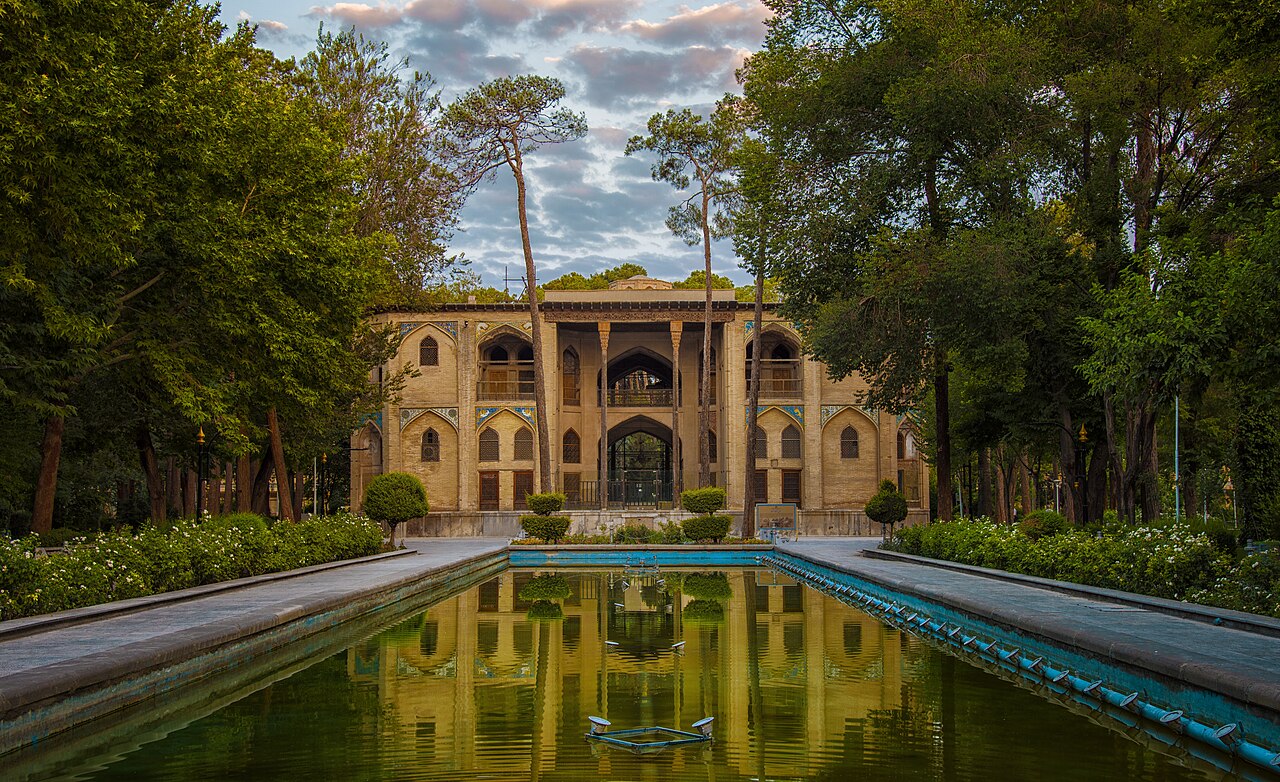
Hasht Behesht (هشت بهشت, “Eight Paradises”) is a two-storey Safavid garden pavilion in central Isfahan, built in 1669 for Shah Suleiman. It is the last surviving pleasure palace of the royal garden quarter beside the Chahar Bagh avenue: an airy building open on all sides, centred on a domed hall with a fountain, now standing in a public park.
| Persian name | Kâkh-e Hasht Behesht |
|---|---|
| Built | 1669 (1080 of the Islamic calendar) |
| Patron | Shah Suleiman (r. 1666–1694) |
| Setting | Originally the Nightingale Garden (Bâgh-e Bolbol); now a public park off Chahar Bagh |
| Plan | Octagonal pavilion, central domed hall, four open porches, corner rooms on two floors |
| UNESCO | Not separately listed; part of the historic Safavid city |

A palace for summer, not for ceremony
The Safavid palaces of Isfahan were not one great building but many pavilions set in walled gardens, each with its own purpose. The Ali Qapu was a gate and viewing stand on the square; the Chehel Sotoun was a hall for receiving envoys and holding banquets (see Chehel Sotoun Palace and Its War Paintings). Hasht Behesht, built half a century after the square, was something more private: a place to live, rest and entertain in the gardens, in the cooler air near the water. The French traveller Jean Chardin, who knew Isfahan in the 1670s, described it soon after it was finished and admired how light and open it was.
The reign it belongs to, that of Shah Suleiman, is often described as a time of decline and withdrawal from public life. The pavilion fits that picture: it faces inward, to the garden and the pools, rather than out to the city.
The plan of the eight paradises
The name refers to a plan type with a long history in Iranian palaces and gardens. A central hall is surrounded by eight spaces: four open porches on the main axes and four groups of rooms in the corners. In Islamic tradition paradise has eight gates or levels, and the name also echoes the poem cycles called Hasht Behesht written by poets such as Amir Khosrow. The idea of the building as a small image of paradise in a garden belongs to the long tradition described in The Persian Garden (Pardis) through History.
From outside, the pavilion is an octagon with its corners cut. On each main side a tall porch rises through both storeys, so you can look straight through the building to the garden on the other side. The north porch, the grandest, has slender wooden columns that lift its flat roof high above a pool.
What to look at inside
- The central hall. Stand in the middle and look up. The dome over the hall ends in a lantern of moqarnas, the honeycomb vaulting of Iranian architecture, here painted and gilded. A fountain basin sits in the floor below, and in the summer water would have cooled the air as breezes passed through the open porches.
- The corner rooms. On two floors, reached by small stairs, they are a maze of little chambers, alcoves and balconies, many with painted and mirror-work ceilings. Some of the paintings date from the Qajar period, when the building was repaired and redecorated.
- The tile panels outside. Look at the spandrels above the arches and the panels on the outer walls, which show birds, animals, hunting scenes and mythical creatures in tile. Some are Safavid, others are later replacements.
- The relation to the garden. Walk all the way round. The building was designed to be seen from the paths and pools, and every side is a facade.
Later history
After the fall of Isfahan in 1722 (see The Siege and Fall of Isfahan), most of the palace gardens of Chahar Bagh were neglected, built over or destroyed, especially in the Qajar period. Hasht Behesht survived because it was used by Qajar governors, who altered and repainted parts of it. Its garden was later reduced and turned into a public park, and the pavilion has been restored several times since the 20th century. With the Chehel Sotoun, it is one of the very few Safavid palace pavilions still standing in Isfahan.
Visiting
- Hasht Behesht is just off Chahar Bagh, a few minutes’ walk from the Chehel Sotoun and about 15 minutes from Naqsh-e Jahan Square. Most visitors see the two palaces together, followed by a walk south along Chahar Bagh to Si-o-se Pol.
- The park around it is free and full of local life in the evenings; the pavilion itself has a ticket. Opening hours and prices change, so check current information locally.
- It is less visited than the square, and is a good place to escape the crowds in the middle of the day. Allow 45 minutes.
The March 2026 strike that damaged Chehel Sotoun hit buildings a short distance away; check current reports on Hasht Behesht and the nearby palaces, and your own government’s travel advice, before visiting. Our older article on the Chehel Sotoun palace covers the neighbouring pavilion.
Persian words from this page
| هشت | hasht | eight |
| بهشت | behesht | paradise |
| باغ | bâgh | garden |
| بلبل | bolbol | nightingale |
| حوض | howz | pool, basin |
| کوشک | kushk | pavilion |
Sources and further reading
- Encyclopaedia Iranica, “Hašt Behešt” (palace and plan type).
- Sussan Babaie, Isfahan and Its Palaces (Edinburgh University Press, 2008).
- Jean Chardin, Voyages en Perse (1686 and later editions), description of Isfahan.
- Robert Hillenbrand, “Safavid Architecture”, in The Cambridge History of Iran, vol. 6 (1986).
Want to learn Persian? Get the free Starter Pack
Get the 14-page printable Starter Pack (all 32 letters, a 7-day reading plan, 100 core words and 20 survival phrases) and a short 5-email course. Free.
More in Top Places to Visit in Iran
- Naqsh-e Jahan Square
- Shah (Imam) Mosque, Isfahan
- Sheikh Lotfollah Mosque
- Ali Qapu Palace
- Jameh Mosque of Isfahan
- Si-o-se Pol and Khaju Bridge
- Vank Cathedral
- Hasht Behesht Palace
- Naqsh-e Rostam
- Eram Garden, Shiraz
- Nasir al-Molk (Pink) Mosque
- Tomb of Hafez (Hafezieh)
- Tomb of Saadi (Saadieh)
- Shah Cheragh Shrine
- Arg of Karim Khan
- Fin Garden, Kashan
- Historic Houses of Kashan
- Jameh Mosque of Yazd
- Yazd Fire Temple and Towers of Silence
- Dowlatabad Garden and Windcatcher
- Amir Chakhmaq Complex
- Golestan Palace
- National Museum of Iran
- Treasury of National Jewels
- Tehran Grand Bazaar
- Milad Tower
- Imam Reza Shrine, Mashhad
- Tomb of Ferdowsi, Tus
- Tomb of Omar Khayyam, Neyshabur
- Tomb of Avicenna, Hamadan
- Ganjnameh Inscriptions, Hamadan
- Behistun (Bisotun): Visiting the Site
- Taq-e Bostan: Visiting the Site
- Tabriz Historic Bazaar
- Takht-e Soleyman
- Armenian Monastic Ensembles of Iran
- Sheikh Safi al-Din Shrine, Ardabil
- Dome of Soltaniyeh
- Alamut Castle
- Falak-ol-Aflak Castle
- Shushtar Historical Hydraulic System
- Chogha Zanbil: Visiting the Ziggurat
- Susa Archaeological Site
- Arg-e Bam
- Ganjali Khan Complex, Kerman
- Shazdeh Garden, Mahan
- Rayen Castle
- Dasht-e Lut (Lut Desert)
- Maranjab Desert and Caravanserai
- Varzaneh Desert
- Mount Damavand
- Hyrcanian Forests
- Lake Urmia
- Badab-e Surt Springs
- Ali Sadr Cave
- The Kaluts of Shahdad
- Qeshm Geopark
- Hormuz Island Colours
- Visiting Persepolis: A Day Trip from Shiraz
- Visiting Pasargadae
- Persian Caravanserais
- The Qanat of Gonabad
- Meymand Village
- Sasanian Sites of Fars: Firuzabad, Bishapur and Sarvestan
- Gonbad-e Qabus: Visiting the Tower
- Zayandeh Rud and Isfahan’s Bridges
- Tochal and Darband: Hiking Above Tehran
- Mount Sabalan
- Skiing in Iran: Dizin and Shemshak
- Golestan National Park