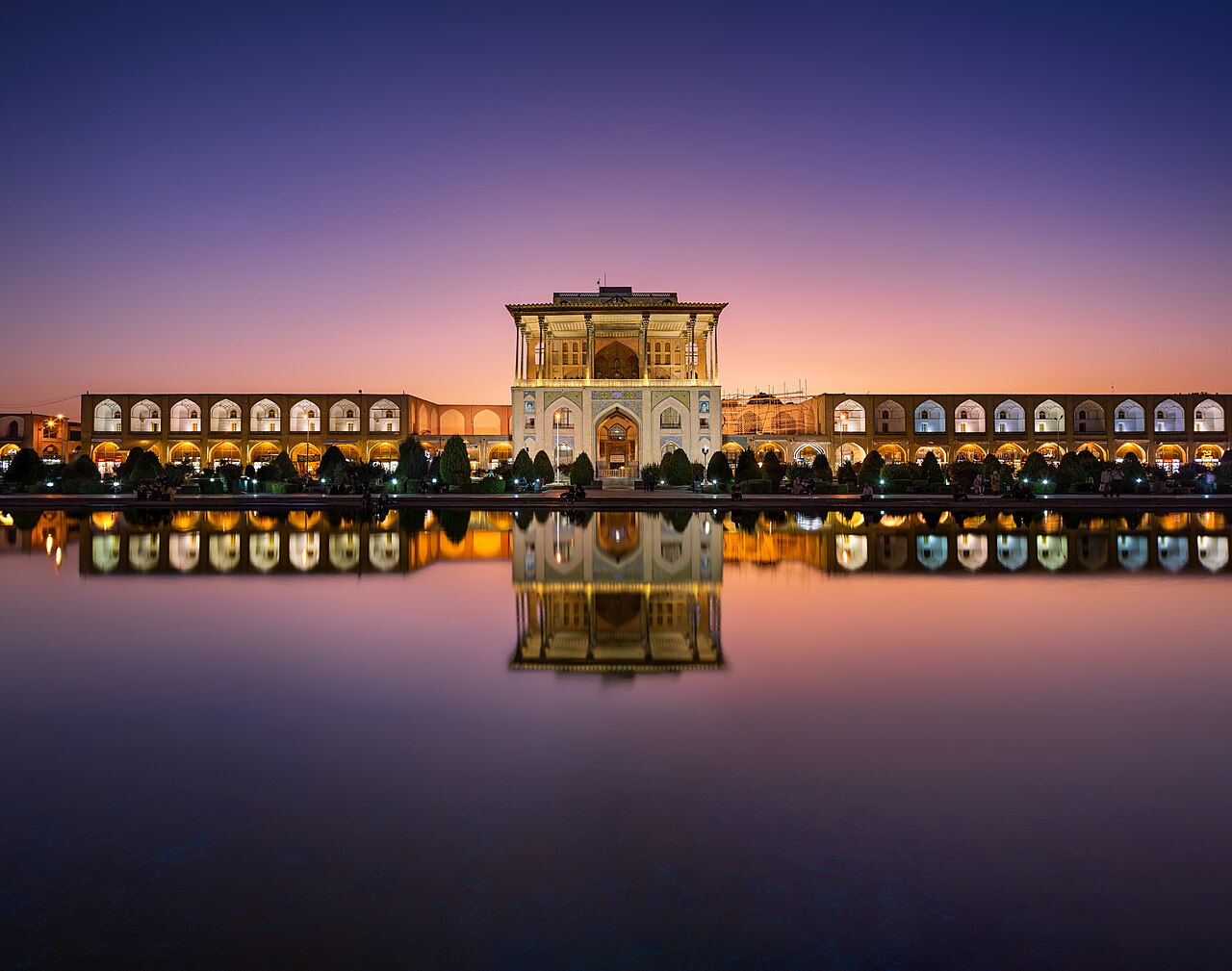
The Ali Qapu (عالیقاپو, “the lofty gate”) is the Safavid palace gatehouse on the west side of Naqsh-e Jahan Square in Isfahan. Begun under Shah Abbas I around 1600 and enlarged over several decades, it is known for its high wooden-columned porch over the square and the “music room” on its top floor, whose walls are cut into the shapes of vases and bottles.
| Persian name | Âli Qâpu |
|---|---|
| Built | From c. 1600 under Abbas I; the great porch usually dated to Abbas II, 1640s |
| Function | Gateway to the royal palace precinct, viewing stand and reception hall |
| Height | About 48 metres, in six storeys |
| Highlights | Columned porch (tâlâr), wall paintings, music room |
| UNESCO | Part of Meidan Emam, Esfahan (1979) |

A gate that became a palace
The Ali Qapu was the main entrance to the Dowlatkhaneh, the walled area of royal gardens and pavilions that lay behind the west side of the square. It started as a modest gatehouse and was raised storey by storey. The result is a building that looks like a block from the square but is very thin from front to back, with small rooms stacked up around narrow stairs. Its development, and the life of the square it faced, is told in The Building of Naqsh-e Jahan Square. The wider palace quarter, of which the Chehel Sotoun and Hasht Behesht survive, is described in Isfahan: “Half the World”.
The porch over the square
The tâlâr, the raised porch, is the reason most people climb the building. Slender wooden columns hold up a flat roof with a coffered wooden ceiling inlaid in geometric patterns, and the floor once had a pool with a fountain. From here the shah watched polo, parades, executions and fireworks in the square below, and received ambassadors in full view of the crowd. European visitors of the 17th century described sitting here as guests at royal entertainments.
Today it gives the best view in Isfahan of the square as a whole. Directly opposite is the Sheikh Lotfollah Mosque; to the right, the portal and dome of the Shah Mosque, clearly turned at an angle to the square; to the left, the Qeysariyeh gate of the bazaar. It is also the easiest place to understand how the mosques were set at an angle to face Mecca.
Painted rooms
The small rooms on the lower floors are decorated with wall paintings: flowering branches, birds, vases and, in some places, figures of young men and women in the elegant style associated with the court painter Reza Abbasi and his followers. Many figural scenes were damaged or painted over in later periods, and much of what you see has been restored. Look closely at the ceilings and the arches between rooms, where fine painted and gilded patterns survive best.
The music room
The top floor holds the room that gives the building its other fame. Its walls and vaults are covered in a deep layer of stucco cut through into hundreds of niches shaped like jugs, bottles, cups and vases. This kind of decoration is called chini-khâne, a “china room”, because such niches were first used to display porcelain and glass.
The room is usually called the music room (otâq-e musiqi), and guides explain that the hollow niches absorbed echoes and made it good for music and singing. That is a reasonable idea and often repeated, but there is no Safavid text that tells us how the room was used. The shapes may be purely decorative, a playful version of a display wall for a palace that held a famous collection of Chinese porcelain. Either way, it is one of the most original rooms of Safavid architecture.
Visiting
- The stairs are steep, narrow and spiral. Allow time and take care, especially going down.
- The porch is the place for photographs of the square. The light on the Shah Mosque and Sheikh Lotfollah is best in the morning; late afternoon is good for the square in shade and the domes in warm light.
- Parts of the building have been under restoration for long periods, and some rooms or floors may be closed.
- Opening hours and tickets change; check current information locally.
In March 2026, according to Iranian officials quoted by The Art Newspaper, the Ali Qapu’s doors and windows were shattered by the blast from a strike on government buildings in the old palace quarter behind it. UNESCO said it had documented shockwave damage at three World Heritage sites in Isfahan. Check current information on access and repairs, and your own government’s travel advice. For the rest of the square, see Naqsh-e Jahan Square.
Persian words from this page
| عالی | âli | lofty, excellent |
| قاپو | qâpu | gate (a Turkic word) |
| تالار | tâlâr | hall; columned porch |
| موسیقی | musiqi | music |
| چینی | chini | porcelain, china |
| کاخ | kâkh | palace |
Sources and further reading
- UNESCO World Heritage Centre, Meidan Emam, Esfahan.
- Encyclopaedia Iranica, “Āli Qāpu”.
- Sussan Babaie, Isfahan and Its Palaces (Edinburgh University Press, 2008).
- Robert Hillenbrand, “Safavid Architecture”, in The Cambridge History of Iran, vol. 6 (1986).
- The Art Newspaper, report on damage to UNESCO sites in Isfahan, 10 March 2026.
Want to learn Persian? Get the free Starter Pack
Get the 14-page printable Starter Pack (all 32 letters, a 7-day reading plan, 100 core words and 20 survival phrases) and a short 5-email course. Free.
More in Top Places to Visit in Iran
- Naqsh-e Jahan Square
- Shah (Imam) Mosque, Isfahan
- Sheikh Lotfollah Mosque
- Ali Qapu Palace
- Jameh Mosque of Isfahan
- Si-o-se Pol and Khaju Bridge
- Vank Cathedral
- Hasht Behesht Palace
- Naqsh-e Rostam
- Eram Garden, Shiraz
- Nasir al-Molk (Pink) Mosque
- Tomb of Hafez (Hafezieh)
- Tomb of Saadi (Saadieh)
- Shah Cheragh Shrine
- Arg of Karim Khan
- Fin Garden, Kashan
- Historic Houses of Kashan
- Jameh Mosque of Yazd
- Yazd Fire Temple and Towers of Silence
- Dowlatabad Garden and Windcatcher
- Amir Chakhmaq Complex
- Golestan Palace
- National Museum of Iran
- Treasury of National Jewels
- Tehran Grand Bazaar
- Milad Tower
- Imam Reza Shrine, Mashhad
- Tomb of Ferdowsi, Tus
- Tomb of Omar Khayyam, Neyshabur
- Tomb of Avicenna, Hamadan
- Ganjnameh Inscriptions, Hamadan
- Behistun (Bisotun): Visiting the Site
- Taq-e Bostan: Visiting the Site
- Tabriz Historic Bazaar
- Takht-e Soleyman
- Armenian Monastic Ensembles of Iran
- Sheikh Safi al-Din Shrine, Ardabil
- Dome of Soltaniyeh
- Alamut Castle
- Falak-ol-Aflak Castle
- Shushtar Historical Hydraulic System
- Chogha Zanbil: Visiting the Ziggurat
- Susa Archaeological Site
- Arg-e Bam
- Ganjali Khan Complex, Kerman
- Shazdeh Garden, Mahan
- Rayen Castle
- Dasht-e Lut (Lut Desert)
- Maranjab Desert and Caravanserai
- Varzaneh Desert
- Mount Damavand
- Hyrcanian Forests
- Lake Urmia
- Badab-e Surt Springs
- Ali Sadr Cave
- The Kaluts of Shahdad
- Qeshm Geopark
- Hormuz Island Colours
- Visiting Persepolis: A Day Trip from Shiraz
- Visiting Pasargadae
- Persian Caravanserais
- The Qanat of Gonabad
- Meymand Village
- Sasanian Sites of Fars: Firuzabad, Bishapur and Sarvestan
- Gonbad-e Qabus: Visiting the Tower
- Zayandeh Rud and Isfahan’s Bridges
- Tochal and Darband: Hiking Above Tehran
- Mount Sabalan
- Skiing in Iran: Dizin and Shemshak
- Golestan National Park