Fin Garden (باغ فین, Bâgh-e Fin), on the edge of Kashan, is a walled Persian garden laid out in its present form under Shah Abbas I around 1590 and fed by a natural spring. It is often called the oldest surviving garden of its kind in Iran, is one of the nine gardens on UNESCO’s Persian Garden listing (2011), and is the place where the reforming minister Amir Kabir was killed in 1852.
| Persian name | Bâgh-e Fin, also Bâgh-e Shâh |
|---|---|
| Location | Fin, about 6 km south-west of central Kashan, at the foot of the Karkas mountains |
| Built | Present layout c. 1590 under Shah Abbas I; Safavid and Qajar pavilions and baths |
| Area | About 2.3 hectares inside walls with four round towers |
| Water | The Soleymaniyeh spring and qanat |
| UNESCO | Part of “The Persian Garden” World Heritage Site, inscribed 2011 |

Water first
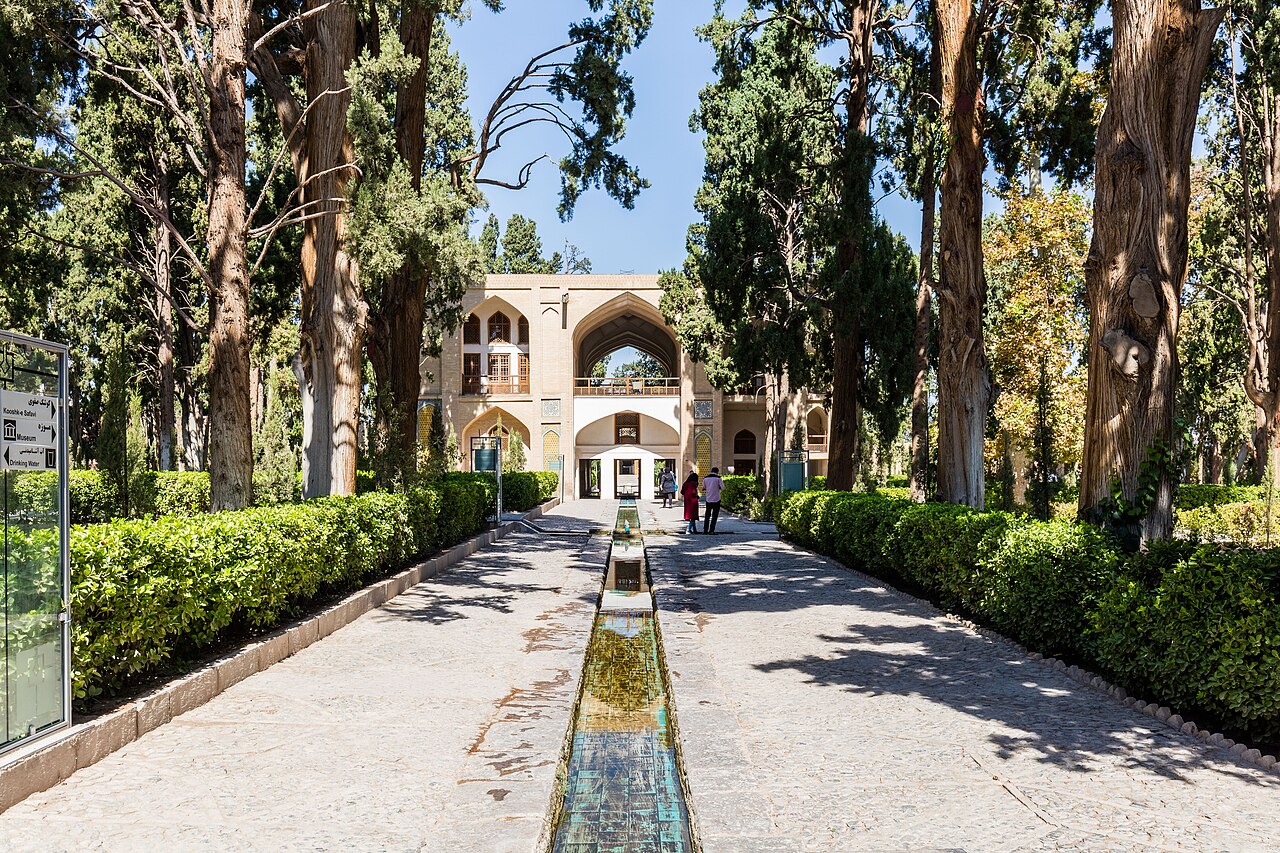
Every Persian garden begins with water, and at Fin the water comes on its own. A spring known as Cheshme-ye Soleymaniyeh (چشمه سلیمانیه) rises in the hills above the village, and its water is carried down in an underground channel to the garden. Because the source lies higher than the garden, the water arrives with enough pressure to feed fountains without any pump. That is the secret of the garden’s sound: dozens of small jets bubbling along the channels all day.
Inside the walls the water is divided along straight channels lined with turquoise tiles, into pools and around the pavilions, before it leaves to irrigate the village fields. Old cypress trees, some said to be several centuries old, shade the paths. The plan follows the classic idea of the chahâr bâgh, a garden divided by water into parts, explained on our page about the Persian garden through history.
Safavid and Qajar builders
There may have been a garden at Fin before the Safavids, and some local accounts say it was moved from a nearby site. The layout we see is credited to Shah Abbas I, who used Kashan as a stopping place on the road between Isfahan and Qom. Later Safavid shahs, including Safi and Abbas II, added buildings and stayed here.
A strong earthquake hit Kashan in 1778. The garden was badly damaged and lay neglected until Fath-Ali Shah Qajar restored it and added new pavilions and a bath in the early 19th century. In the 20th century the garden was registered as a national monument in 1935, and in 1968 a museum was built inside it.
The death of Amir Kabir
Mirza Taqi Khan, called Amir Kabir, was the chief minister of the young Naser al-Din Shah from 1848. He reorganised the army and finances, founded the Dar al-Funun college in Tehran and tried to limit corruption at court. His enemies, including the shah’s mother, turned the shah against him. He was dismissed in late 1851 and sent with his wife, the shah’s sister, to Fin.
On 10 January 1852 agents sent by the shah entered the small bathhouse in the garden and killed him by cutting the veins of his arms. The bath is preserved, with figures that reconstruct the scene, and many Iranian visitors come to Fin for this room above all. Our history page on Amir Kabir tells his career and why he is remembered as a national hero.
What to see
The entrance portal
The garden is entered through a tall gatehouse with a painted ceiling. From its upper floor the main water axis runs straight ahead, so the first view is along the channel to the central pavilion.
The central pavilion
At the meeting of the main axes stands a two-storey pavilion (kushk) open to the breeze, with water flowing through and around it. Its domed ceiling is painted with Qajar-period designs, and it was where the shahs sat to enjoy the garden.
The baths
There are two bathhouses. The larger one shows the full Iranian bath plan, with a changing hall and a hot room. The smaller one is the bath of Amir Kabir’s death.
The Kashan National Museum
The museum inside the garden shows archaeological finds from the region, including pottery from Tepe Sialk, the prehistoric mound on the road between Kashan and Fin.
Practical notes
- Fin is a short taxi ride from central Kashan. Many visitors combine it with Tepe Sialk, which lies on the way.
- The garden is busy at weekends and during the Nowruz holidays. Early morning is the quietest time and the best for photographs along the channels.
- Rosewater from the mountain villages of Qamsar and Niasar is sold outside the gate, especially in May. Our Kashan page explains the rose harvest.
- Opening hours and ticket prices change. Check current information locally.
For other gardens on the UNESCO list, see Eram Garden in Shiraz and Dowlatabad Garden in Yazd.
Persian words from this page
| باغ | bâgh | garden |
| باغ فین | Bâgh-e Fin | Fin Garden |
| چشمه | cheshme | spring |
| چهارباغ | chahâr bâgh | “four gardens”, the divided garden plan |
| کوشک | kushk | garden pavilion |
| امیرکبیر | Amir Kabir | “the Great Amir”, title of Mirza Taqi Khan |
| کاشان | Kâshân | Kashan |
Sources and further reading
- UNESCO World Heritage Centre, “The Persian Garden” (inscribed 2011).
- Encyclopaedia Iranica, “KASHAN“.
- Encyclopaedia Iranica, “ČAHĀRBĀḠ“.
- Abbas Amanat, Pivot of the Universe: Nasir al-Din Shah Qajar and the Iranian Monarchy, 1831–1896 (University of California Press, 1997), on the fall of Amir Kabir.
- Penelope Hobhouse, Gardens of Persia (Kales Press, 2004).
Want to learn Persian? Get the free Starter Pack
Get the 14-page printable Starter Pack (all 32 letters, a 7-day reading plan, 100 core words and 20 survival phrases) and a short 5-email course. Free.
More in Top Places to Visit in Iran
- Naqsh-e Jahan Square
- Shah (Imam) Mosque, Isfahan
- Sheikh Lotfollah Mosque
- Ali Qapu Palace
- Jameh Mosque of Isfahan
- Si-o-se Pol and Khaju Bridge
- Vank Cathedral
- Hasht Behesht Palace
- Naqsh-e Rostam
- Eram Garden, Shiraz
- Nasir al-Molk (Pink) Mosque
- Tomb of Hafez (Hafezieh)
- Tomb of Saadi (Saadieh)
- Shah Cheragh Shrine
- Arg of Karim Khan
- Fin Garden, Kashan
- Historic Houses of Kashan
- Jameh Mosque of Yazd
- Yazd Fire Temple and Towers of Silence
- Dowlatabad Garden and Windcatcher
- Amir Chakhmaq Complex
- Golestan Palace
- National Museum of Iran
- Treasury of National Jewels
- Tehran Grand Bazaar
- Milad Tower
- Imam Reza Shrine, Mashhad
- Tomb of Ferdowsi, Tus
- Tomb of Omar Khayyam, Neyshabur
- Tomb of Avicenna, Hamadan
- Ganjnameh Inscriptions, Hamadan
- Behistun (Bisotun): Visiting the Site
- Taq-e Bostan: Visiting the Site
- Tabriz Historic Bazaar
- Takht-e Soleyman
- Armenian Monastic Ensembles of Iran
- Sheikh Safi al-Din Shrine, Ardabil
- Dome of Soltaniyeh
- Alamut Castle
- Falak-ol-Aflak Castle
- Shushtar Historical Hydraulic System
- Chogha Zanbil: Visiting the Ziggurat
- Susa Archaeological Site
- Arg-e Bam
- Ganjali Khan Complex, Kerman
- Shazdeh Garden, Mahan
- Rayen Castle
- Dasht-e Lut (Lut Desert)
- Maranjab Desert and Caravanserai
- Varzaneh Desert
- Mount Damavand
- Hyrcanian Forests
- Lake Urmia
- Badab-e Surt Springs
- Ali Sadr Cave
- The Kaluts of Shahdad
- Qeshm Geopark
- Hormuz Island Colours
- Visiting Persepolis: A Day Trip from Shiraz
- Visiting Pasargadae
- Persian Caravanserais
- The Qanat of Gonabad
- Meymand Village
- Sasanian Sites of Fars: Firuzabad, Bishapur and Sarvestan
- Gonbad-e Qabus: Visiting the Tower
- Zayandeh Rud and Isfahan’s Bridges
- Tochal and Darband: Hiking Above Tehran
- Mount Sabalan
- Skiing in Iran: Dizin and Shemshak
- Golestan National Park