Golestan Palace (کاخ گلستان) in central Tehran is what remains of the royal citadel of the Qajar shahs, who ruled Iran from Tehran from 1786 to 1925. Its halls, terraces and gardens were built and rebuilt mainly in the 19th century, and it became a UNESCO World Heritage Site in 2013. In March 2026 it was damaged by the blast of an air strike on the nearby Arg Square during the war with the United States and Israel.
| Persian name | Kâkh-e Golestân (“Palace of the Rose Garden”) |
|---|---|
| Origins | Safavid citadel (Arg) of Tehran, 16th century; additions under Karim Khan Zand |
| Main period | Qajar, 1786–1925, especially the reigns of Fath-Ali Shah and Naser al-Din Shah |
| Today | Eight main palace buildings around a garden, mostly museums; about 5.3 ha |
| UNESCO | Inscribed 2013 (site 1422) |
| 2026 | Windows, doors and mirror work reported damaged by a nearby strike, March 2026 |
Our post on Golestan Palace walks through its architecture and its best-known halls, the Shams-ol-Emareh, the Hall of Mirrors and the Hall of Diamonds. This page tells the story of the palace as the seat of a dynasty, and what that means for what you see today.
From a Safavid fort to the Qajar court
In the 16th century Tehran was a small town near the ancient city of Rey. Shah Tahmasp I gave it walls, and inside them a citadel, the arg. Karim Khan Zand, who considered making Tehran his capital, added a residence there in the 1750s; a small terrace from his time, the Khalvat-e Karim Khani, still stands in the garden.
The decisive change came in 1786, when Agha Mohammad Khan Qajar made Tehran his capital. Tehran was closer to the Qajar tribal lands in the north-east and to the Caucasus frontier. For the next 140 years the citadel was the centre of Iranian government: the shah lived, held audiences, received ambassadors and kept his treasury here.
Building a royal image
Fath-Ali Shah’s marble throne
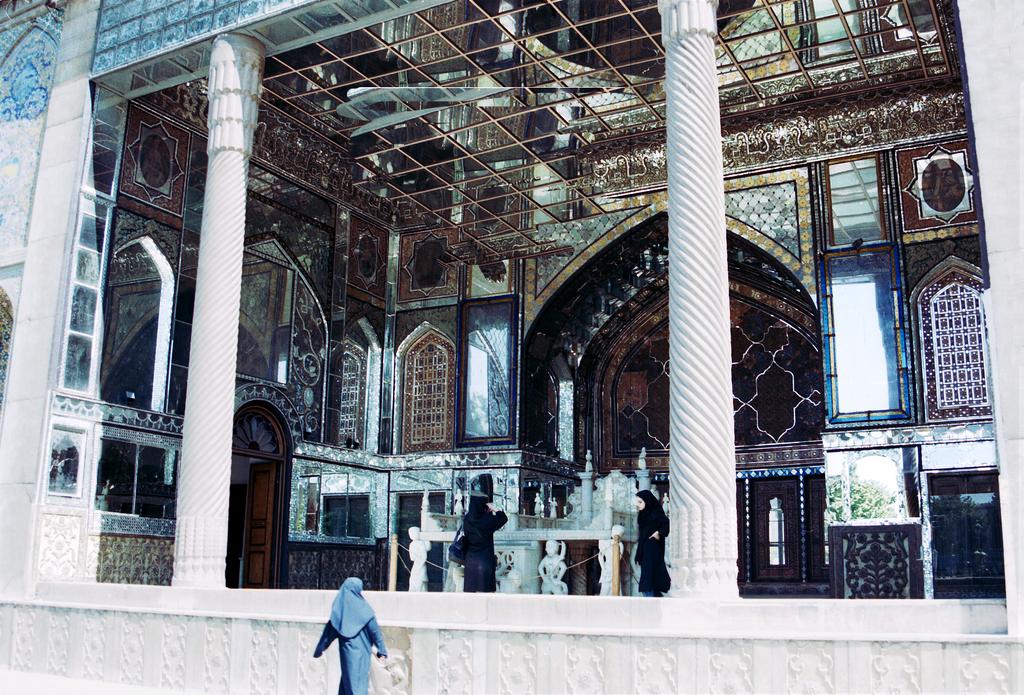
Fath-Ali Shah (ruled 1797–1834) turned the court into a display of royal splendour, with long beards, jewelled robes and huge painted portraits. His most lasting monument at Golestan is the Takht-e Marmar, an open audience hall (eyvân) whose centrepiece is a throne platform carved from yellow marble, held up by figures of men, women and demons. The date usually given for the throne is 1806. Here the shah sat on public occasions, framed by mirror work and paintings, visible to the crowd in the courtyard below.
Naser al-Din Shah’s European turn
Naser al-Din Shah (ruled 1848–1896) reshaped the complex more than anyone. After seeing European capitals on his journeys to Europe from 1873, he built halls with European proportions and furnishings, clock towers and wide windows, while keeping Persian tile and mirror decoration. The Shams-ol-Emareh, the tall “Edifice of the Sun” built in the 1860s, let him look out over the city from its towers.
He was also a keen photographer. The palace kept a photographic studio, and its archive holds tens of thousands of photographs made by the shah, his court photographers and visitors. It is one of the most important early photographic collections in Asia and an essential source for Qajar art and society.
The Abyaz (“White”) Palace was completed in 1883 to display gifts sent by the Ottoman sultan. It now houses an ethnographic museum.

Coronations and demolitions
After the Qajars fell in 1925, the palace kept a ceremonial role. Reza Shah was crowned here in 1926, and Mohammad Reza Shah’s coronation took place at Golestan in 1967. Reza Shah, however, saw the old citadel as an obstacle to a modern capital. Large parts of the Arg, including many Qajar buildings, were pulled down in the 1920s and 1930s for ministries and new streets, and more went in the following decades. What survives is perhaps a fraction of the 19th-century complex.
Damage in 2026
During the war of 2026, US and Israeli air strikes hit targets in central Tehran. In early March a strike on the area of Arg Square, just next to the palace, sent shockwaves and debris into the complex. Reports, including from the arts magazine Artforum on 4 March 2026, said windows, doors and mirror work were damaged. UNESCO publicly expressed concern about the protection of cultural heritage in the region, as reported by Euronews on 3 March 2026. Detailed damage assessments had not been widely published at the time of writing, so visitors should check whether halls are open. The wider conflict is covered on our page about the 2026 war.
What to see on a visit
- Takht-e Marmar, the marble throne terrace, at the north of the garden.
- Khalvat-e Karim Khani, the small Zand-period terrace. The marble tombstone of Naser al-Din Shah, assassinated in 1896, is displayed here.
- Talar-e Salam and the Hall of Mirrors, the main reception halls, decorated with mirror mosaic and European chandeliers.
- Shams-ol-Emareh, the twin-towered building on the east side.
- The Emarat-e Badgir, a pavilion with windcatchers, and the Howz-khane, a summer room with a pool, which now shows European paintings given to the Qajars.
- The Abyaz Palace ethnographic museum, and the photograph gallery when it is open.
Practical notes
- The palace is on the south side of central Tehran, close to the Grand Bazaar. Many people combine the two. See our Tehran Grand Bazaar page and the Tehran city guide.
- Entry to the garden and to individual halls has traditionally been ticketed separately. Prices and opening hours change, and after the 2026 damage some halls may be closed. Check current official information before you go, and see your own government’s travel advice for Iran.
- Allow at least two to three hours.
Persian words from this page
| کاخ | kâkh | palace |
| گلستان | golestân | rose garden |
| تخت مرمر | Takht-e Marmar | the Marble Throne |
| شمسالعماره | Shams-ol-Emâre | “Edifice of the Sun” |
| ارگ | arg | citadel |
| عکاسخانه | akkâs-khâne | photographic studio |
Sources and further reading
- UNESCO World Heritage Centre, “Golestan Palace” (inscribed 2013).
- Encyclopaedia Iranica, “TEHRAN“.
- Abbas Amanat, Pivot of the Universe: Nasir al-Din Shah Qajar and the Iranian Monarchy, 1831–1896 (University of California Press, 1997).
- “Golestan Palace, Tehran’s Only UNESCO World Heritage Site, Damaged in US-Israeli Airstrikes”, Artforum, 4 March 2026.
- Tokunbo Salako, “UNESCO expresses concern over the protection of cultural heritage sites in Middle East”, Euronews, 3 March 2026.
Want to learn Persian? Get the free Starter Pack
Get the 14-page printable Starter Pack (all 32 letters, a 7-day reading plan, 100 core words and 20 survival phrases) and a short 5-email course. Free.
More in Top Places to Visit in Iran
- Naqsh-e Jahan Square
- Shah (Imam) Mosque, Isfahan
- Sheikh Lotfollah Mosque
- Ali Qapu Palace
- Jameh Mosque of Isfahan
- Si-o-se Pol and Khaju Bridge
- Vank Cathedral
- Hasht Behesht Palace
- Naqsh-e Rostam
- Eram Garden, Shiraz
- Nasir al-Molk (Pink) Mosque
- Tomb of Hafez (Hafezieh)
- Tomb of Saadi (Saadieh)
- Shah Cheragh Shrine
- Arg of Karim Khan
- Fin Garden, Kashan
- Historic Houses of Kashan
- Jameh Mosque of Yazd
- Yazd Fire Temple and Towers of Silence
- Dowlatabad Garden and Windcatcher
- Amir Chakhmaq Complex
- Golestan Palace
- National Museum of Iran
- Treasury of National Jewels
- Tehran Grand Bazaar
- Milad Tower
- Imam Reza Shrine, Mashhad
- Tomb of Ferdowsi, Tus
- Tomb of Omar Khayyam, Neyshabur
- Tomb of Avicenna, Hamadan
- Ganjnameh Inscriptions, Hamadan
- Behistun (Bisotun): Visiting the Site
- Taq-e Bostan: Visiting the Site
- Tabriz Historic Bazaar
- Takht-e Soleyman
- Armenian Monastic Ensembles of Iran
- Sheikh Safi al-Din Shrine, Ardabil
- Dome of Soltaniyeh
- Alamut Castle
- Falak-ol-Aflak Castle
- Shushtar Historical Hydraulic System
- Chogha Zanbil: Visiting the Ziggurat
- Susa Archaeological Site
- Arg-e Bam
- Ganjali Khan Complex, Kerman
- Shazdeh Garden, Mahan
- Rayen Castle
- Dasht-e Lut (Lut Desert)
- Maranjab Desert and Caravanserai
- Varzaneh Desert
- Mount Damavand
- Hyrcanian Forests
- Lake Urmia
- Badab-e Surt Springs
- Ali Sadr Cave
- The Kaluts of Shahdad
- Qeshm Geopark
- Hormuz Island Colours
- Visiting Persepolis: A Day Trip from Shiraz
- Visiting Pasargadae
- Persian Caravanserais
- The Qanat of Gonabad
- Meymand Village
- Sasanian Sites of Fars: Firuzabad, Bishapur and Sarvestan
- Gonbad-e Qabus: Visiting the Tower
- Zayandeh Rud and Isfahan’s Bridges
- Tochal and Darband: Hiking Above Tehran
- Mount Sabalan
- Skiing in Iran: Dizin and Shemshak
- Golestan National Park