Abyaneh is a village of red mud-brick houses at about 2,100 m in the Karkas Mountains of Isfahan province, some 70 km south-east of Kashan. Its colour comes from the iron-rich clay it is built of, and it is known across Iran for its old houses, carved wooden doors and balconies, a mosque with an 11th-century pulpit, and the traditional dress its women still wear.
| Persian name | ابیانه (Abyâne) |
|---|---|
| Province | Isfahan, Natanz County |
| Elevation | About 2,100 m |
| Population | 301 (2016 census); many more in summer |
| River | Barz river |
| Nearest towns | Natanz; Kashan about 70 km to the north-west |
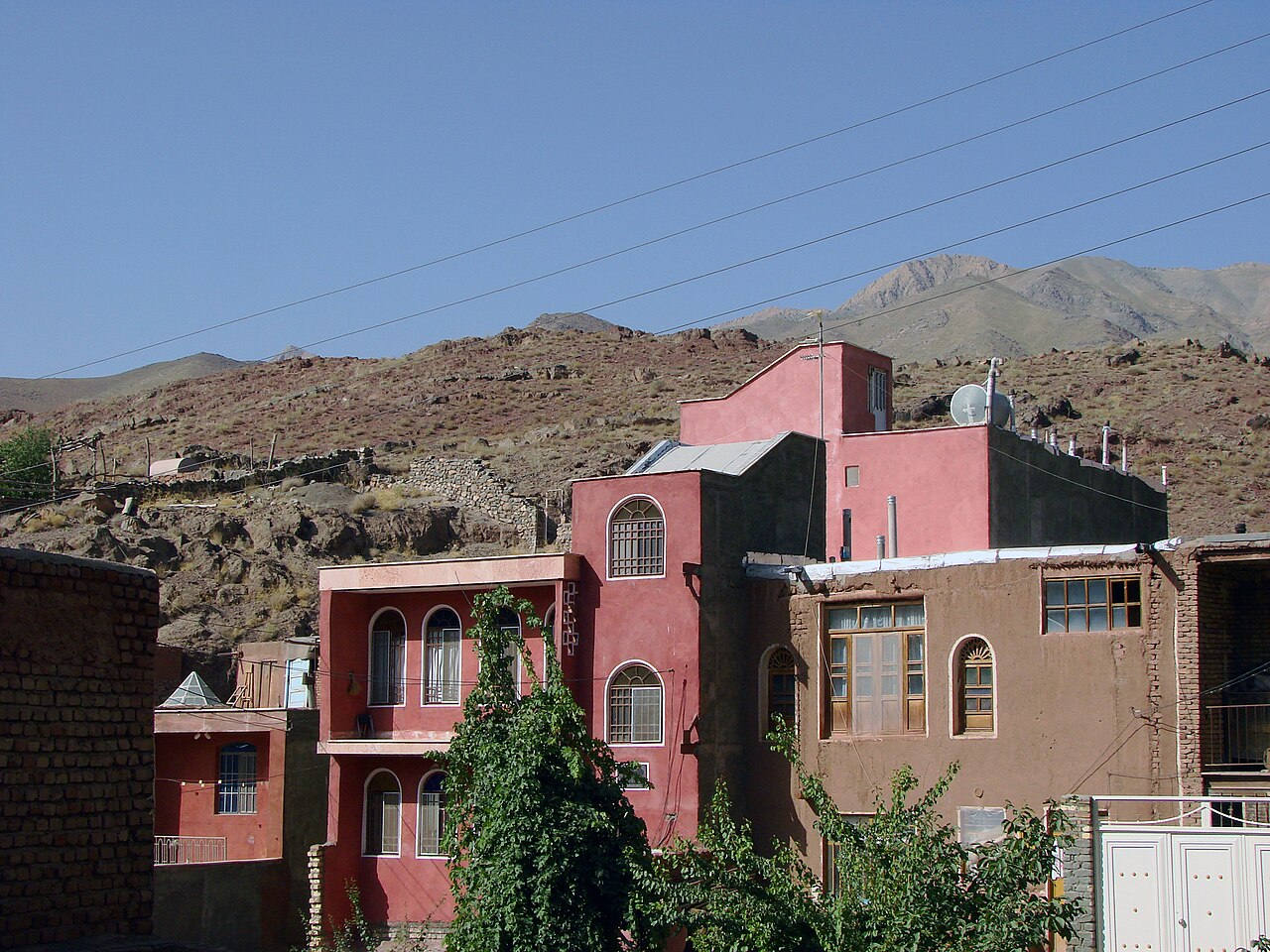

The red village
Abyaneh is built on a slope above the narrow valley of the Barz river, facing south-east to catch the sun. The houses are made of mud brick and finished in a plaster of local clay that contains iron oxides, so the whole village is a deep red-brown, like the hills around it. The houses rise in steps up the hillside, with narrow lanes, flat roofs and small terraces between them. Many have upper floors with wooden balconies and lattice windows, and heavy wooden doors carved with dates and verses, some with two different knockers, one for men and one for women, so that people inside knew who was calling.
The village looks much as it did a hundred years ago because it was remote, and because many families moved away to Tehran, Kashan and Isfahan during the 20th century, leaving houses unaltered rather than rebuilt in concrete.
A long history in the mountains
People have lived in the valley for a very long time, but the village’s early history is mostly tradition. On a hill above the houses are the remains of a fire temple known as Harpak, which local people date to before the coming of Islam. Two ruined fortresses on the heights, Pala and Herdah, and the Palahamooneh fort on the far side of the valley, were refuges in times of raids.
The firmest dates come from the Jameh Mosque. Its carved wooden minbar (pulpit) is dated by inscription to 1073–1074 CE, in the Seljuk period, and its wooden mihrab carries an inscription from the 14th century. The village also has a shrine, an imamzadeh, said to hold the remains of two sons of the seventh Shi’a imam, Musa al-Kazim, and several smaller mosques and husseiniyehs where the mourning ceremonies of Muharram are held.
Dress and dialect
Abyaneh is one of the few places in central Iran where traditional dress is still worn every day, mainly by older women. They wear a long white headscarf printed with bright flowers that falls below the waist, a dark pleated skirt reaching to the knee, and cotton stockings. Men’s dress, a black jacket and wide black trousers, is now rarely seen except on festival days.
The villagers also speak a local dialect, Abyanei, which differs from standard Persian in grammar and vocabulary and is often said to keep forms older than modern Persian. It belongs to the group of central Iranian dialects spoken in the villages between Kashan and Isfahan. Like many local dialects in Iran, it is spoken less by younger people.
Visiting Abyaneh
Abyaneh is usually visited on a day trip from Kashan or on the road between Kashan and Isfahan, with a detour from Natanz. Cars are left at the entrance, and the village is explored on foot. The lanes are steep, so allow two or three hours. A few guesthouses and a hotel near the village give the chance to stay overnight, when the day visitors have gone and the sunset turns the walls bright red.
Older residents sell dried apples, plums and other fruit from the orchards, as well as headscarves in the local style. The village is crowded during Nowruz and in spring and summer; in winter it is cold, often snowy and very quiet. Abyaneh is a living village with a small and mostly elderly winter population, so be considerate when taking photographs, and ask before photographing people. Check current local information on access before you go.
Near the road, the town of Natanz has a fine Ilkhanid shrine and mosque complex, and a uranium enrichment site that has put its name in the news; the area around it is restricted and photography near it is forbidden.
See also Kashan, the usual base for a visit, and the other famous villages on this site, Masuleh and Kandovan. Meymand in Kerman province, with its cave homes, is described in Meymand Village.
Persian words from this page
| ابیانه | Abyâne | Abyaneh |
| خشت | khesht | mud brick |
| خاک رس | khâk-e ros | clay |
| منبر | menbar | pulpit (minbar) |
| محراب | mehrâb | prayer niche (mihrab) |
| گویش | guyesh | dialect |
| نطنز | Natanz | Natanz |
Sources and further reading
- Encyclopaedia Iranica, article “Abyana”.
- Encyclopaedia Iranica, article “Central dialects”.
- Statistical Centre of Iran, 2016 National Population and Housing Census.
- Sheila Blair, The Ilkhanid Shrine Complex at Natanz, Iran (Harvard, 1986).
Want to learn Persian? Get the free Starter Pack
Get the 14-page printable Starter Pack (all 32 letters, a 7-day reading plan, 100 core words and 20 survival phrases) and a short 5-email course. Free.
More in Cities of Iran
- Tehran: Iran’s Capital
- Mashhad
- Isfahan
- Shiraz
- Tabriz
- Yazd
- Kashan
- Kerman
- Hamadan
- Qom
- Ahvaz
- Rasht
- Kermanshah
- Urmia
- Ardabil
- Zanjan
- Qazvin
- Sanandaj
- Khorramabad
- Bandar Abbas
- Bushehr
- Zahedan
- Birjand
- Gorgan
- Sari
- Semnan
- Arak
- Ilam
- Yasuj
- Shahr-e Kord
- Bojnurd
- Karaj
- Abadan and Khorramshahr
- Kish Island
- Qeshm Island
- Hormuz Island
- Masuleh
- Abyaneh
- Kandovan
- Bam
- Neyshabur (Nishapur)
- Shush (Susa) Today