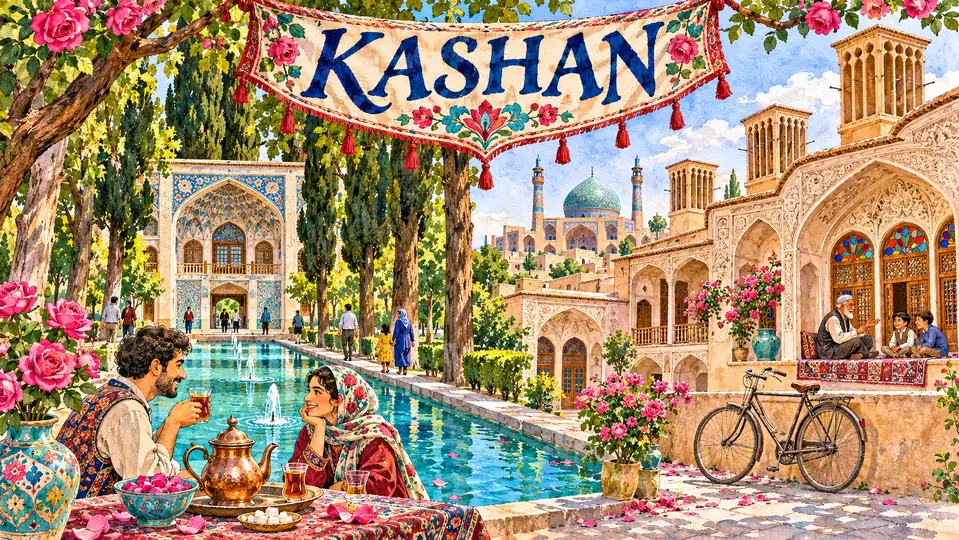
Kashan (کاشان, Kâshân) is a desert-edge city on the road between Tehran and Isfahan, known for the grand 19th-century courtyard houses of its merchants, the Safavid Fin Garden where Amir Kabir was killed in 1852, and the rosewater distilled in its mountain villages each May. People have lived here since prehistory, at Tepe Sialk. The city had 304,487 inhabitants at the 2016 census.
| Persian name | کاشان (Kâshân) |
|---|---|
| Province | Isfahan |
| Population | 304,487 (city, 2016 census, Statistical Centre of Iran) |
| Location | About 240 km south of Tehran, at the edge of the Dasht-e Kavir and the foot of the Karkas mountains |
| Known for | Tepe Sialk, lustre tiles, Fin Garden, Qajar houses, rosewater, carpets |
| UNESCO | Fin Garden, as part of the Persian Garden (2011) |
Tepe Sialk: Kashan before history
On the south-western edge of the modern city lie two mounds called Tepe Sialk. The French archaeologist Roman Ghirshman dug here in the 1930s and found layers of villages going back to the 6th millennium BCE or earlier, with painted pottery, early copper work and, later, a mud-brick platform often described as a ziggurat. Sialk is one of the key sites for the early farming villages of the plateau; see Prehistoric Iran. The site is open to visitors, with a small museum, though much of what Ghirshman found went to the Louvre and the National Museum in Tehran.
The city of tiles
In the 12th to 14th centuries Kashan was one of the great pottery centres of the Islamic world. Its workshops produced lustreware, glazed pottery with a metallic sheen, and the star- and cross-shaped tiles that covered shrines from Qom to Mashhad. A Kashani potter, Abu’l-Qasim Kashani, wrote a treatise on pottery-making in 1301. The fame of these tiles left a mark on the language: kâshi (کاشی), the everyday Persian word for a glazed tile, means “from Kashan”. Our page on Iranian handicrafts traces what came after.
The Safavid shahs liked Kashan as a stopping place between Qazvin, Qom and Isfahan, and Shah Abbas I asked to be buried here; his grave lies in the shrine of Habib ibn Musa in the city.
Fin Garden and the death of Amir Kabir
About 6 km south-west of the centre, a spring flows out of the foot of the mountains, and around it lies the Bagh-e Fin (باغ فین). Several Safavid shahs are credited with building it, from Tahmasp to Abbas I and Safi. Water from the spring runs through tiled channels and pools under old cypress trees, a classic plan of the Persian garden. After an earthquake in 1778 badly damaged Kashan, Fath-Ali Shah Qajar repaired the garden and added a pavilion.
Fin is remembered across Iran for one event. In late 1851 Naser al-Din Shah dismissed his reforming chief minister, Amir Kabir, and exiled him here. On 10 January 1852 the shah’s agents killed him in the garden’s small bathhouse by opening the veins of his arms. The bath is still shown to visitors. See the Fin Garden page for the layout and the story.
Merchant houses of the 19th century
The 1778 earthquake destroyed much of old Kashan. When the city recovered under the Qajars, its carpet, silk and rosewater merchants built themselves houses that are now the main reason most visitors come. From the lane they show only a plain wall and a door. Inside, a series of courtyards descends below street level to reach cooler ground, with summer rooms, winter rooms, windcatchers, stucco, mirror work and stained glass.
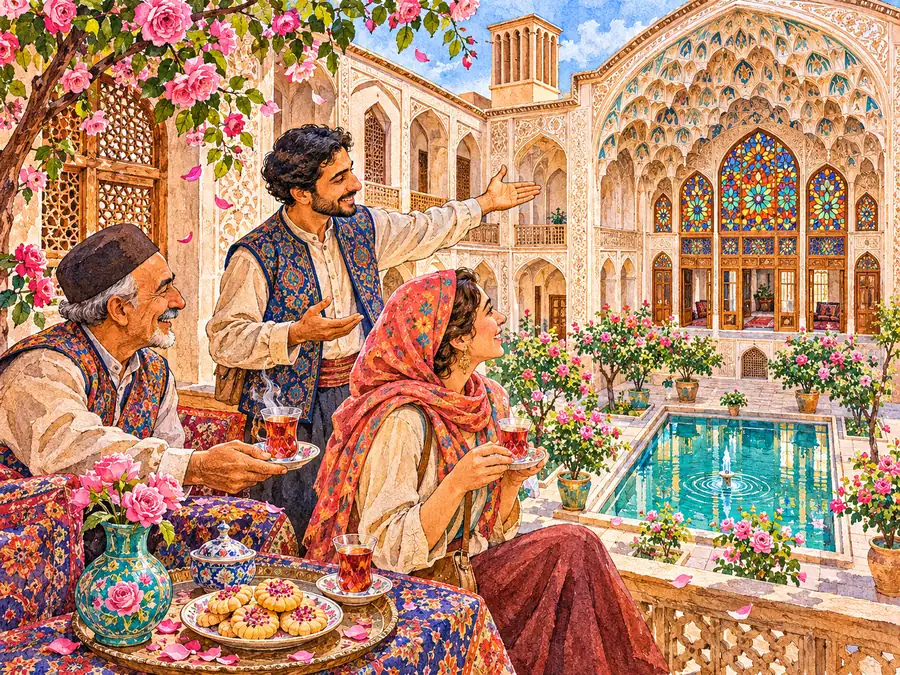
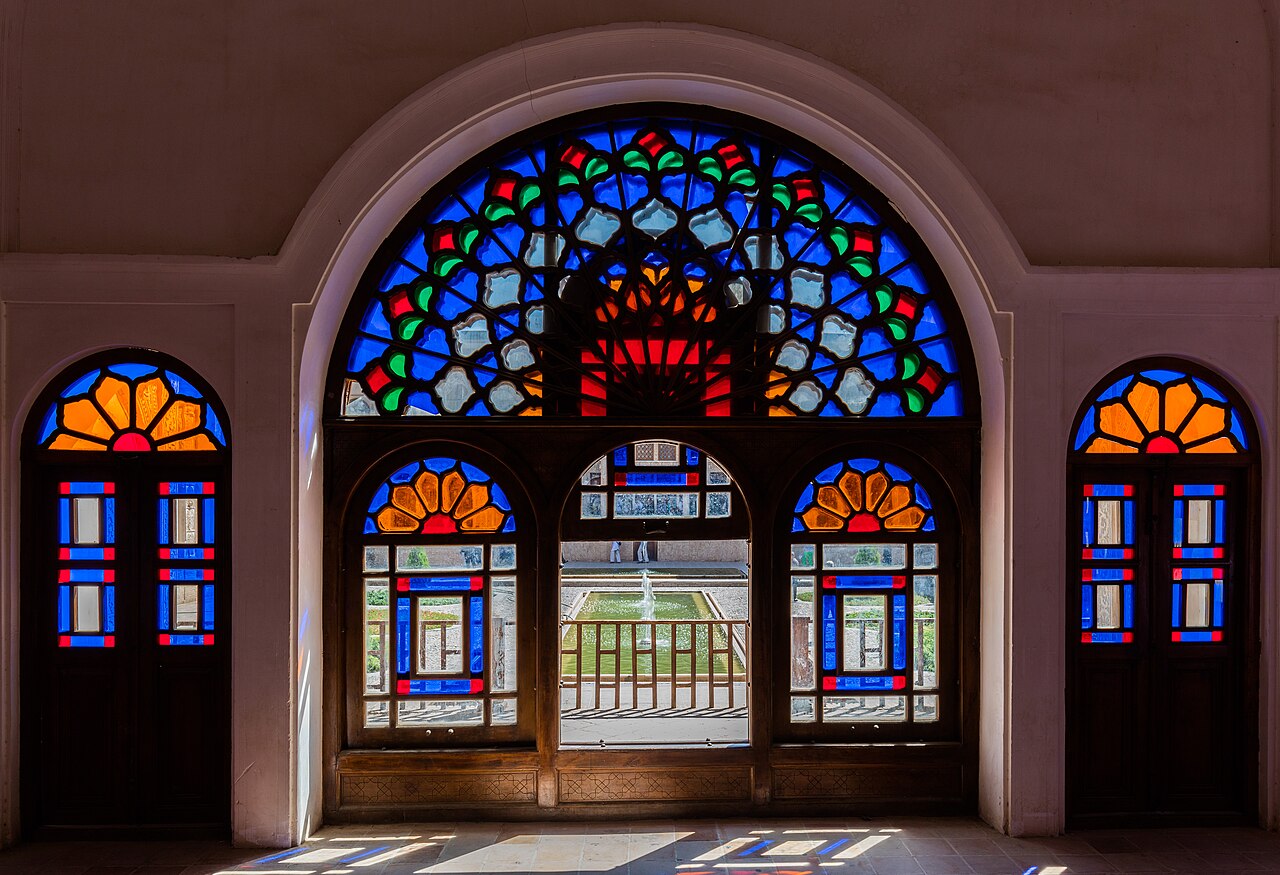

- Tabatabaei House, built in the 1880s for the carpet merchant Seyyed Ja’far Tabatabaei, with four courtyards and some of the finest stucco in Iran.
- Borujerdi House, built in the mid-19th century for a merchant who traded with Borujerd. Its tall windcatchers rise above a domed hall. The story goes that it was built for the bride from the Tabatabaei family.
- Abbasian House and Ameri House, two very large complexes, the second now partly a hotel.
Close to them are the Sultan Amir Ahmad Bathhouse, with a rooftop of domes and light wells, and the Agha Bozorg Mosque, whose sunken courtyard and brick dome date from the late 18th and early 19th centuries. The houses are described on Historic Houses of Kashan.
Rosewater in Qamsar and Niasar
Each May, during the Persian month of Ordibehesht, the villages of Qamsar and Niasar in the mountains above Kashan pick the flowers of the damask rose before dawn and distil them in copper pots to make golâb (گلاب), rosewater. The ceremony, called golâbgiri, draws crowds from all over Iran. Kashan rosewater goes into sweets, rice dishes and drinks, and is sprinkled on guests and mourners at religious ceremonies.
Poets, painters and a rebel
Kashan produced two well-loved modern Iranian artists: the painter Mohammad Ghaffari, known as Kamal-ol-Molk, and the poet and painter Sohrab Sepehri (1928–1980), whose line “I am from Kashan” opens one of his best-known poems. In the early 20th century the city was also the base of the rebel Nayeb Hossein Kashi, whose bands controlled the roads around Kashan for years until his capture and execution in 1919.
Getting there, getting around and day trips
Kashan lies on the main road and railway between Tehran and Isfahan, around three hours by road from Tehran, and is reachable from Imam Khomeini Airport without going into the capital. Trains and buses stop here on the way to Isfahan, Yazd and Kerman. The old houses, the bazaar and the bathhouse are close together and best seen on foot; Fin Garden and Tepe Sialk are a short taxi ride.
The red mud-brick village of Abyaneh is about an hour to the south, and the dunes and caravanserai of Maranjab lie to the north-east. Check opening times with official sources and follow your own government’s travel advice.
Persian words from this page
| کاشان | Kâshân | Kashan |
| کاشی | kâshi | glazed tile (“from Kashan”) |
| باغ فین | Bâgh-e Fin | Fin Garden |
| گلاب | golâb | rosewater |
| گلابگیری | golâbgiri | rosewater distilling |
| حمام | hammâm | bathhouse |
| حیاط | hayât | courtyard |
Sources and further reading
- Encyclopaedia Iranica, “Kashan” and “Bāḡ-e Fin”.
- Roman Ghirshman, Fouilles de Sialk, près de Kashan, 1933, 1934, 1937 (2 vols., Paris, 1938–1939).
- Oliver Watson, Persian Lustre Ware (Faber, 1985).
- Abbas Amanat, Pivot of the Universe: Nasir al-Din Shah Qajar and the Iranian Monarchy, 1831–1896 (1997), on the fall of Amir Kabir.
- UNESCO World Heritage Centre, The Persian Garden.
Want to learn Persian? Get the free Starter Pack
Get the 14-page printable Starter Pack (all 32 letters, a 7-day reading plan, 100 core words and 20 survival phrases) and a short 5-email course. Free.
More in Cities of Iran
- Tehran: Iran’s Capital
- Mashhad
- Isfahan
- Shiraz
- Tabriz
- Yazd
- Kashan
- Kerman
- Hamadan
- Qom
- Ahvaz
- Rasht
- Kermanshah
- Urmia
- Ardabil
- Zanjan
- Qazvin
- Sanandaj
- Khorramabad
- Bandar Abbas
- Bushehr
- Zahedan
- Birjand
- Gorgan
- Sari
- Semnan
- Arak
- Ilam
- Yasuj
- Shahr-e Kord
- Bojnurd
- Karaj
- Abadan and Khorramshahr
- Kish Island
- Qeshm Island
- Hormuz Island
- Masuleh
- Abyaneh
- Kandovan
- Bam
- Neyshabur (Nishapur)
- Shush (Susa) Today