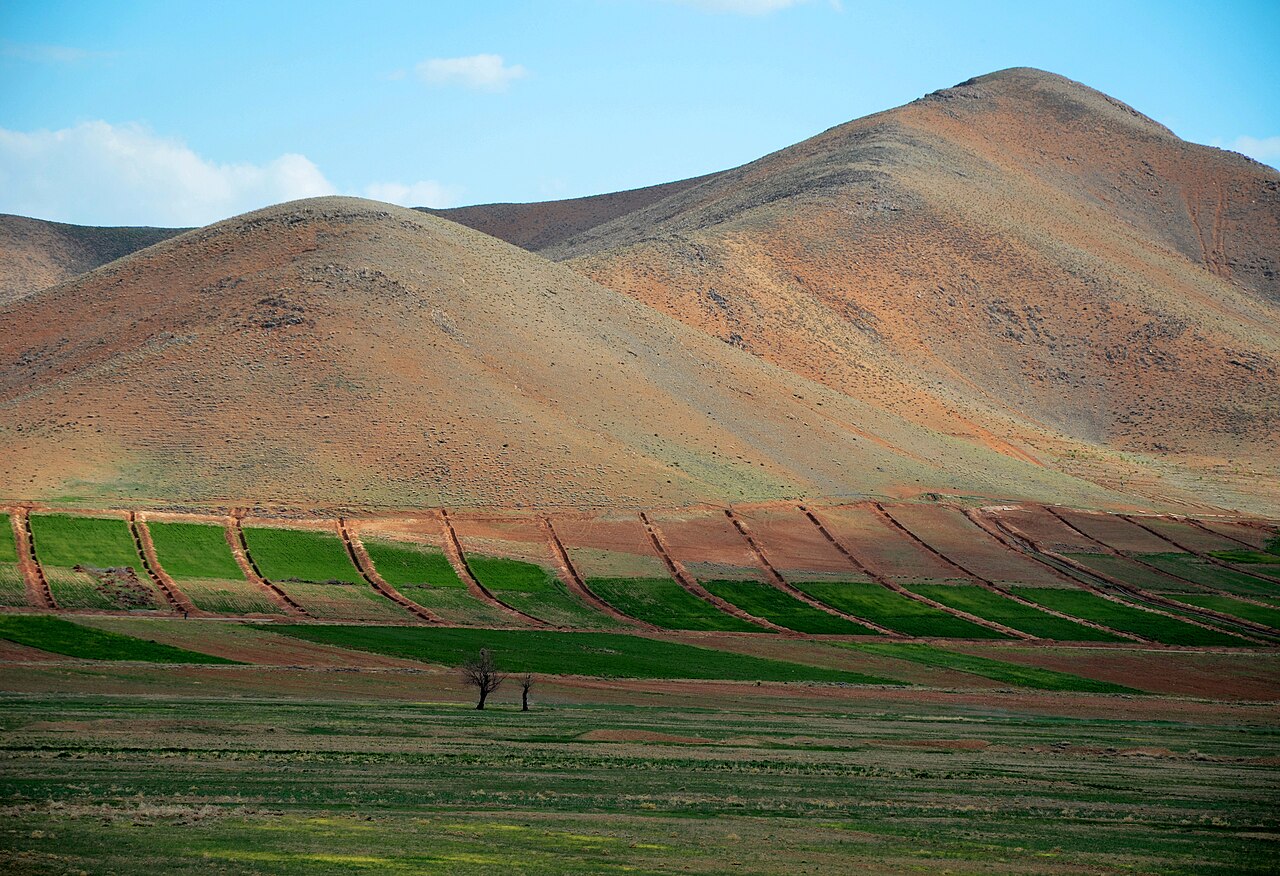
Shahr-e Kord is the capital of Chaharmahal and Bakhtiari province, about 100 km west of Isfahan in the central Zagros. At roughly 2,070 m it is one of the highest cities in Iran, with long, snowy winters. It is the administrative centre of the Bakhtiari lands, home to one of Iran’s best-known nomadic tribal confederations, and its mountains feed both the Zayandeh Rud of Isfahan and the Karun of Khuzestan.
| Persian name | شهرکرد (Shahr-e Kord) |
|---|---|
| Former name | Deh-e Kord (“village of the Kurds”) |
| Province | Chaharmahal and Bakhtiari (capital) |
| Population | 190,441 (city, 2016 national census) |
| Elevation | about 2,070 m |

From Deh-e Kord to Shahr-e Kord
The town’s old name, Deh-e Kord, means “village of the Kurds”, and it is usually explained by a Kurdish group settled here in earlier centuries; the details of that settlement are not well documented. In the Pahlavi period, when many places were renamed, “village” (deh) was upgraded to “city” (shahr), giving Shahr-e Kord (شهرکرد).
The province’s name joins two regions. Chaharmahal (چهارمحال), “four districts”, is the settled farming country of high plains around the city, long administered from Isfahan. Bakhtiari (بختیاری) refers to the mountain country to the west and south, the summer pastures of the Bakhtiari tribes. The two were made a separate province in 1973, with Shahr-e Kord as its capital.
The Bakhtiari and the great migration
The Bakhtiari are a Lur people who speak Bakhtiari Luri, divided into two great branches, the Haft Lang and the Chahar Lang. For centuries many of them moved twice a year with their flocks: down to winter pastures on the warm plains of Khuzestan, and back up in spring to the high valleys of the Zagros. The route crosses rivers in flood and passes over 3,000 m. The 1925 documentary Grass, filmed by Merian C. Cooper, Ernest Schoedsack and Marguerite Harrison, followed one of these migrations and brought it to world audiences.
Today fewer Bakhtiari families migrate, and many who do move their animals by truck for part of the way, but the kuch (کوچ) still happens each spring and autumn. In summer, tents and herds are spread across the uplands west of the city around Chelgerd and Kuhrang.
Khans in the capital
The great Bakhtiari khans became national figures at the start of the twentieth century. In 1909, during the Constitutional Revolution, Bakhtiari horsemen under Sardar As’ad and Samsam al-Saltaneh marched on Tehran with forces from Gilan and helped depose Mohammad Ali Shah; see our pages on the Bakhtiari and the Revolution and the constitutionalists’ capture of Tehran. The khans also had a stake in the early oil industry, since the first oil field at Masjed Soleyman lay on Bakhtiari land. Reza Shah later broke their power, and Soraya Esfandiary-Bakhtiari, second wife of Mohammad Reza Shah, came from one of their leading families.
Traces of that world survive near the city. At Chaleshtor, about 10 km away, the Qajar-era mansion of a Bakhtiari khan has been restored, with painted plasterwork and a courtyard, and is open to visitors; check current hours locally.
Where Isfahan’s river begins
The Zagros west of Shahr-e Kord catch heavy snow, and the Zard Kuh range, rising above 4,000 m, holds the springs of two great rivers. The Karun flows south-west to Khuzestan and the Persian Gulf. The Zayandeh Rud flows east to Isfahan. Since the 1950s tunnels at Kuhrang (کوهرنگ) have carried extra water from the Karun headwaters across the watershed into the Zayandeh Rud, and plans for more transfers remain a source of dispute between provinces short of water.
Winter city
Shahr-e Kord’s altitude gives it some of the coldest winters of any Iranian provincial capital, with frequent snow and frosts, and mild summers that attract visitors from the hot plains. The surrounding countryside produces wheat, potatoes and dairy products, and the province is known for gabbeh and Bakhtiari carpets with garden-panel designs, and for the chugha, the woven striped cloak traditionally worn by Bakhtiari men. For the wider craft tradition, see Iranian handicrafts; for the neighbouring city on the plain, Isfahan.
Persian words from this page
| شهر | shahr | city |
| ده | deh | village |
| چهارمحال | Chahârmahâl | “four districts” |
| بختیاری | Bakhtiâri | Bakhtiari |
| کوچ | kuch | seasonal migration |
| برف | barf | snow |
| خان | khân | khan, chief |
Sources and further reading
- Encyclopaedia Iranica, “Bakhtiari Tribe”.
- Encyclopaedia Iranica, “Chaharmahal”.
- Gene R. Garthwaite, Khans and Shahs: A History of the Bakhtiyari Tribe in Iran (Cambridge University Press, 1983).
- Merian C. Cooper, Ernest B. Schoedsack and Marguerite Harrison, Grass (documentary film, 1925).
- Statistical Centre of Iran, National Population and Housing Census 2016 (1395).
Want to learn Persian? Get the free Starter Pack
Get the 14-page printable Starter Pack (all 32 letters, a 7-day reading plan, 100 core words and 20 survival phrases) and a short 5-email course. Free.
More in Cities of Iran
- Tehran: Iran’s Capital
- Mashhad
- Isfahan
- Shiraz
- Tabriz
- Yazd
- Kashan
- Kerman
- Hamadan
- Qom
- Ahvaz
- Rasht
- Kermanshah
- Urmia
- Ardabil
- Zanjan
- Qazvin
- Sanandaj
- Khorramabad
- Bandar Abbas
- Bushehr
- Zahedan
- Birjand
- Gorgan
- Sari
- Semnan
- Arak
- Ilam
- Yasuj
- Shahr-e Kord
- Bojnurd
- Karaj
- Abadan and Khorramshahr
- Kish Island
- Qeshm Island
- Hormuz Island
- Masuleh
- Abyaneh
- Kandovan
- Bam
- Neyshabur (Nishapur)
- Shush (Susa) Today