Kandovan is a village on the slopes of Mount Sahand in East Azerbaijan province, about 60 km south of Tabriz, where families still live in homes carved out of tall cones of volcanic rock. The cones, called karan, were shaped by erosion from ash deposits left by ancient eruptions of Sahand, and the village is often compared with Cappadocia in Turkey.
| Persian name | کندوان (Kandovân) |
|---|---|
| Province | East Azerbaijan, Osku County |
| Population | 450 (2016 census) |
| Setting | North-western foothills of Mount Sahand, on the Kandovan river |
| Language | Azerbaijani Turkish |
| Nearest city | Tabriz, about 60 km by road via Osku |
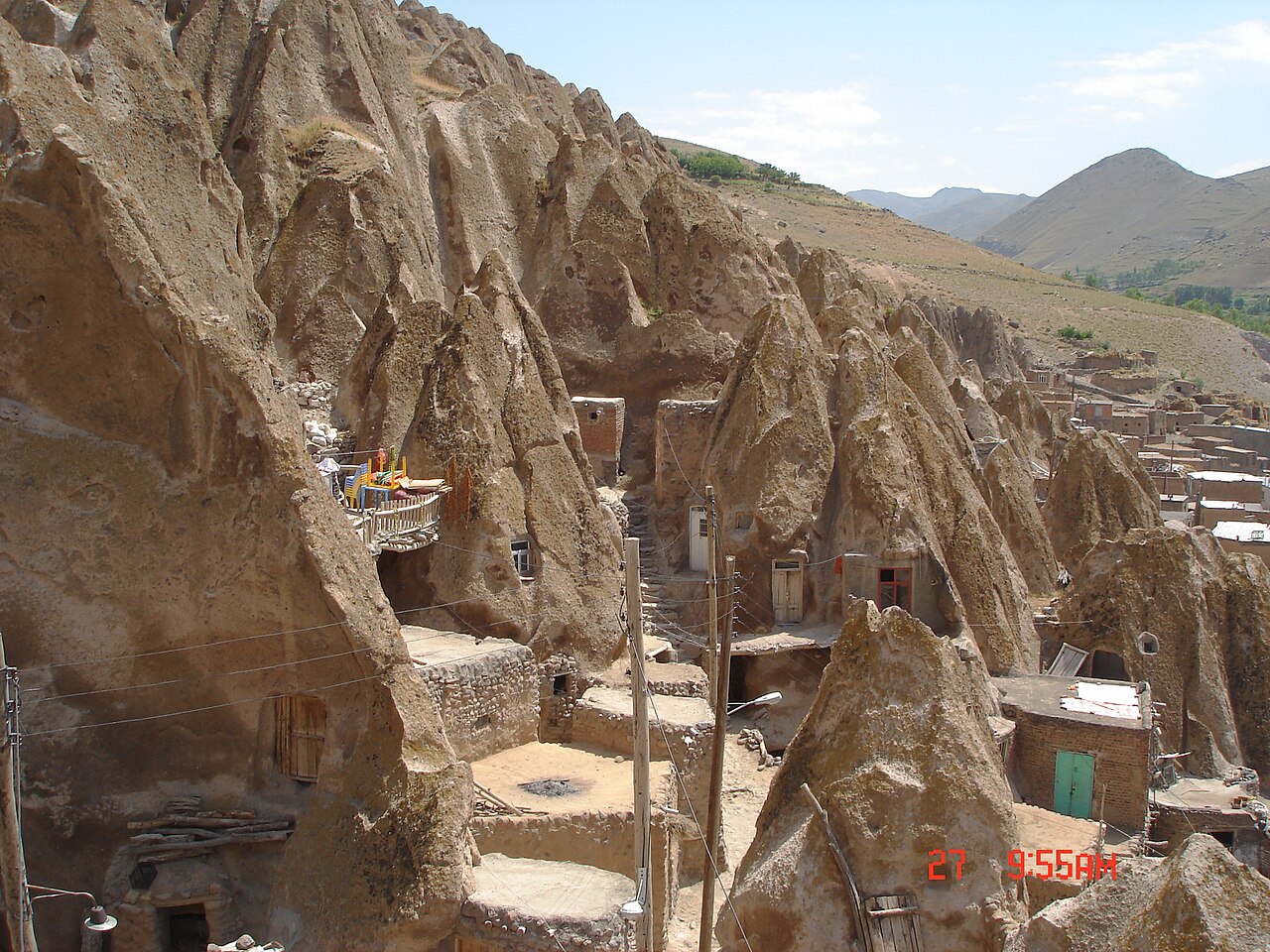

Houses inside the rock
Sahand, a large extinct volcano south of Tabriz, covered its slopes with thick layers of ash and pumice in eruptions long before people lived here. The ash hardened into a soft rock called tuff, or ignimbrite, more than 100 m thick in places. Rain, snowmelt and the Kandovan river cut the deposit into ravines and left behind clusters of pointed cones, some 30 to 40 m tall.
The soft rock is easy to dig but strong enough to stand, so villagers hollowed rooms into the cones, usually two to four storeys inside each one. Traditionally the ground floor was a stable for sheep and goats, the middle floors held the family’s living rooms, and the top was used for storing grain and fodder. Small doors and windows are cut into the rock face, many with wooden frames and painted shutters, and steps and ladders link the levels outside. Rock walls are thick, so the houses stay cool in summer and hold heat in the cold Azerbaijani winter, saving fuel.
How old is Kandovan
No one knows when people first carved homes here. A common local story says that villagers came here centuries ago to hide from the Mongol invasions of the 13th century, and another that herders first used the cones as summer shelters before settling. Neither has been confirmed by excavation, and the rooms themselves are hard to date because they have been recut and extended many times. Claims of an exact age of 700 or more years, often repeated in travel writing, should be treated as tradition.
Village life
Kandovan is a working village. Most residents keep animals, grow fruit in the valley, and keep bees on the flower-rich slopes of Sahand; the honey of the area is well known in Iran and is sold in jars along the lanes. A mineral spring in the village is popular with Iranian visitors, many of whom believe its water helps with kidney complaints. Shops sell dried fruit, herbal teas, knitted goods and local handicrafts.
Tourism has changed the village since the 1990s. Some cones have been turned into shops and tea houses, and a rock hotel, the Laleh Kandovan, has rooms cut into the stone with modern bathrooms. Newer houses of brick and concrete have been built at the edge of the village, and the population has fallen as young people move to Tabriz and Osku.
Visiting
Kandovan is an easy half-day or day trip from Tabriz by car or taxi, through the town of Osku. From the car park, a bridge crosses the river to the old village on the far bank, where paths climb between the cones. The lanes are steep and uneven, and slippery in winter, when snow often covers the area. Spring and early autumn are the most pleasant seasons; summer weekends are crowded with visitors escaping the heat of the city.
Remember that most cones are private homes. Do not enter without being invited, and ask before photographing people.
For the city that serves as the base for a visit, see Tabriz and its historic bazaar. Iran has other villages adapted to hard ground: the cave homes of Meymand in Kerman, the stepped houses of Masuleh and the red clay lanes of Abyaneh.
Persian words from this page
| کندوان | Kandovân | Kandovan |
| سهند | Sahand | Mount Sahand |
| آتشفشان | âtashfeshân | volcano |
| صخره | sakhre | rock |
| عسل | asal | honey |
| چشمه | cheshme | spring |
Sources and further reading
- Encyclopaedia Iranica, article “Azerbaijan i. Geography”.
- Statistical Centre of Iran, 2016 National Population and Housing Census.
- Encyclopaedia Iranica, article “Tabriz”.
- Lonely Planet, Iran (latest edition), chapter on Tabriz and East Azerbaijan.
Want to learn Persian? Get the free Starter Pack
Get the 14-page printable Starter Pack (all 32 letters, a 7-day reading plan, 100 core words and 20 survival phrases) and a short 5-email course. Free.
More in Cities of Iran
- Tehran: Iran’s Capital
- Mashhad
- Isfahan
- Shiraz
- Tabriz
- Yazd
- Kashan
- Kerman
- Hamadan
- Qom
- Ahvaz
- Rasht
- Kermanshah
- Urmia
- Ardabil
- Zanjan
- Qazvin
- Sanandaj
- Khorramabad
- Bandar Abbas
- Bushehr
- Zahedan
- Birjand
- Gorgan
- Sari
- Semnan
- Arak
- Ilam
- Yasuj
- Shahr-e Kord
- Bojnurd
- Karaj
- Abadan and Khorramshahr
- Kish Island
- Qeshm Island
- Hormuz Island
- Masuleh
- Abyaneh
- Kandovan
- Bam
- Neyshabur (Nishapur)
- Shush (Susa) Today