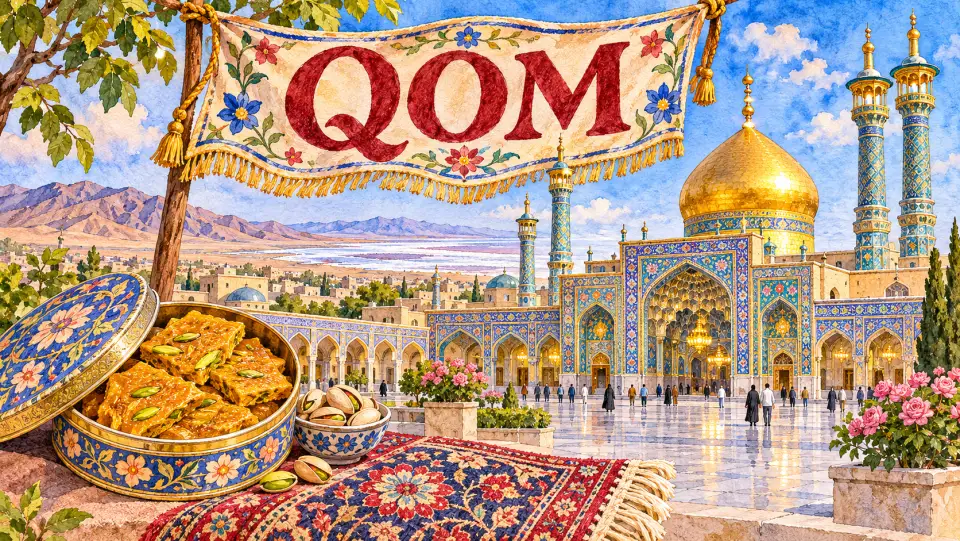
Qom (قم) is a city about 140 km south of Tehran and, after Mashhad, the second most important Shi’a pilgrimage centre in Iran. It grew around the tomb of Fatima Masumeh, sister of Imam Reza, who died here in 816 or 817, and since the 1920s it has been the leading centre of Shi’a religious learning in the world alongside Najaf in Iraq. At the 2016 census it had 1,201,158 inhabitants.
| Persian name | قم (Qom) |
|---|---|
| Province | Qom (capital) |
| Population | 1,201,158 (city, 2016 census, Statistical Centre of Iran) |
| Known for | Shrine of Fatima Masumeh; the seminaries (howze); Jamkaran Mosque; sohân sweets; silk carpets |
| Location | On the edge of the Dasht-e Kavir, on the main road and railway from Tehran to Isfahan and the south |

An early Shi’a town
There was a settlement at Qom before Islam, but the city’s character was set in the early Islamic period. Around the end of the 7th century members of the Ash’ari, an Arab clan from Kufa with Shi’a sympathies, settled here. Qom became one of the few towns in Iran where most of the population was Shi’a at a time when the country as a whole was mainly Sunni, and it kept that identity for centuries.
In 816 or 817 (201 in the Islamic calendar) Fatima, daughter of the seventh imam Musa al-Kazim, was travelling to join her brother Imam Reza in Khorasan. According to Shi’a tradition she fell ill near Saveh, asked to be taken to Qom, and died there. A local Ash’ari notable buried her on his own land. She became known as Ma’sume, “the innocent” or “the sinless one”, and her tomb became a place of pilgrimage. The sources for her life are few and come mainly from later Shi’a writers.
The shrine and its royal patrons
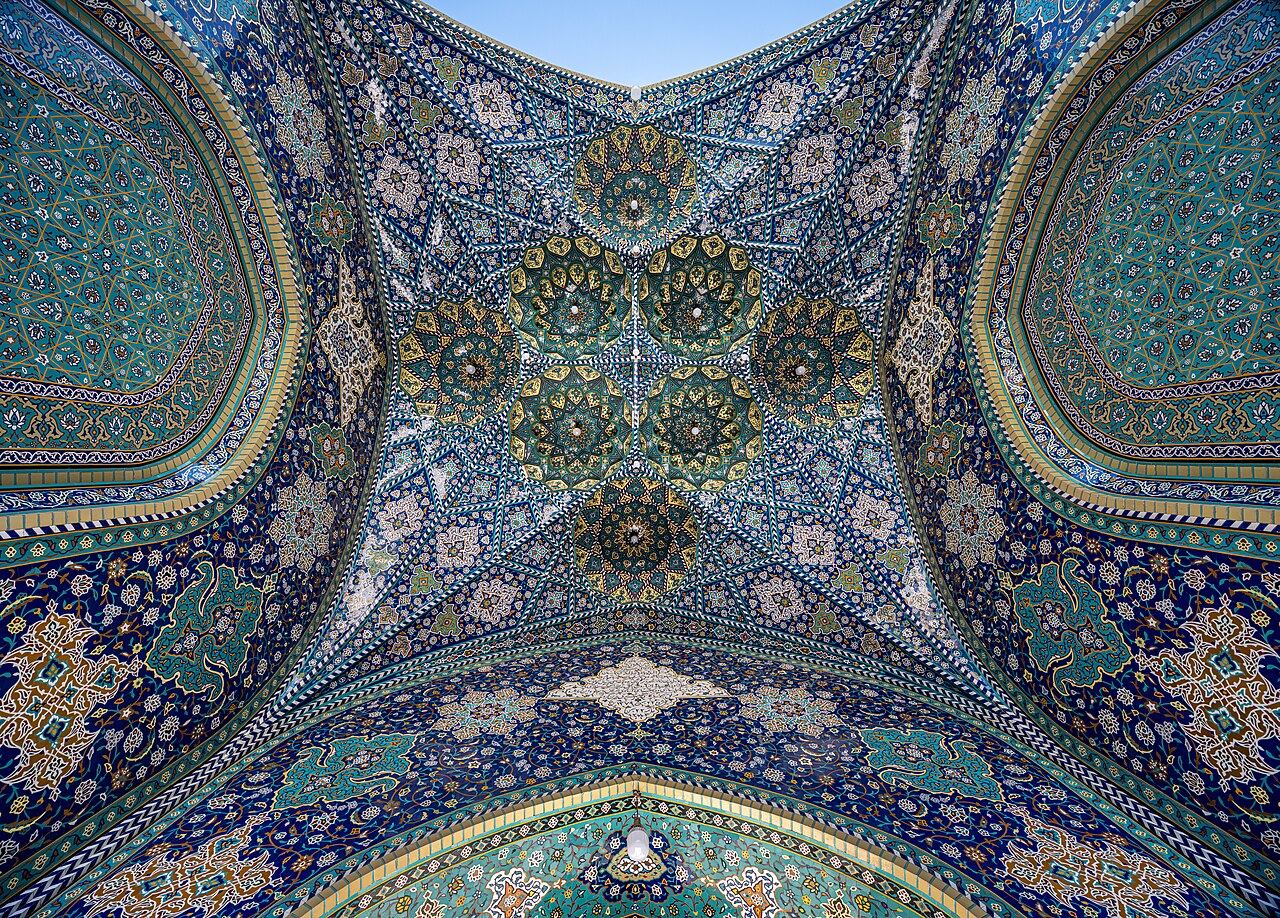
The shrine took its present shape under the Safavids. In 1519 Tajlu Khanum, a wife of Shah Ismail I, paid for a new domed tomb chamber, a gilded iwan and minarets. Because Mecca, Najaf and Karbala lay outside their borders, the Safavid shahs encouraged pilgrimage to Qom and Mashhad, and several of them chose to be buried here, including Shah Safi and Shah Abbas II.
The Qajar king Fath-Ali Shah regilded the dome in 1803 and enlarged the courtyards, and he too is buried in the shrine, as are other members of his family. In the 1880s the chief minister Amin al-Soltan and his son added the New Court (Sahn-e Jadid). Since 1979 the complex has been greatly expanded with new courtyards, prayer halls and underground spaces for the crowds who come on Thursday evenings, Fridays and religious anniversaries.
Visitors who are not Muslim can usually enter the courtyards, often with a guide from the shrine’s international office, but the tomb chamber may be restricted. Women are expected to wear a chador inside the shrine, and chadors are lent at the entrances. Rules can change, so ask at the gate.
The seminaries: how Qom became a centre of learning
For most of the Qajar period Qom had seminaries, but the main centres of Shi’a scholarship were Najaf and Karbala in Ottoman Iraq. That changed in 1922, when the senior cleric Sheikh Abdolkarim Haeri Yazdi settled in Qom and reorganised its religious colleges into a single howze-ye elmiye (حوزه علمیه), a seminary system. Students came from all over Iran.
From the mid-1940s until his death in 1961, Ayatollah Hossein Borujerdi, widely recognised as the leading marja’ (source of emulation) of his time, led the Qom seminary and built the large A’zam Mosque beside the shrine. Today tens of thousands of seminary students (tollâb), Iranian and foreign, study in Qom, and the city is home to many senior ayatollahs, libraries and religious publishers.
Qom in modern politics
Qom’s seminaries became politically important in the 1960s. Ruhollah Khomeini, then a teacher in Qom, opposed the Shah’s reform programme, the White Revolution of 1963. Security forces raided the Feyziyeh seminary in March 1963, and his arrest in June that year set off protests in Qom, Tehran and other cities. He was exiled in 1964.
In January 1978 a newspaper article attacking Khomeini led to protests by seminary students in Qom in which several people were killed. The cycle of mourning ceremonies and new protests that followed is often seen as the start of the revolution of 1978–1979; see Causes of the 1979 Revolution. Since then Qom has been closely tied to the clerical establishment of the Islamic Republic, though its scholars hold a range of views on politics and on the role of clerics in government. Our page on religion in Iran today gives the wider picture.
Jamkaran and the edges of the city
About 6 km east of the centre is the Jamkaran Mosque, associated in popular belief with the Twelfth Imam, the Mahdi, whom Twelver Shi’as believe to be in occultation. Its importance has grown greatly since the 1990s. Large crowds gather on Tuesday nights, when pilgrims drop written petitions into a well in the grounds.
Beyond the city the land opens into salt desert. On the road from Tehran you pass the Hoz-e Soltan salt lake, and to the east lies the large Namak lake on the edge of the Dasht-e Kavir.
Sohan, carpets and the bazaar
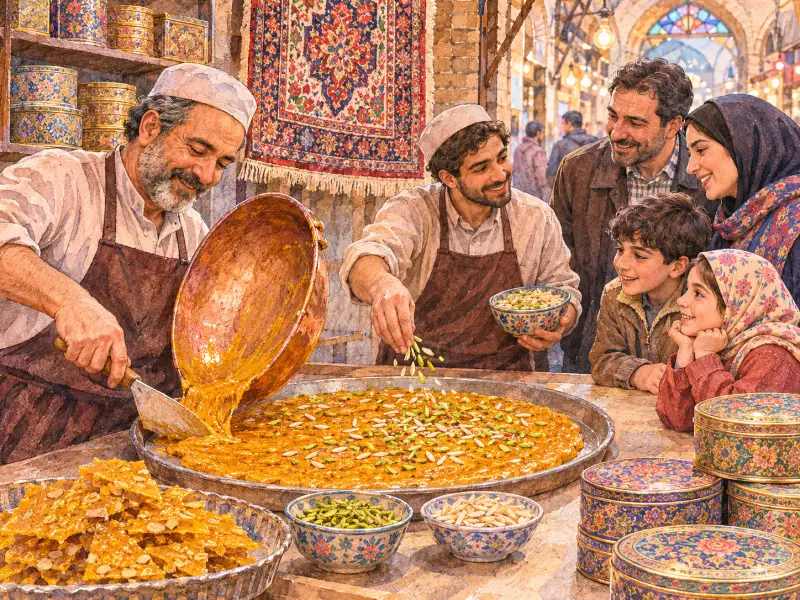
Iranians know Qom best for sohân (سوهان), a brittle sweet of wheat sprouts, sugar, butter and saffron topped with pistachios and almonds, sold in round tins along the streets near the shrine. Qom is also a centre for fine silk carpets, a craft that grew in the 20th century. The bazaar near the shrine sells prayer beads, religious books and pilgrims’ souvenirs.
Getting there and getting around
Qom is about 140 km from Tehran by motorway, roughly a 90-minute drive, and many visitors come for a day. Imam Khomeini International Airport lies between the two cities. Trains on the lines from Tehran to Isfahan, Kashan, Yazd and the south stop in Qom, and buses run frequently. The shrine and bazaar are in the centre; Jamkaran is a short taxi ride. Qom is a conservative city, so dress modestly. For current entry and safety information, check official sources and your own government’s travel advice. Many travellers continue south to Kashan and Isfahan.
Persian words from this page
| قم | Qom | Qom |
| معصومه | Ma’sume | “the sinless one”, title of Fatima |
| حوزه علمیه | howze-ye elmiye | seminary system |
| طلبه | talabe | seminary student (plural tollâb) |
| مرجع تقلید | marja’-e taqlid | source of emulation, a senior cleric |
| چادر | châdor | full-length cloak worn by women |
| سوهان | sohân | Qom’s brittle saffron sweet |
Sources and further reading
- Encyclopaedia of Islam, 2nd edition, “Ḳum”.
- Encyclopaedia Britannica, “Qom”.
- Hasan ibn Muhammad al-Qummi, Tarikh-e Qom (10th-century local history, surviving in a later Persian translation).
- Roy Mottahedeh, The Mantle of the Prophet: Religion and Politics in Iran (1985), on Qom’s seminaries.
- Ervand Abrahamian, A History of Modern Iran (Cambridge University Press, 2008).
- Statistical Centre of Iran, National Population and Housing Census 2016 (1395).
Want to learn Persian? Get the free Starter Pack
Get the 14-page printable Starter Pack (all 32 letters, a 7-day reading plan, 100 core words and 20 survival phrases) and a short 5-email course. Free.
More in Cities of Iran
- Tehran: Iran’s Capital
- Mashhad
- Isfahan
- Shiraz
- Tabriz
- Yazd
- Kashan
- Kerman
- Hamadan
- Qom
- Ahvaz
- Rasht
- Kermanshah
- Urmia
- Ardabil
- Zanjan
- Qazvin
- Sanandaj
- Khorramabad
- Bandar Abbas
- Bushehr
- Zahedan
- Birjand
- Gorgan
- Sari
- Semnan
- Arak
- Ilam
- Yasuj
- Shahr-e Kord
- Bojnurd
- Karaj
- Abadan and Khorramshahr
- Kish Island
- Qeshm Island
- Hormuz Island
- Masuleh
- Abyaneh
- Kandovan
- Bam
- Neyshabur (Nishapur)
- Shush (Susa) Today