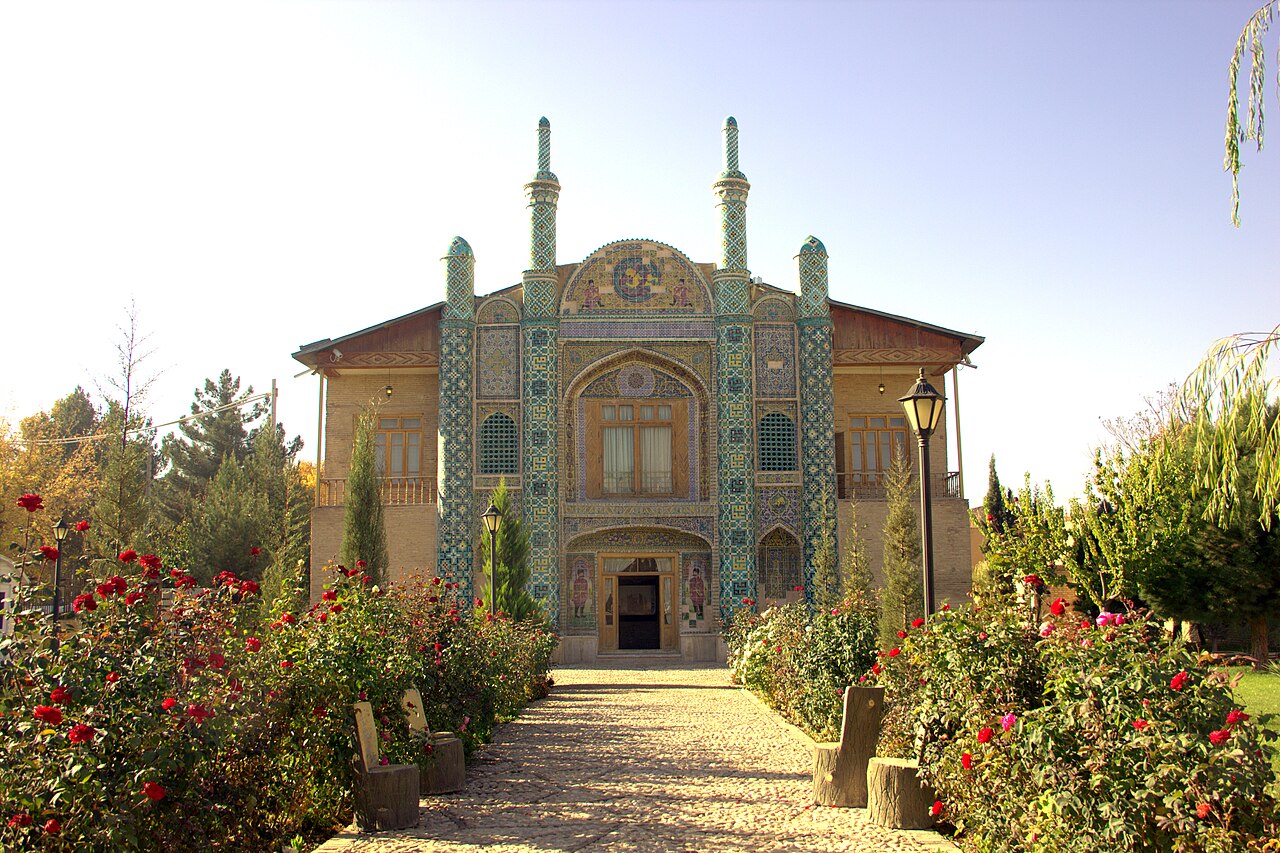
Bojnurd is the capital of North Khorasan province, in the mountains of north-eastern Iran not far from the border with Turkmenistan. Its character comes from the Kurmanji Kurds whom the Safavid shahs moved here in the seventeenth century to guard the frontier, and from the khans of the Shadlu tribe who ruled the town until the twentieth century. Their best-known building, the tiled Mofakham Mirror House, is the city’s emblem.
| Persian name | بجنورد (Bojnurd, also spelled Bojnord) |
|---|---|
| Province | North Khorasan (capital since the province was created in 2004) |
| Population | 228,931 (city, 2016 national census) |
| Elevation | about 1,050 m |
| Main languages | Kurmanji Kurdish, Khorasani Turkic, Persian, Turkmen |

Kurds on the Khorasan frontier
For centuries the valleys between the Alborz and the Kopet Dag were exposed to raids from Central Asia by Uzbeks and Turkmen. Shah Abbas I, around the start of the seventeenth century, answered by moving thousands of Kurdish families from western Iran to northern Khorasan and giving them land in return for defending it. Their descendants, the Kurmanji (کرمانج, Kormânj) of Khorasan, still live in a belt of towns and villages from Quchan to Bojnurd and Shirvan, and speak a form of Kurmanji Kurdish that has developed apart from the Kurdish of Turkey and Iraq for four centuries.
Bojnurd became the seat of the Shadlu, one of the leading Kurdish tribes. Its chiefs held the title ilkhani and governed the district with considerable independence under the Afsharids and Qajars, keeping the road between Mashhad and Astarabad (today’s Gorgan).
The Mofakham Mirror House
In the late nineteenth century the Shadlu khan Sardar Mofakham built a complex of residences and gardens in Bojnurd. The surviving pavilion, known as the Mofakham Mirror House (آینهخانه مفخم, Âyeneh-khâneh-ye Mofakham), is famous for its façade: panels of painted tiles showing Qajar soldiers, courtiers, hunting scenes and figures from Persian legend, a gallery of late Qajar taste. Inside, the reception room is lined with mirror mosaic, the decoration that gives the building its name. It now serves as a museum. For the art of this period more broadly, see Qajar art, photography and society.
Opening hours change, so check current local information before visiting.
A city of four languages
Bojnurd is a meeting point. Kurmanji Kurds, Khorasani Turks, Persian speakers and, to the north and west, Turkmen live in the same province, and in the bazaar you may hear all four. The mix shows in music and dress: Kurmanji women’s clothing is brightly coloured with layered skirts and headscarves, and Kurmanji circle dances are a regular part of weddings and festivals.
Northern Khorasan is also the home of the bakhshi (بخشی), singer-musicians who perform long narrative songs and epic tales on the two-stringed dotâr, in Kurmanji, Turkic and Persian. UNESCO added the music of the bakhshis of Khorasan to its list of intangible cultural heritage in 2010. For more on the region’s peoples, see the ethnic groups of Iran.
Mountains and the road east
The city lies in a valley between the Aladagh and Kopet Dag ranges, with orchards and wheat fields on the valley floor and summer pastures above. Winters are cold and summers mild. To the west the road to Gorgan crosses the forested hills of Golestan National Park, Iran’s oldest national park, which extends into North Khorasan. To the east, the road to Mashhad follows the old frontier towns of Shirvan and Quchan; Mashhad’s shrine city is covered in more depth on our blog post on Mashhad.
North Khorasan was separated from the old Khorasan province in 2004, along with South Khorasan, whose capital is Birjand. Bojnurd has an airport and road links to Tehran and Mashhad. Read your own government’s travel advice before any trip to Iran.
Persian words from this page
| بجنورد | Bojnurd | Bojnurd |
| خراسان شمالی | Khorâsân-e Shomâli | North Khorasan |
| آینه | âyene | mirror |
| کاشی | kâshi | tile |
| کرمانج | Kormânj | Kurmanji Kurd |
| بخشی | bakhshi | bakhshi, epic singer |
| دوتار | dotâr | two-stringed lute |
Sources and further reading
- Encyclopaedia Iranica, “Bojnurd”.
- Encyclopaedia Iranica, “Abbas I”, on the Safavid resettlement policies of his reign.
- UNESCO Intangible Cultural Heritage, “Music of the Bakhshis of Khorasan” (inscribed 2010).
- Statistical Centre of Iran, National Population and Housing Census 2016 (1395).
Want to learn Persian? Get the free Starter Pack
Get the 14-page printable Starter Pack (all 32 letters, a 7-day reading plan, 100 core words and 20 survival phrases) and a short 5-email course. Free.
More in Cities of Iran
- Tehran: Iran’s Capital
- Mashhad
- Isfahan
- Shiraz
- Tabriz
- Yazd
- Kashan
- Kerman
- Hamadan
- Qom
- Ahvaz
- Rasht
- Kermanshah
- Urmia
- Ardabil
- Zanjan
- Qazvin
- Sanandaj
- Khorramabad
- Bandar Abbas
- Bushehr
- Zahedan
- Birjand
- Gorgan
- Sari
- Semnan
- Arak
- Ilam
- Yasuj
- Shahr-e Kord
- Bojnurd
- Karaj
- Abadan and Khorramshahr
- Kish Island
- Qeshm Island
- Hormuz Island
- Masuleh
- Abyaneh
- Kandovan
- Bam
- Neyshabur (Nishapur)
- Shush (Susa) Today