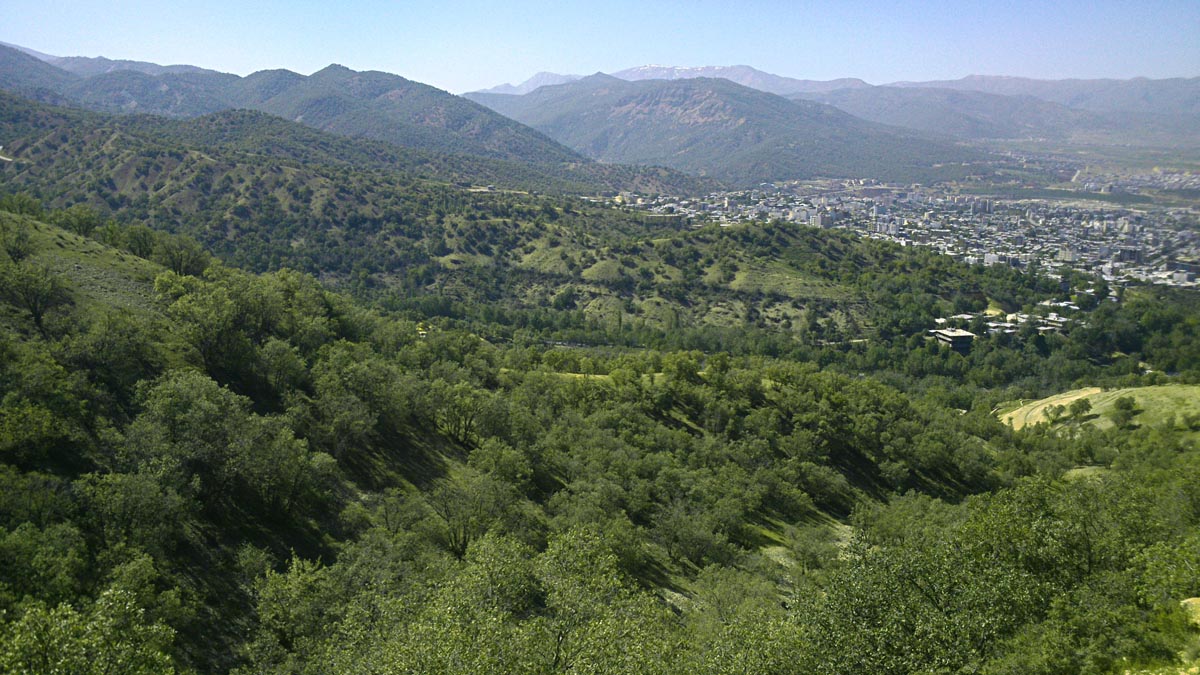
Yasuj is the capital of Kohgiluyeh and Boyer-Ahmad province, a mountain city of the central Zagros at about 1,800 m, below the long ridge of Mount Dena. It is one of Iran’s youngest provincial capitals: until the 1960s it was a seasonal gathering place of the Boyer-Ahmadi Lur tribes, and it grew into a town only after the state began settling and administering the region. The mountains around it are the likely setting of the Persian Gates, where a Persian force held up Alexander the Great in the winter of 331 to 330 BCE.
| Persian name | یاسوج (Yâsuj) |
|---|---|
| Province | Kohgiluyeh and Boyer-Ahmad (capital) |
| Population | 134,532 (city, 2016 national census) |
| Elevation | about 1,800 m |
| Nearby peak | Dena, about 4,400 m |
| Main languages | Luri, Persian |

From tribal pasture to provincial capital
The highlands of Kohgiluyeh (کهگیلویه) and Boyer-Ahmad (بویراحمد) were, until the mid-twentieth century, the country of Lur tribes who lived by herding and moved between warm winter pastures in the lowlands towards Khuzestan and cool summer grazing in the high valleys. The Boyer-Ahmadi confederation was among the most independent of them, and its chiefs resisted central government repeatedly under Reza Shah and into the reign of his son.
The valley of Yasuj, with water and level ground, was where the Boyer-Ahmadi gathered in summer. After the tribal risings of the early 1960s, the government pushed for settlement and built administrative offices here, and from about 1963 a town took shape. When Kohgiluyeh and Boyer-Ahmad became a full province in the 1970s, Yasuj was made its capital. As a result the city has few old buildings: its streets, offices and university date from the last sixty years.
The Persian Gates
In the winter of 331 to 330 BCE, after his victory at Gaugamela, Alexander marched from Susa towards Persepolis by the mountain road. In a narrow pass called by the Greek and Roman historians the Persian Gates, the satrap Ariobarzanes blocked the way with a smaller force and held it for some time, rolling rocks down on the Macedonians. Arrian and Curtius Rufus say Alexander finally took the position by sending troops around it on a mountain path, led by a local guide, and attacked from behind. Ariobarzanes was killed and Alexander went on to Persepolis.
The exact site of the pass is debated. Many scholars and local tradition place it at Tang-e Meyran, a gorge north-east of Yasuj on the old route to the Fars plain; others prefer different passes further south-east. The ancient accounts describe the terrain but not the place name, so certainty is not possible. The wider story is on our page on Alexander the Great in Iran.
Mount Dena and the waterfalls
Yasuj sits below Dena (دنا), a limestone ridge running for some 80 km, with a series of summits above 4,000 m and the highest at about 4,400 m. Its slopes are a protected area with oak woodland, wild almond and rare plants, and snow stays on the top until early summer. Climbers usually approach the high peaks from villages near Sisakht, north of the city.
Water is the other feature of the region. A waterfall (آبشار, âbshâr) runs through a park in Yasuj itself, and the rivers of the area feed into the Karun and Zohreh systems that reach Khuzestan. The rainfall and snow make this one of the wettest parts of the Zagros, and the springs and valleys draw visitors from the hot southern provinces in summer.
Lur life today
Most people in Yasuj speak Luri, an Iranian language close to Persian, and many families still identify by tribe. Fewer people migrate with their flocks than a generation ago, but seasonal movement continues, and in spring and autumn you may still see herds and black tents on the move. Weddings with the chupi line dance, music of the sorna (shawm) and drum, and woven goods such as gabbeh rugs and goat-hair tents are part of local culture. Our page on the ethnic groups of Iran explains where the Lurs fit, and the city pages for Khorramabad and Shahr-e Kord cover neighbouring parts of the Zagros.
Getting there
Yasuj lies on the road between Shiraz, about three hours to the south-east, and Isfahan and Ahvaz to the north and west. It has a small airport. Mountain roads can close in winter, so check conditions, and read your own government’s travel advice before any trip to Iran.
Persian words from this page
| یاسوج | Yâsuj | Yasuj |
| دنا | Denâ | Dena (mountain) |
| آبشار | âbshâr | waterfall |
| لر | Lor | Lur |
| ایل | il | tribe, tribal confederation |
| کوچ | kuch | seasonal migration |
| تنگ | tang | gorge, narrow pass |
Sources and further reading
- Arrian, Anabasis of Alexander, Book 3.18.
- Quintus Curtius Rufus, History of Alexander, Book 5.
- Encyclopaedia Iranica, “Boir-Ahmadi”.
- Encyclopaedia Iranica, “Kohgiluya”.
- Statistical Centre of Iran, National Population and Housing Census 2016 (1395).
Want to learn Persian? Get the free Starter Pack
Get the 14-page printable Starter Pack (all 32 letters, a 7-day reading plan, 100 core words and 20 survival phrases) and a short 5-email course. Free.
More in Cities of Iran
- Tehran: Iran’s Capital
- Mashhad
- Isfahan
- Shiraz
- Tabriz
- Yazd
- Kashan
- Kerman
- Hamadan
- Qom
- Ahvaz
- Rasht
- Kermanshah
- Urmia
- Ardabil
- Zanjan
- Qazvin
- Sanandaj
- Khorramabad
- Bandar Abbas
- Bushehr
- Zahedan
- Birjand
- Gorgan
- Sari
- Semnan
- Arak
- Ilam
- Yasuj
- Shahr-e Kord
- Bojnurd
- Karaj
- Abadan and Khorramshahr
- Kish Island
- Qeshm Island
- Hormuz Island
- Masuleh
- Abyaneh
- Kandovan
- Bam
- Neyshabur (Nishapur)
- Shush (Susa) Today