Ilam is the capital of Ilam province, on Iran’s western border with Iraq, in a valley of the Zagros mountains at about 1,400 m. Until the 1920s it was the seat of the valis of Posht-e Kuh, hereditary governors who ruled the region almost independently; their castle still stands above the city. Ilam is a mainly Kurdish city, and it was one of the places hit hardest by the Iran-Iraq War of 1980 to 1988.
| Persian name | ایلام (Ilâm) |
|---|---|
| Former name | Hosseinabad |
| Province | Ilam (capital) |
| Population | 194,030 (city, 2016 national census) |
| Elevation | about 1,320 to 1,430 m (sources differ) |
| Main languages | Kurdish (southern Kurdish dialects), Laki, Persian |

Posht-e Kuh: the land behind the mountain
The region was long known as Posht-e Kuh (پشتکوه), “behind the mountain”: seen from Lorestan and the plateau, it lay on the far side of the Kabir Kuh range, sloping down towards the plains of Mesopotamia. Its high pastures and oak woods were home to tribes who moved their flocks between summer and winter grazing.
The name of the province, Ilam, recalls ancient Elam, whose lands reached into these mountains, though the city itself is not an Elamite site. Our page on Elam, Iran’s first great kingdom covers that civilisation. Later, in the Sasanian period and the first Islamic centuries, the area had towns of its own; the ruins of Seymareh near Darreh Shahr, in the east of the province, were a regional capital until the tenth century.
The valis and Vali Castle
From the Safavid period onward the area was governed by the valis (والی), a family of hereditary rulers of Feyli Kurdish and Lur country. Under the Qajars, the valis of Posht-e Kuh were powerful local lords who paid only loose allegiance to the shah. The town that is now Ilam was then called Hosseinabad, and under Vali Hossein Qoli Khan, in the late nineteenth century, it became their main seat.
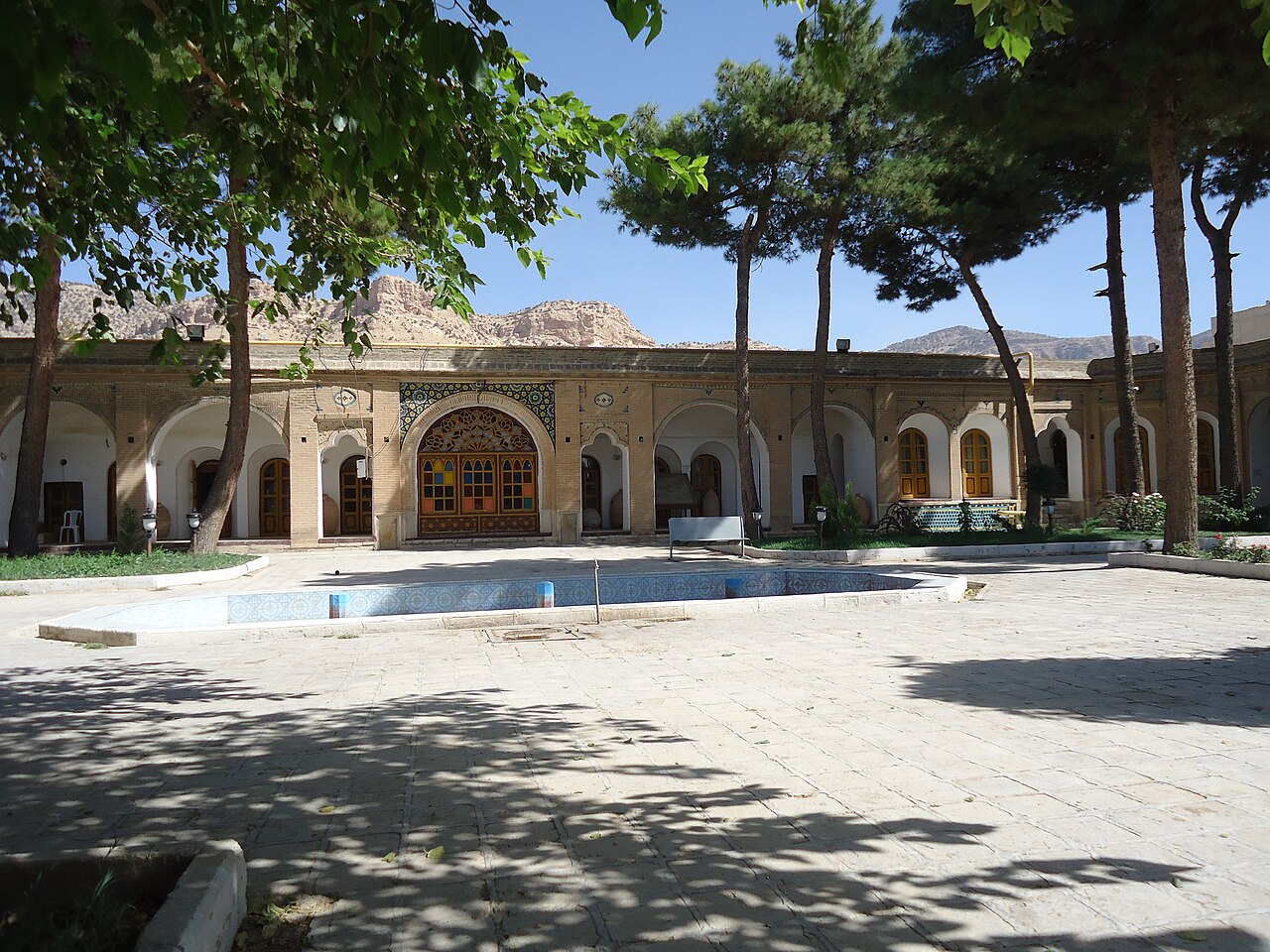
His successor Gholamreza Khan built the castle that now dominates the city, completed in 1908: a two-storey mansion of stone and brick with arcaded verandas, set in a garden with pools on a slope above town. In 1928, as Reza Shah’s army imposed central control across the tribal regions, the last vali left for Iraq without a fight, and the region was brought under direct rule. The town took the name Ilam soon after. Vali Castle (قلعه والی) is now a registered national monument and houses a museum of anthropology. Ilam also keeps a few other courtyard houses of the vali period, such as the Falahati mansion and the castle of Mir Gholam.
A frontier city in the Iran-Iraq War
When Iraq invaded Iran in September 1980, Ilam province was on the front line. Border towns such as Mehran and Dehloran changed hands, and Ilam city was bombed repeatedly by Iraqi aircraft and missiles throughout the war. Thousands of people left, and the damage set back the province’s development for years. The war is covered in our pages on the causes of the Iran-Iraq War and its end in 1988. Memorials and war cemeteries are part of the city today.
Kurds, Laks and Lurs
Most people in Ilam city speak southern Kurdish dialects, and many belong to Feyli Kurdish tribes such as the Kalhor and the Malekshahi. Laki, which some classify as Kurdish and some as close to Luri, is spoken in the east of the province, Luri in the south, and Arabic in a few villages near the Khuzestan border. Most Feyli Kurds are Shia Muslims, unlike the mostly Sunni Kurds of Kurdistan province to the north; for the wider picture see our page on the Kurds in Iranian history and the city page on Sanandaj.
Mountains, oak forest and the road to Karbala
Ilam lies among the oak forests of the central Zagros, and in spring the hills around the city turn green and are covered with wildflowers. The Kabir Kuh (کبیرکوه) range, one of the longest ridges of the Zagros, runs along the east of the province.
Since the fall of Saddam Hussein in 2003, the Mehran border crossing, about 100 km south-west of Ilam, has become one of the main routes for Iranian pilgrims travelling to the Shia shrine cities of Iraq. During Arbaeen, the fortieth day after Ashura, very large numbers of pilgrims pass through the province on their way to Karbala. Anyone thinking of travelling in the border region should read their own government’s current travel advice first.
Persian words from this page
| ایلام | Ilâm | Ilam |
| پشتکوه | Posht-e Kuh | “behind the mountain” |
| کوه | kuh | mountain |
| والی | vâli | governor |
| کرد | Kord | Kurd |
| مرز | marz | border |
| جنگ | jang | war |
Sources and further reading
- Encyclopaedia Iranica, “Ilam”.
- Ervand Abrahamian, A History of Modern Iran (Cambridge University Press, 2008), on Reza Shah and the tribes.
- Pierre Razoux, The Iran-Iraq War (Harvard University Press, 2015).
- Statistical Centre of Iran, National Population and Housing Census 2016 (1395).
Want to learn Persian? Get the free Starter Pack
Get the 14-page printable Starter Pack (all 32 letters, a 7-day reading plan, 100 core words and 20 survival phrases) and a short 5-email course. Free.
More in Cities of Iran
- Tehran: Iran’s Capital
- Mashhad
- Isfahan
- Shiraz
- Tabriz
- Yazd
- Kashan
- Kerman
- Hamadan
- Qom
- Ahvaz
- Rasht
- Kermanshah
- Urmia
- Ardabil
- Zanjan
- Qazvin
- Sanandaj
- Khorramabad
- Bandar Abbas
- Bushehr
- Zahedan
- Birjand
- Gorgan
- Sari
- Semnan
- Arak
- Ilam
- Yasuj
- Shahr-e Kord
- Bojnurd
- Karaj
- Abadan and Khorramshahr
- Kish Island
- Qeshm Island
- Hormuz Island
- Masuleh
- Abyaneh
- Kandovan
- Bam
- Neyshabur (Nishapur)
- Shush (Susa) Today