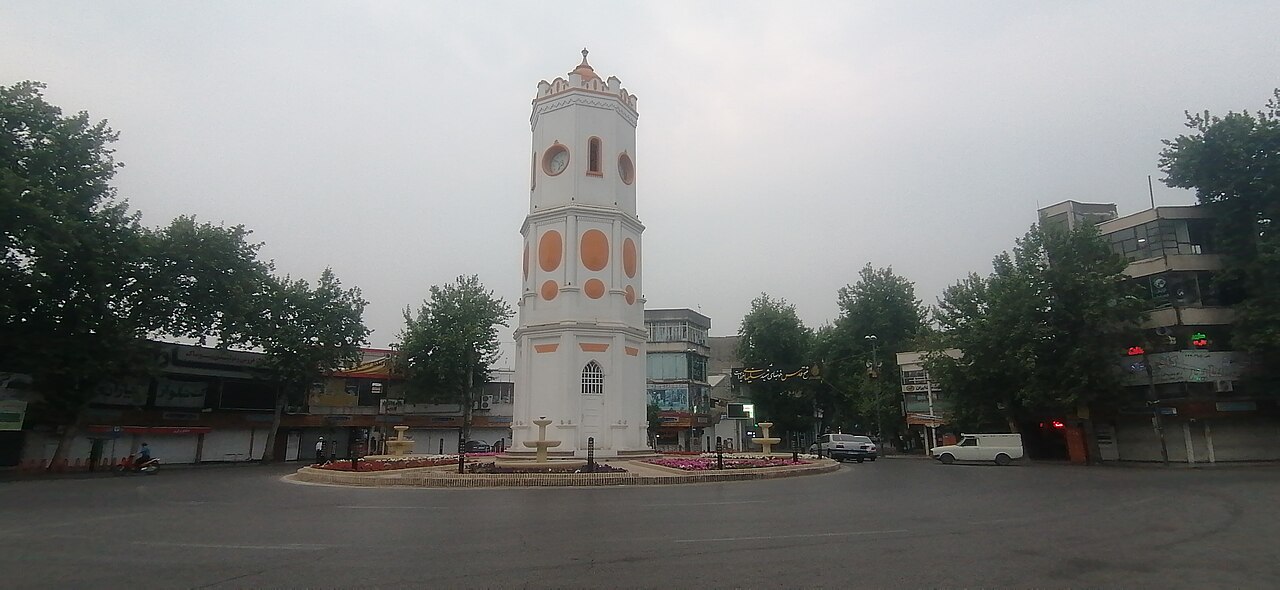
Sari is the capital of Mazandaran province, on the green plain between the Alborz mountains and the Caspian Sea, about 25 km inland. It was the capital of medieval Tabaristan, the mountain-and-forest country that held out longest against Arab rule, and today it is a busy provincial city of rice fields, citrus orchards and markets, with a 1930 clock tower at its centre.
| Persian name | ساری (Sâri) |
|---|---|
| Province | Mazandaran (capital) |
| Population | 347,402 (city, 2016 national census) |
| Elevation | roughly 25 to 200 m |
| River | Tajan (تجن) |
| Local language | Mazandarani (Tabari), alongside Persian |

Capital of Tabaristan
The Caspian lowland south of the sea was known in Islamic times as Tabaristan (طبرستان), after the Tapuri people. It was hard to reach: dense forest and the Alborz wall kept armies out. In the seventh century the local Dabuyid rulers, who claimed Sasanian descent, made Sari their capital; local tradition links the city’s name to Saruyeh, a son of the Dabuyid ruler Farrukhan. The Dabuyids and their successors kept Zoroastrian, Iranian rule here for more than a century after the fall of the Sasanian empire, and later dynasties such as the Bavandids and the Zaydi Alavids held Tabaristan as a world of its own. Our history pages on Tabaristan and the Dabuyids and on the Alavids of Tabaristan tell that story in detail.
Some writers identify Sari with Zadracarta, the Hyrcanian town Alexander’s army passed through, but other scholars place Zadracarta further east near Gorgan; the question is not settled.
Marashi tombs and Safavid palaces
In the fourteenth and fifteenth centuries Mazandaran was ruled by the Marashi sayyids, a local Shia dynasty. From this period come Sari’s two best-known older buildings: the tomb tower of Soltan Zeyn al-Abedin and the shrine of Imamzadeh Yahya. Both are brick tower tombs with pointed, tent-like roofs, a shape typical of the Caspian region, where heavy rain rules out the domes of the dry plateau.
The Safavid shah Abbas I, whose mother came from Mazandaran, loved this coast. In the early seventeenth century he built a palace town at Farahabad, on the shore north of Sari, and gardens at Ashraf (now Behshahr) to the east. Farahabad was abandoned after the Safavid period and only fragments survive.
Qajar and Pahlavi Sari
In the 1780s Agha Mohammad Khan, founder of the Qajar dynasty, fought for control of Mazandaran and used it as a base before he made Tehran his capital in 1786. In the twentieth century Reza Shah, who was born in the Mazandarani district of Savadkuh, paid close attention to the province. The Trans-Iranian Railway, built in the 1930s, comes down from the mountains through Savadkuh and passes Sari on its way east.
The clock tower in the main square dates from this period: it was built in 1930 and the square around it, Meydan-e Sa’at, is still the place everyone uses to give directions. Around it run the streets of the old bazaar, where traders sell rice, smoked fish, local sweets and citrus.
Rice, citrus and the Caspian table
Mazandaran is one of Iran’s main rice regions, and the paddies start at the edge of Sari. Fragrant northern varieties are considered the best rice in the country. Oranges, tangerines and bitter oranges (نارنج, nârenj) are the other great crop; in spring the smell of orange blossom fills the city. Local cooking uses more herbs, garlic, sour pomegranate and fish than the food of central Iran. Our overview of Persian food covers the wider tradition.
Many people in and around Sari speak Mazandarani, an Iranian language related to Persian but distinct from it, with its own songs and poetry. Persian is used in schools and offices. Learners will hear the difference quickly in the countryside.
Trips from Sari
Sari is a practical base for the eastern Caspian. About 95 km south-east, in the mountains, are the terraced orange and red travertine springs of Badab-e Surt. The forests of the Alborz slopes begin just south of the city, described on our page on the Alborz and Caspian forests. For the beaches, rice country and summer crowds of the coast as a whole, read our blog post on Shomal, the north of Iran. Sari has an airport and railway station; check current timetables before travelling.
Persian words from this page
| ساری | Sâri | Sari |
| مازندران | Mâzandarân | Mazandaran |
| طبرستان | Tabarestân | Tabaristan |
| برنج | berenj | rice |
| نارنج | nârenj | bitter orange |
| ساعت | sâ’at | clock, hour |
| میدان | meydân | square |
Sources and further reading
- Encyclopaedia Iranica, “Sari”.
- Encyclopaedia Iranica, “Tabarestan”.
- Encyclopaedia Iranica, “Dabuyids”.
- Ebn Esfandiyar, Tarikh-e Tabarestan (13th century), translated in abridged form by E. G. Browne, An Abridged Translation of the History of Tabaristan (1905).
- Statistical Centre of Iran, National Population and Housing Census 2016 (1395).
Want to learn Persian? Get the free Starter Pack
Get the 14-page printable Starter Pack (all 32 letters, a 7-day reading plan, 100 core words and 20 survival phrases) and a short 5-email course. Free.
More in Cities of Iran
- Tehran: Iran’s Capital
- Mashhad
- Isfahan
- Shiraz
- Tabriz
- Yazd
- Kashan
- Kerman
- Hamadan
- Qom
- Ahvaz
- Rasht
- Kermanshah
- Urmia
- Ardabil
- Zanjan
- Qazvin
- Sanandaj
- Khorramabad
- Bandar Abbas
- Bushehr
- Zahedan
- Birjand
- Gorgan
- Sari
- Semnan
- Arak
- Ilam
- Yasuj
- Shahr-e Kord
- Bojnurd
- Karaj
- Abadan and Khorramshahr
- Kish Island
- Qeshm Island
- Hormuz Island
- Masuleh
- Abyaneh
- Kandovan
- Bam
- Neyshabur (Nishapur)
- Shush (Susa) Today