Semnan is the capital of Semnan province, about 220 km east of Tehran, on the narrow strip of farmland between the southern slopes of the Alborz and the salt desert of the Dasht-e Kavir. For centuries it was a stage on the great road from Rey to Khorasan, and it keeps an 11th-century minaret, a Qajar royal mosque and gate, and a language of its own, Semnani.
| Persian name | سمنان (Semnân) |
|---|---|
| Province | Semnan (capital) |
| Population | 185,129 (city, 2016 national census) |
| Elevation | about 1,130 m |
| Setting | Between the Alborz mountains (north) and the Dasht-e Kavir (south) |

A stage on the Khorasan Road
The main route from western Iran to Khorasan and Central Asia has always had to squeeze between the mountains and the desert. Semnan, Damghan and Shahrud grew up at the points where streams from the Alborz made farming possible. Caravans, armies and pilgrims bound for Mashhad all passed through, and the province is still lined with caravanserais from the Safavid and Qajar centuries; see our page on Iran’s caravanserais. Today the Tehran to Mashhad railway and motorway follow the same corridor.
The Jameh Mosque and its minaret
The oldest standing structure in Semnan is the brick minaret of the Jameh Mosque (مسجد جامع), in the old bazaar. An inscription names the local governor who built it and dates it to the 1020s or early 1030s CE. The mosque around it was rebuilt many times: there is work from the Ilkhanid period, a large iwan facing Mecca dated 1424 to 1425 under the Timurids, and later Safavid repairs. Walking from the bazaar into the courtyard, you pass through roughly a thousand years of building in a few steps.
Qajar Semnan: the Soltani Mosque and the Arg gate
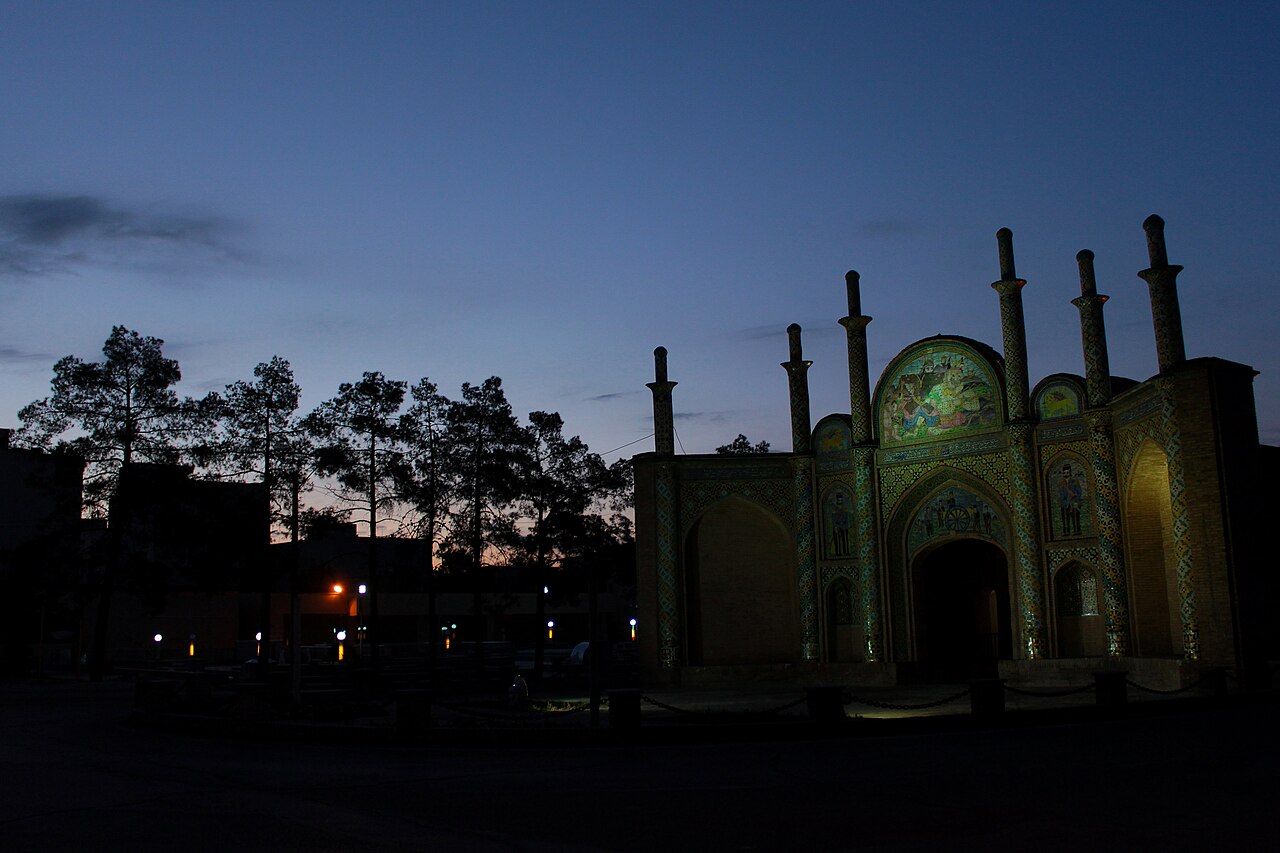
Fath-Ali Shah Qajar, in the early nineteenth century, gave Semnan a royal mosque, the Soltani or Imam Mosque, with a broad courtyard, a tiled iwan and an attached school. Later in the Qajar period the town’s government quarter, the Arg, was given a new gateway. The Arg gate (دروازه ارگ) is the image most people associate with Semnan: a tall brick façade faced with glazed tile panels, standing at the head of a modern street. The rest of the Arg has largely disappeared.
Other old buildings are scattered through the historic centre, including the Pahneh takyeh, where Muharram mourning ceremonies are held, and the Pahneh bathhouse nearby, which has been restored and opened to visitors. Check current local information for hours.
Semnani: a language, not a dialect
Older residents of Semnan speak Semnani (سمنانی), an Iranian language of its own. Linguists group it with the Caspian and central Iranian languages rather than with Persian, and a Persian speaker from Tehran cannot follow a conversation in it. Neighbouring towns such as Sangsar and Sorkheh have related but different speech. Like many small languages in Iran, Semnani is being replaced by Persian among younger people. Our page on languages spoken in Iran puts it in context.
The medieval Sufi master Ala al-Dawla Semnani (1261 to 1336), an influential writer on mysticism, came from the city, and his family’s estates lay nearby.
Desert, mountains and wildlife
South of the city the land drops to the Dasht-e Kavir, a vast salt desert of crusted flats and marshes; the parts most visited by travellers lie to the west, around Maranjab. North of Semnan, a short drive up the valleys, are mountain villages such as Shahmirzad, with walnut orchards and cooler summers, a favourite escape from the desert heat.
Semnan province also contains Touran, a large protected area of desert and steppe further east, which is one of the last refuges of the Asiatic cheetah and of the Persian onager, a wild ass. Elsewhere in the province, Damghan has the Tarikhaneh, one of the oldest surviving mosques in Iran, and Bastam near Shahrud holds the shrine of the Sufi Bayazid Bastami.
Getting there
Semnan is on the main railway and motorway between Tehran and Mashhad, so it is easy to stop on the way. Read your own government’s travel advice before any trip to Iran, and check entry rules with official sources.
Persian words from this page
| سمنان | Semnân | Semnan |
| کویر | kavir | salt desert |
| دروازه | darvâze | gate |
| ارگ | arg | citadel, government quarter |
| مناره | manâre | minaret |
| حمام | hammâm | bathhouse |
| کاروانسرا | kârvânsarâ | caravanserai |
Sources and further reading
- Encyclopaedia Iranica, “Alā al-Dawla Semnānī”.
- Gernot Windfuhr (ed.), The Iranian Languages (Routledge, 2009), on Semnani and the other Caspian and central languages.
- Sheila S. Blair, The Monumental Inscriptions from Early Islamic Iran and Transoxiana (Brill, 1992).
- Statistical Centre of Iran, National Population and Housing Census 2016 (1395).
Want to learn Persian? Get the free Starter Pack
Get the 14-page printable Starter Pack (all 32 letters, a 7-day reading plan, 100 core words and 20 survival phrases) and a short 5-email course. Free.
More in Cities of Iran
- Tehran: Iran’s Capital
- Mashhad
- Isfahan
- Shiraz
- Tabriz
- Yazd
- Kashan
- Kerman
- Hamadan
- Qom
- Ahvaz
- Rasht
- Kermanshah
- Urmia
- Ardabil
- Zanjan
- Qazvin
- Sanandaj
- Khorramabad
- Bandar Abbas
- Bushehr
- Zahedan
- Birjand
- Gorgan
- Sari
- Semnan
- Arak
- Ilam
- Yasuj
- Shahr-e Kord
- Bojnurd
- Karaj
- Abadan and Khorramshahr
- Kish Island
- Qeshm Island
- Hormuz Island
- Masuleh
- Abyaneh
- Kandovan
- Bam
- Neyshabur (Nishapur)
- Shush (Susa) Today